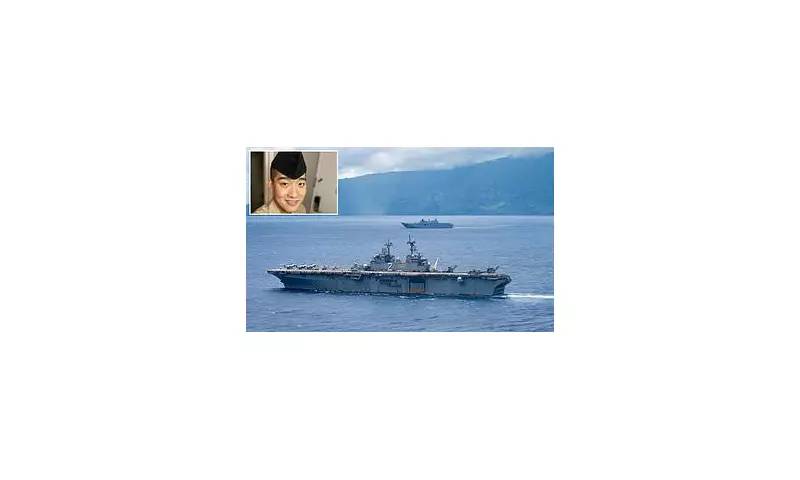
A former United States Navy sailor has been handed a prison sentence of more than 16 years for committing espionage on behalf of the Chinese Communist Party.
The Betrayal and the Deal
Jinchao Wei, a 25-year-old former machinist's mate, was convicted of trading highly sensitive technical secrets concerning the amphibious assault ship USS Essex, alongside information detailing the locations of other US Navy vessels. In exchange for this classified material, he received a payment of $12,000 from a Chinese intelligence officer.
According to the US Department of Justice (DOJ), the illicit relationship began in early 2022 when Wei was contacted on social media by a Chinese operative posing as a naval enthusiast. Even after Wei grew suspicious that the individual was a spy, he continued the communications, eventually moving to a more secure, encrypted messaging application to conceal their conversations.

A Sustained Campaign of Espionage
Over a period of 18 months, Wei engaged in a systematic betrayal. He transmitted thousands of pages of Navy technical manuals directly from his work computers. This trove of stolen information included photographs, videos of the USS Essex, sensitive fleet locations, and intricate details about the ship's weapons systems.
The compromised data contained restricted technical specifics on critical ship operations, including steering and weapons controls, aircraft elevators, and protocols for US sailors to manage damage or emergencies at sea.
During sentencing on Monday, US Attorney Adam Gordon stated: 'He betrayed his oath, his shipmates, the United States Navy, and the American people, a level of disloyalty that strikes at the heart of our national security and demanded this powerful sentence.' Wei received a sentence of 200 months in federal prison.
Investigation and Broader Security Concerns
The spy ring was uncovered through a joint investigation by the FBI and the Naval Criminal Investigative Service (NCIS). Agents examined Wei's phone messages, audio recordings, handwritten payment receipts, and other digital records which proved his contact with a genuine Chinese spy. He was arrested in August 2023 as he reported for duty on the Essex and later admitted to the FBI that he had shared 'thousands of pages' and described his own actions as 'espionage.'
Cyberwarfare expert James Knight of DigitalWarfare.com highlighted the scale of the threat, noting that the FBI considers China the top counterintelligence danger to the US. 'The number one thing China is seeking from US spies, and broader espionage, is advanced technology and intellectual property to accelerate its own development and reduce reliance on foreign innovation,' Knight told the Daily Mail.
He added that this case exemplifies a common and growing concern, with China actively targeting military technology such as naval systems, aircraft designs, and breakthroughs in semiconductors, AI, and quantum computing.
Wei employed classic spycraft techniques to avoid detection, including deleting messages immediately, using self-erasing digital drop boxes, and even receiving a new phone and computer from his handler. Knight pointed out that while agencies like the FBI and NCIS are well-equipped with modern forensic tools, 'human factors often remain the weakest link' in national security, as evidenced by Wei confiding in another sailor about the offer of money for information.
Assistant Attorney General for National Security John Eisenberg condemned Wei's actions, saying: 'He made a mockery of these commitments when he chose to endanger our Nation and our servicemembers by selling US military secrets to a Chinese intelligence officer for personal profit.'