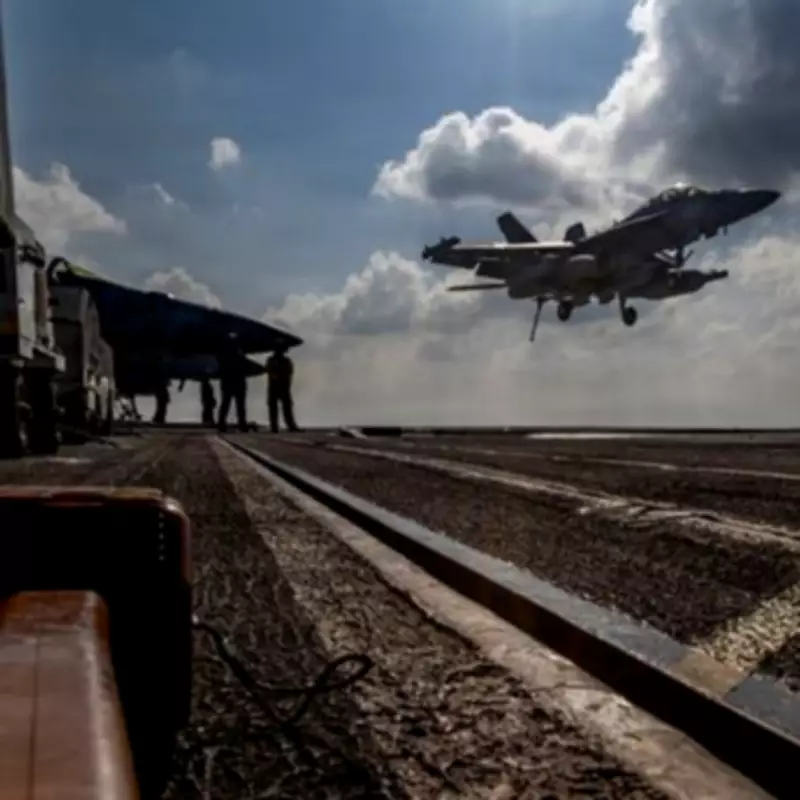
As America's formidable carrier strike force maintains a watchful presence off the coast of Iran, geopolitical tensions continue to mount dangerously. Iran has issued stark warnings of a bloody response to any aggression, setting the stage for a potential conflict with far-reaching consequences. Military analysts now caution that US strikes could ignite waves of terror across Western nations, with the United Kingdom positioned as a vulnerable target due to its alliance with Washington.
Diplomatic Chaos and Military Posturing
The entire Middle East and international community watches anxiously, wondering whether US President Donald Trump will authorise military strikes and what specific targets might be selected. Any substantial military operation requires precise strategic objectives and meticulously detailed plans for post-conflict scenarios, yet these crucial elements appear conspicuously absent from current preparations.
The chaos and violence that could erupt within Iran following an attack might, over subsequent years, manifest as terrorism reaching all the way to British streets. As America's junior partner in global affairs, the UK represents a softer target for retaliatory actions by Iranian proxies and affiliated networks.

UN Emergency Meeting and Shifting Justifications
Iran has formally demanded that the United Nations Security Council intervene to prevent US military action, prompting the organisation to convene an emergency meeting in New York. This diplomatic manoeuvring occurs even as Washington continues to issue threats through various channels.
President Trump's position has undergone significant fluctuations, initially threatening military action if Tehran executed hundreds of protesters, then shifting focus to the complete elimination of Iran's nuclear ambitions. His recent bellicose rhetoric aimed to reassure Iranian protesters that "help is on its way," before pivoting back to threats concerning Iran's nuclear programme.
Intelligence Assessments and Military Readiness
American intelligence evaluations have revealed that previous attacks merely delayed Iran's nuclear ambitions by several months, with enriched uranium stocks surviving the assault. Meanwhile, reports suggest the killing of protesters continues within Iran, even as US military support arrives in the form of the USS Abraham Lincoln carrier strike group.
Earlier this month, as protests swept Iranian streets, Trump warned Tehran that American forces were "locked and loaded and ready to go," promising rescue operations. However, this justification apparently proved insufficient for intervention, prompting yesterday's return to nuclear-focused threats.
The Dangers of Social Media Diplomacy
Trump's social media threats, including warnings that "time is running out," create confusion through their failure to establish clear deadlines or coherent negotiation frameworks. Back-channel communications appear ineffective, increasing the risk of dangerous miscalculations.
The combination of unsophisticated White House communications, Iran's bellicose rhetoric, and the inherent limitations of Twitter diplomacy places the Middle East on a hair-trigger alert. The Islamic Revolutionary Guard Corps has declared readiness for attack and promised violent retaliation, deploying drone ships near Bandar-Abbas port as US and Iranian surveillance aircraft monitor each other's movements in the region.
Regime Change Complications
Israeli sources suggest the Trump administration now desires regime change in Tehran, though achieving this objective presents enormous challenges. Persuading approximately 250,000 heavily-armed IRGC zealots to defect to a largely unarmed opposition without triggering widespread insurgency represents a near-impossible task.
This scenario mirrors what occurred in Iraq following US intervention, where dismantled security networks and disenfranchised security personnel eventually bolstered terrorist organisations. The resulting momentum ultimately created what experts describe as "al-Qaeda on steroids" in the form of the Islamic State, whose destructive legacy continues more than two decades after the Iraq war began.

Global Terror Networks and UK Vulnerability
The IRGC and its proxy Hezbollah maintain extensive global networks that continue threatening Western interests, possessing the contacts and capability to deploy terrorism across Europe including British territory. Intelligence briefings presumably inform Trump that smooth power transition in Iran remains virtually impossible, though some advisers may argue that if regime change is achievable, the current moment presents the optimal opportunity.
The repercussions of war with Iran would likely prove more severe than the Iraq conflict, given Iran's greater military capabilities, pre-existing terror networks, and superior organisational capacity. While some regional actors might welcome regime change in Tehran, the implications for long-term global instability and terrorism represent grave concerns for international security planners.