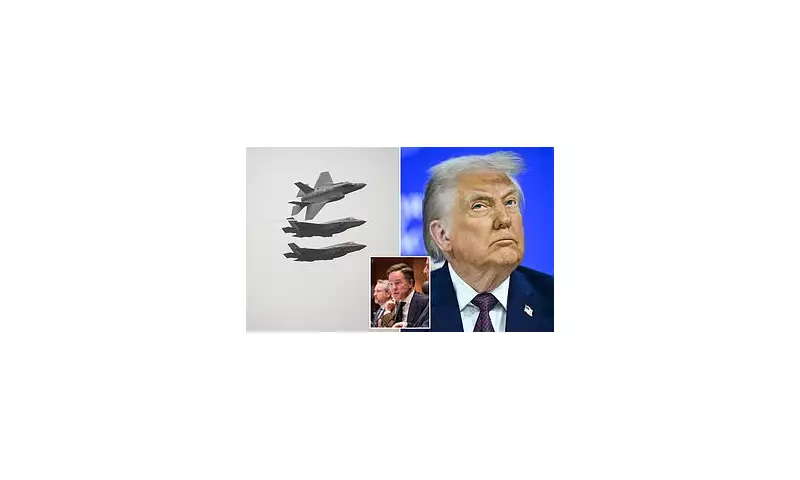
NATO Secretary General Mark Rutte has issued a blunt and unequivocal warning to European politicians, declaring that the continent remains utterly incapable of defending itself without the military might of the United States. The stark assessment was delivered during a high-stakes address to lawmakers at the European Parliament in Strasbourg.
A Stark Reality Check for European Defence Ambitions
'If anyone thinks here again, that the European Union, or Europe as a whole, can defend itself without the US - keep on dreaming. You can't,' Rutte stated emphatically. His comments serve as a sobering reality check amid growing political discourse about European strategic autonomy and calls for the continent to stand on its own feet militarily.
Geopolitical Tensions Over Greenland Fuel the Debate
Rutte's intervention comes against a backdrop of significant diplomatic strain following aggressive moves by former US President Donald Trump regarding Greenland. The vast, self-ruling Arctic territory is part of EU-member Denmark, which is also a founding member of the NATO alliance.

President Trump had previously threatened to impose massive 25% tariffs on EU goods unless Denmark agreed to cede control of Greenland to the United States. In remarks to the New York Times, he framed the issue as a potential choice for America between annexing the territory and maintaining the integrity of the NATO alliance.
'Because that's what I feel is psychologically needed for success,' Trump explained regarding his desire for the territory. 'I think that ownership gives you a thing that you can't do with, you're talking about a lease or a treaty. Ownership gives you elements that you can't get from just signing a document.'
A Shift in Stance and Ongoing Uncertainty
While Trump later withdrew his explicit tariff threats, he claimed a new deal was being negotiated with NATO that would grant America total and permanent access to Greenland, asserting the US could do 'exactly what we want to do' there. Details of any such agreement remain shrouded in uncertainty, with Denmark maintaining that its sovereignty over the island is non-negotiable.
Greenland's Prime Minister, Jens-Frederik Nielsen, expressed cautious relief at the reversal but highlighted a lack of clarity. 'I don't know what there is in the agreement, or the deal, about my country,' he told reporters in the capital, Nuuk. He firmly stated that sovereignty represents an absolute red line, adding, 'We have to respect our territorial integrity. We have to respect international law.'
Broader Implications for Transatlantic Relations
The episode has sent shockwaves through the transatlantic partnership. EU foreign policy chief Kaja Kallas acknowledged that relations with the US had taken a big blow in recent weeks. Remarkably, in a historic move reflecting the heightened tensions, Denmark's intelligence services classified the United States as a security threat for the first time in December.
A report from the Danish Defence Intelligence Service warned that the US is increasingly using its economic and technological dominance as a tool of power against both adversaries and allies. In a clear reference to the Greenland crisis, it noted the US 'no longer excludes the use of military force, even against allies.'
Against this fraught geopolitical backdrop, Rutte's warning underscores a fundamental and uncomfortable truth for European capitals. Despite aspirations for greater defence cooperation and autonomy, the continent's security architecture remains inextricably linked to, and dependent upon, the United States through the NATO framework. The Greenland affair has merely exposed the fragility and underlying tensions within that vital alliance.