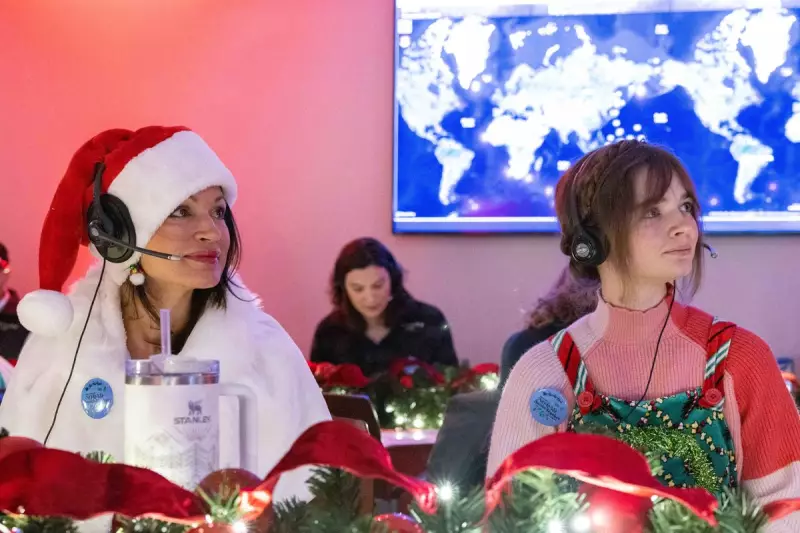
For the 70th consecutive Christmas, the North American Aerospace Defense Command (NORAD) is deploying its formidable military technology for a uniquely festive mission: tracking the global journey of Santa Claus. This heart-warming tradition, born from a Cold War-era mistake, continues to captivate children and adults alike, blending high-tech defence capabilities with seasonal magic.
A High-Tech Operation with a Festive Heart
Starting at 4 a.m. Mountain Standard Time on Christmas Eve, more than 1,000 volunteers will gather to answer calls on the dedicated hotline, 1-877-HI-NORAD. The operation runs until midnight from a festively decorated hangar at Peterson Space Force Base in Colorado Springs, NORAD's headquarters. Last year, the team fielded a staggering 380,000 calls from eager Santa seekers worldwide.
This year introduces a significant update for international followers. For the first time, people outside North America can place a call directly through the programme's website, making it easier to connect. The site itself allows users to monitor Santa's progress in nine languages, including English and Japanese.

Colonel Kelly Frushour, a NORAD spokesperson, explains that while Santa poses no threat, the same combination of radar, satellites, and fighter jets used for year-round aerospace defence is perfectly suited to this merry task. Tracking begins as Santa crosses the international date line over the Pacific Ocean. "Rudolph's nose gives off a heat signature similar to a missile that is picked up by NORAD's satellites," Frushour revealed.
Heartwarming Calls and a Legacy of Kindness
The calls received often create memorable moments. Volunteers recall children worried Santa won't find them, or those who hastily drop the phone upon hearing he won't arrive if they're awake. Frushour shared one story from last year where a girl became distressed learning Santa was headed toward the International Space Station, where astronauts were stranded. "Thankfully, by the time the call was over, Santa Claus had moved on... and the child was reassured," she said.
Michelle Martin, a NORAD staffer and Marine veteran, remembers a regular caller named Henry, a man with special needs, who once asked if the jet pilot escorting Santa could slip him a note confirming he was in bed. "I explained that Santa travels 'faster than starlight'," Martin recalled. "I don’t know that our pilot can catch up with him fast enough. He just waves and he goes."
A Tradition Born from a Misprinted Phone Number
This decades-long custom has an origin story as charming as the event itself. It began in 1955 when NORAD's predecessor, the Continental Air Defense Command (CONAD), was on high alert for potential Soviet nuclear attacks. According to NORAD, a child mistakenly dialled the unlisted phone number for the combat operations centre, asking to speak to Santa Claus.
The commander on duty, Air Force Colonel Harry Shoup, chose not to disappoint the caller. In a 1999 interview with The Associated Press, Shoup recalled playing along once he understood, telling the child, "Ho, ho, ho, I am Santa." He then instructed his bewildered staff to begin tracking Saint Nick's imagined journey and to handle subsequent calls. The errant call is believed to have stemmed from a misprinted telephone number in a Sears newspaper advertisement in Colorado Springs.
By 23 December 1955, the AP was reporting that CONAD was tracking Santa. The tradition solidified as CONAD evolved into NORAD. While some details, like the call coming into a top-secret attack line, have been questioned over the years, the core story of a colonel's spontaneous kindness endures. It has grown into a beloved global phenomenon that showcases the human side of a formidable military alliance between the United States and Canada.