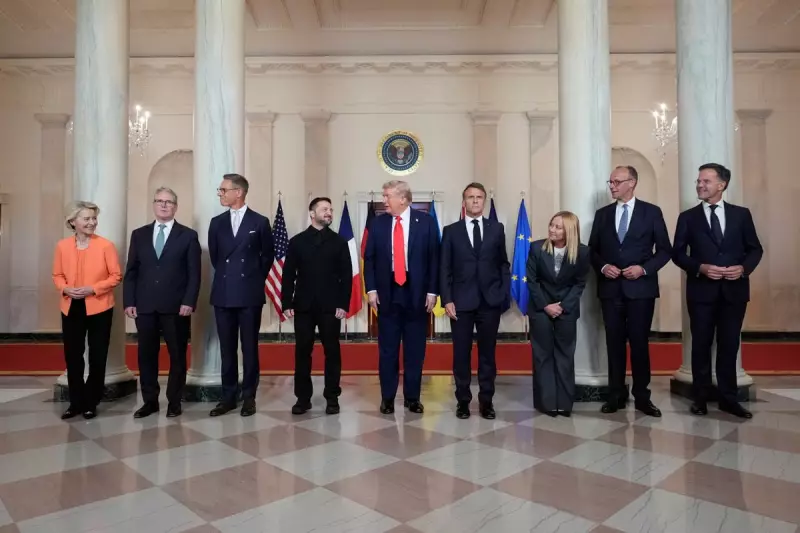
British voters have delivered a stark verdict on the nation's future security, with a clear majority now calling for a new defence pact with European allies, driven by fears that a Trump-led United States cannot be relied upon to come to Britain's aid in a conflict.
Poll Reveals Deepening Distrust in US Security Guarantee
According to an exclusive survey conducted for The Independent, 55 per cent of British voters support the creation of a new UK and Europe defence alliance that would operate independently of America. The poll, carried out by JL Partners on the 13th and 14th of December, found that only 11 per cent of respondents opposed such a historic move.
The findings highlight a profound shift in public sentiment, directly linked to the dramatic changes in US foreign policy following the re-election of President Donald Trump last year and the escalating hostility from Russia's Vladimir Putin towards Europe. James Johnson of JL Partners stated, "The radical change in views on foreign policy from Donald Trump’s White House appears to have taken its toll on British voters."

The NATO Question and a Resurgent Russian Threat
For decades, the defence of Britain and Europe has rested on the NATO alliance, founded in 1949. Its core principle, Article 5, states that an attack on one member is an attack on all, a pledge historically underwritten by the immense military power of the United States.
However, President Trump's stance has thrown that certainty into doubt. He has repeatedly labelled European nations as "weak" and criticised their defence spending, even threatening to ignore NATO's collective defence pledge for countries that do not meet spending targets. His approach to the Russia-Ukraine war, including promises of limited protection and accusations of siding with Moscow, has further eroded confidence.
This comes amid grave warnings from senior security figures. NATO Secretary General Mark Rutte has urged allies to prepare for a potential conflict on the scale seen by past generations. The new head of MI6, Blaise Metreweli, warned that Russia is "testing us in the grey zone," while Defence Minister Al Carns said the "shadow of war is knocking on Europe's door." Concerns are mounting that Putin could follow his invasion of Ukraine with aggression against Baltic states, following repeated violations of European airspace and cyber-attacks.
A Historic Shift Towards European Strategic Autonomy
The poll suggests the British public is now looking squarely towards Europe to fill the potential security vacuum. "Judging from our survey, voters have lost faith in the belief that if Britain or any of its European neighbours faces a real military threat, America will automatically come to its rescue," Johnson added. "They think Europe should take control of its own military protection to guarantee its safety."
While European collaboration already exists through mechanisms like the UK-led Joint Expeditionary Force, and nations are increasing defence budgets, the capability to defend the continent without US support remains years away. A new, formalised pact would therefore represent a fundamental realignment of post-war defence policy, with significant diplomatic ramifications.
The move would also align with Prime Minister Sir Keir Starmer's efforts to strengthen ties with Europe, even as he maintains a reportedly good working relationship with President Trump. The data indicates that, regardless of diplomatic rapport at the top, the foundational trust in the transatlantic security guarantee has been critically damaged in the eyes of the British electorate.