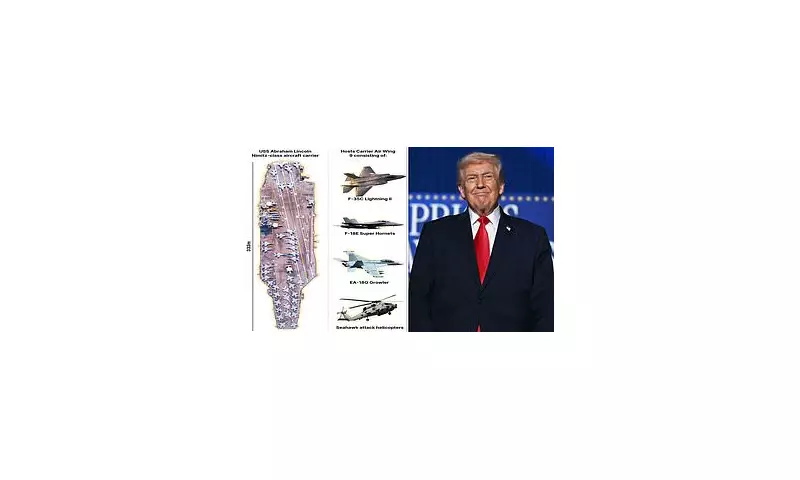
In a significant escalation of geopolitical tensions, former US President Donald Trump has issued stark warnings to Iran in recent weeks, threatening potential military intervention following deadly nationwide protests that have reportedly claimed thousands of lives. The situation intensified dramatically on Wednesday when Trump declared that a 'massive armada' stands ready to strike should the Islamic Republic refuse to negotiate a deal on nuclear weapons.
Naval Deployment Raises Alarm
The United States Navy has redirected the USS Abraham Lincoln Carrier Strike Group from operations in the Indo-Pacific to the Central Command's zone of responsibility, positioning significant military assets in the Persian Gulf region. This strategic movement, involving the nuclear-powered aircraft carrier accompanied by Arleigh Burke-class destroyers including USS Frank E Petersen, Jr, USS Spruance, and USS Michael Murphy, has heightened concerns about imminent military action against Iran.
Analysing Trump's Potential Strategies
Defence experts have been carefully examining the possible courses of action available to the Trump administration. According to Nate Swanson, director of the Iran Strategy Project, several distinct approaches could be under consideration, each with different implications for regional stability and the Iranian regime.

Conventional Target Strikes
One option involves targeting Iran's nuclear or missile programmes through conventional military strikes. While such actions might demonstrate resolve and prevent accusations of ignoring previously established 'red lines,' Swanson notes they would likely provide minimal assistance to activists protesting against the Iranian government.
Security Force Engagement
A broader strategic attack could focus on Iran's security apparatus, including the Islamic Revolutionary Guard Corps responsible for suppressing protests. Shashank Joshi, defence editor at The Economist, suggests that limited attacks might reduce the risk of wider conflict but would probably do little to weaken the regime's overall position. Swanson cautions that with over a million individuals in Iran's security forces, isolated strikes are unlikely to alter the regime's calculus regarding protest suppression.
Economic Infrastructure Targeting
Another possibility involves striking economic targets such as oil export terminals and critical natural gas infrastructure. Such operations would carry significant risks, potentially impacting global energy markets, but could effectively pressure a government already teetering on economic collapse.
Regime Leadership Strikes
The most extreme option would involve targeting the regime's leadership, including Supreme Leader Ayatollah Ali Khamenei. This approach would create an unprecedented power vacuum with unpredictable consequences for Iran's population, despite some officials suggesting that improved succession protocols might enable a smooth transition.
Diplomatic Posturing and Regional Dynamics
Trump's recent Truth Social post emphasised the deployment's seriousness, comparing it to previous actions against Venezuela and warning that 'the next attack will be far worse' if Iran refuses to negotiate. In response, Iran's UN mission stated Tehran remains open to dialogue based on mutual respect but warned of unprecedented self-defence if provoked.
The situation has prompted precautionary measures across the region, with Air India rerouting flights away from Iranian airspace via Iraq. Meanwhile, Gulf Arab states have indicated reluctance to participate in any attack despite hosting American military personnel, complicating potential operations.
Protest Crackdown and Humanitarian Concerns
The current crisis follows widespread protests that began in late December, with various sources reporting death tolls ranging from official Iranian figures of approximately 3,117 to estimates exceeding 30,000 from international observers. A near-total internet shutdown now in its fourth week has hampered verification efforts, while reports indicate overwhelmed morgues, forced mass burials, and medical professionals treating trauma patients outside official systems to avoid identification and arrest.

German Chancellor Friedrich Merz recently declared that the Iranian government's 'days are numbered,' supporting Italy's push for the European Union to designate the Islamic Revolutionary Guard Corps as a terrorist organisation. The United States has bolstered its regional military presence further with additional fighter jets, electronic-warfare planes, and air-defence systems including Patriot and THAAD batteries.
Nuclear Negotiations and Economic Pressure
Trump has previously called for Iran to abandon nuclear enrichment entirely, relinquish long-range missiles, and cease support for regional armed groups. Although Iranian officials reportedly reached out to restart negotiations suspended after June attacks, the UN's nuclear watchdog confirms Iran retains stockpiles of highly-enriched uranium, maintaining nuclear programme capabilities.
As economic pressures mount with everyday goods becoming increasingly unaffordable for ordinary Iranians, the arrival of American naval forces provides tangible strike capabilities. Private security firm Ambrey assesses that the US has positioned sufficient military capability for kinetic operations while maintaining defensive capacities, though notes that supporting protesters through punitive strikes alone appears insufficient justification for sustained conflict.
The Iranian regime has responded with symbolic defiance, unveiling a mural in Tehran's Enghelab Square depicting a damaged aircraft carrier with the warning: 'If you sow the wind, you will reap the whirlwind.' With tensions at their highest point in years and military assets converging on the region, the international community watches anxiously as diplomatic channels remain open but increasingly strained.