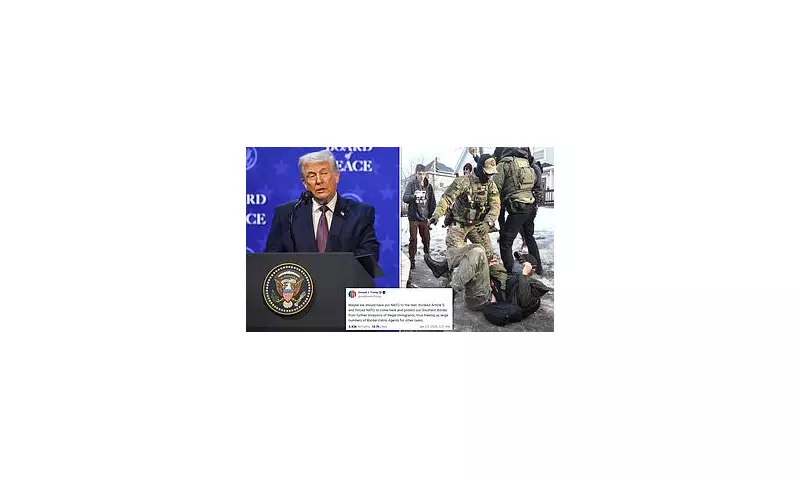
Trump Proposes Testing NATO with Border Protection Request
Former US President Donald Trump has ignited controversy by suggesting putting the North Atlantic Treaty Organization (NATO) "to the test" through a provocative social media post. The proposal came just hours after Trump made contentious remarks about the role of UK and NATO forces during the Afghanistan conflict, casting doubt on the alliance's reliability.
Controversial Social Media Proposal
In a Truth Social post on Thursday night, Trump wrote: "Maybe we should have put NATO to the test: Invoked Article 5, and forced NATO to come here and protect our Southern Border from further Invasions of Illegal Immigrants, thus freeing up large numbers of Border Patrol Agents for other tasks."
This suggestion represents a significant departure from traditional interpretations of NATO's mutual defence clause. Article 5 states that an armed attack against one member is considered an attack against all 32 member states, but NATO clarifies that events lacking an international element, such as domestic border issues, do not typically trigger this provision.

Questioning NATO's Afghanistan Commitment
The social media post followed an interview with Fox News where Trump claimed UK and NATO troops stayed "a little off the front lines" during the war in Afghanistan. He further expressed uncertainty about whether the alliance would support America "if we ever needed them," despite NATO's historical commitment.
These comments sparked immediate backlash from British politicians and military veterans. Labour MP Emily Thornberry, chair of the foreign affairs committee, called Trump's remarks an "absolute insult" to the 457 British service personnel killed in Afghanistan.
Historical Context of Article 5
In NATO's nearly 80-year history, Article 5 has only been invoked once - following the September 11, 2001 terrorist attacks on the World Trade Center in New York. This invocation led to the US-led invasion of Afghanistan, where NATO allies collectively supported the American response.
During the Afghanistan conflict, America's NATO allies suffered 1,160 military deaths, representing approximately one-third of total coalition fatalities. The United States experienced 2,461 deaths, while the United Kingdom, as the second-highest contributor, lost 457 personnel.
Political Backlash and Military Response
Conservative MP Ben Obese-Jecty, who served as a captain in the Royal Yorkshire Regiment in Afghanistan, responded: "I saw firsthand the sacrifices made by British soldiers I served alongside in Sangin, where we suffered horrific casualties, as did the US Marines the following year. I don't believe US military personnel share the view of President Trump; his words do them a disservice as our closest military allies."
Liberal Democrat leader Sir Ed Davey added: "How dare he question their sacrifice?" while Social Care Minister Stephen Kinnock described Trump's claims as "deeply disappointing."
NATO Secretary General's Rebuttal
Following Trump's comments, NATO Secretary General Mark Rutte delivered a pointed correction, telling the former president: "For every two Americans who paid the ultimate price, there was one soldier from another NATO country who did not come back to his family. So you can be assured, absolutely, if ever the United States were under attack, your allies will be with you. There is an absolute guarantee."
Rutte specifically highlighted Denmark's contribution, noting the country had the highest per capita death toll among coalition forces in Afghanistan, despite Trump previously calling the nation "ungrateful" for US protection during World War II.
Broader Implications for Transatlantic Relations
The controversy emerges amid ongoing discussions about NATO's future role and America's commitment to the alliance. Trump's suggestion to use Article 5 for border protection represents a novel interpretation that could potentially reshape understanding of mutual defence obligations.
Meanwhile, the debate about troop contributions in Afghanistan continues to resonate, with multiple British politicians emphasizing their nation's frontline participation and significant sacrifices during the twenty-year conflict.

As transatlantic relations face renewed scrutiny, Trump's comments have reignited discussions about NATO's purpose, member commitments, and the historical record of military cooperation in conflict zones like Afghanistan.