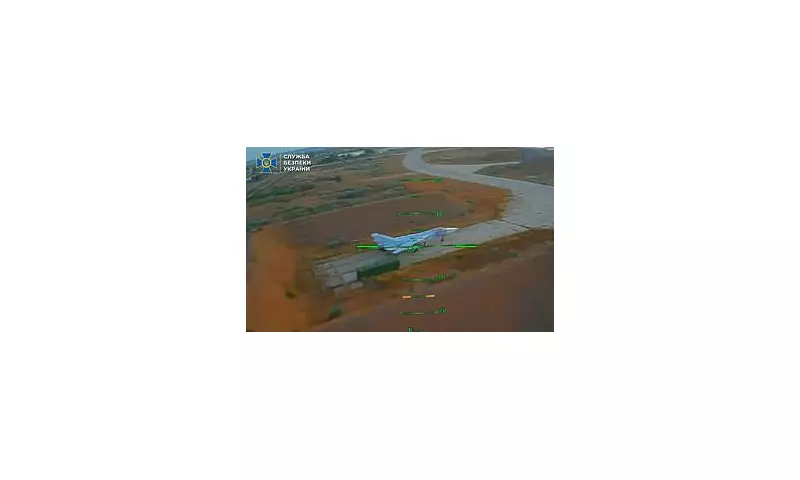
In a significant blow to Russian military capabilities, Ukrainian drones have successfully targeted and destroyed fifteen of Vladimir Putin's military aircraft at airfields deep behind the front lines. Dramatic footage has emerged showing unmanned aerial vehicles striking planes across five different military airfields in a coordinated operation.
Major Losses for Russian Air Force
Ukraine's Security Service, known as the SBU, has claimed responsibility for eliminating eleven Sukhoi and MiG fighter jets, three helicopters, and an Antonov An-26 cargo plane. According to intelligence sources, these destroyed aircraft represent a staggering loss exceeding one billion dollars in value for the Russian military.
Sophisticated Operation by Elite Unit
The SBU has revealed that its elite Alpha unit executed these precision strikes. Among the destroyed aircraft were Su-30SM and Su-34 jets, which represent some of the Kremlin's most important frontline combat planes. Older Su-27 and Su-24 models, regularly used to attack Ukrainian positions, were also eliminated in the operation.

Perhaps most significantly, Ukraine destroyed MiG-31 interceptors, which serve as a crucial component of Russia's air defence system. These aircraft are frequently deployed to launch hypersonic Kinzhal missiles against Ukrainian targets. The destruction of three helicopters - a Mi-8, Mi-26, and Mi-28 - will substantially impair Russia's transport and logistics capabilities in the region.
Additional Infrastructure Damage
Beyond the aircraft destruction, the SBU confirmed that fuel and ammunition depots were also successfully targeted during the operation. This dual approach of eliminating both aircraft and supporting infrastructure represents a comprehensive strategy to degrade Russian military effectiveness.
Ukraine's Energy Crisis Deepens
Despite this military success, Ukraine faces severe challenges on the home front. A senior Ukrainian lawmaker has warned that the coming three weeks will be particularly difficult for citizens due to plunging temperatures and intensified Russian attacks on the energy system.
Freezing Conditions and Power Shortages
Official forecasts predict temperatures dropping below minus twenty degrees Celsius in northern and eastern Ukraine next week, creating extremely challenging conditions. Andriy Gerus, head of parliament's energy committee, acknowledged the severity of the situation while offering some hope.
'The bad news is that there will indeed be frosts, and it will be difficult,' Gerus stated during a national television appearance. 'The good news is that we need to hold out for three weeks, and then it will get easier,' he added, citing predicted warmer temperatures and increased solar power generation from longer days.
Widespread Infrastructure Damage
The last two Russian missile and drone attacks on Kyiv in January left approximately one million people without electricity and six thousand apartment buildings without heating. Despite weeks of repair efforts, around seven hundred buildings still lack proper heating systems.
This pattern repeats across the country, with northern and eastern regions - including major cities like Kyiv, Kharkiv, Chernihiv, and Sumy - regularly targeted. The attacks have resulted in power restrictions for industrial operations and frequent power cuts for ordinary consumers.
Strategic Energy Warfare
Attacks on power stations, energy transmission systems, and gas infrastructure have become key elements of Russia's full-scale invasion strategy since February 2022. Moscow claims these strikes aim to undermine Ukraine's ability to continue fighting, while Kyiv has responded by targeting Russian oil processing infrastructure to reduce state revenues funding the war.
Solar Power Expansion
Ukraine's solar energy association reports that approximately 1.5 gigawatts of new solar capacity was commissioned in 2025, bringing total installed solar capacity to over 8.5 gigawatts. This figure exceeds the installed capacity of all three Ukrainian-controlled nuclear power plants combined, which stands at 7.7 gigawatts.

Solar power proved crucial during repairs to nuclear plants last summer, though output remains weather-dependent. President Volodymyr Zelenskiy recently revealed that Ukraine's damaged energy system currently meets only sixty percent of the country's electricity needs this winter, with generation capacity of eleven gigawatts against a requirement of eighteen gigawatts.
Balancing the Energy System
Maximum electricity imports from European Union countries, combined with strategic power cuts across entire regions, are allowing Ukraine's energy system to remain balanced despite the substantial damage. However, the head of Ukraine's largest private power producer has warned that the country is approaching a 'humanitarian catastrophe' due to energy system damage amidst freezing temperatures, calling for a ceasefire on attacks against energy assets.
The situation represents a complex battlefield where military successes like the destruction of Russian aircraft must be balanced against severe domestic challenges, particularly as Ukraine enters the coldest period of winter with significantly compromised energy infrastructure.