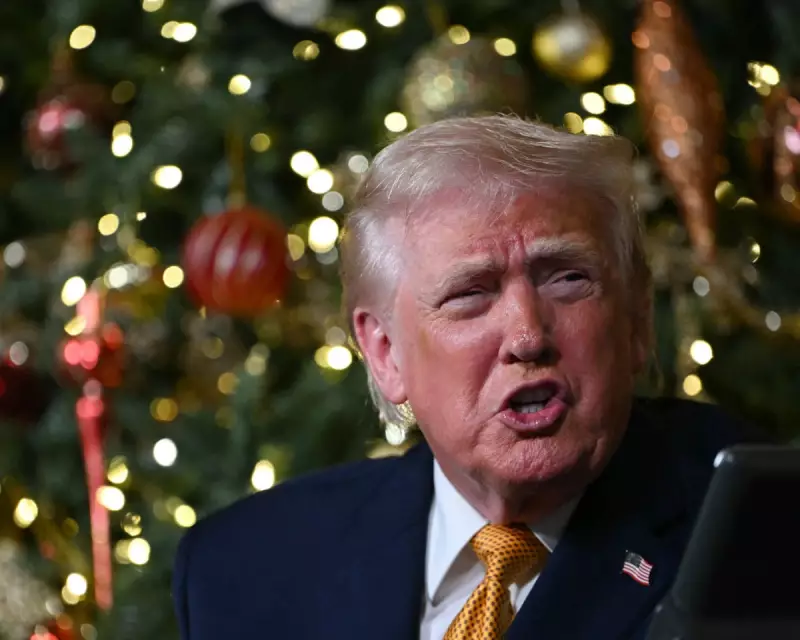
Former US President Donald Trump has publicly declared that American forces carried out a series of airstrikes against Islamic State (ISIS) militants in Nigeria on Thursday. The announcement was made via his Truth Social platform, marking a significant escalation in US military involvement in the region.
Trump's Announcement and Justification
In a characteristically forceful post, Trump stated he had directed the strikes as Commander in Chief. He described the operation as a "powerful and deadly strike against ISIS Terrorist Scum in Northwest Nigeria." The former president justified the action by accusing the militant group of targeting and killing "primarily, innocent Christians, at levels not seen for many years, and even Centuries."
Trump claimed he had previously warned the militants to cease attacks on Christian communities or face severe consequences. "I have previously warned these Terrorists that if they did not stop the slaughtering of Christians, there would be hell to pay, and tonight, there was," he wrote. He praised the execution of the strikes, which he said were carried out by the "Department of War."

Official Confirmation and Nigerian Coordination
The US military's Africa Command (AFRICOM) later confirmed the operation, stating it was conducted in Sokoto state in north-west Nigeria. Crucially, AFRICOM emphasised the action was taken "in coordination with the Nigerian authorities." This detail aligns with a since-deleted social media post from the command which initially said the strike was conducted at the request of the Nigerian government.
Pentagon chief Pete Hegseth expressed gratitude for "Nigerian government support + cooperation." Nigeria's foreign ministry also acknowledged the strikes, framing them as part of ongoing security cooperation with the United States. The ministry's statement highlighted intelligence sharing and strategic coordination aimed at militant groups, which "has led to precision hits on terrorist targets in Nigeria by air strikes in the North West."
Complex Background of Nigeria's Security Crisis
This military intervention occurs against a backdrop of complex and long-running violence in Nigeria. The country's population is nearly evenly split between Muslims (approximately 53%) and Christians (around 45%), and it is officially a secular state. While attacks on Christian communities have drawn significant international attention—particularly from the American religious right—the Nigerian government has consistently rejected framing the violence purely as religious persecution.
Authorities in Abuja argue that armed groups target both Muslims and Christians, and that simplifying the conflict to religious strife ignores a multifaceted security situation. Many analysts point to deeper roots in competition over land and water resources, particularly between itinerant Muslim herders and predominantly Christian farming communities.
Furthermore, the trend of kidnapping priests and pastors for ransom is seen by some experts as being driven more by criminal economics than ideological religious discrimination. Despite these complexities, the Nigerian government has previously agreed to work with the US to bolster its forces against militant insurgencies.
A Pattern of Military Action
Trump's announcement is notable given his 2024 campaign positioning as the "candidate of peace" who promised to extract America from "endless wars." However, his first year back in office has seen a notable number of overseas military interventions. These have included strikes in Yemen, Iran, and Syria, alongside a significant military buildup in the Caribbean aimed at Venezuela.
The decision to publicise the Nigeria strikes directly on social media continues Trump's pattern of bypassing traditional government communication channels, placing a renewed spotlight on US foreign policy in Africa and the ongoing fight against Islamic State affiliates beyond their traditional Middle Eastern strongholds.