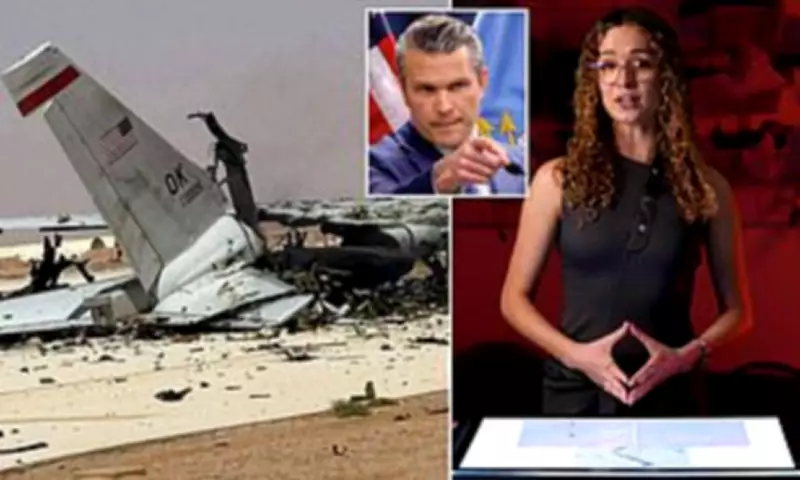
Satellite Evidence Suggests US Underreporting War Losses Against Iran
In a recent investigation featured in the Daily Mail's Photo Evidence series, reporter Catherine Barnwell has examined new satellite images that raise serious questions about the transparency of America's Department of War regarding military losses during the ongoing conflict with Iran. The analysis suggests that the scale of destruction to strategic American assets might be significantly greater than officially acknowledged.
Unconventional Iranian Warfare Strategy
Since Operation Epic Fury commenced on February 28, a joint US-Israeli bombing campaign targeting Iran, the Iranian regime has retaliated with coordinated missile and drone strikes against American military installations across the Gulf region. Barnwell's investigation reveals that Iran's Revolutionary Guard Corps (IRGC) has adopted a highly unconventional warfare approach.
Rather than focusing on traditional military targets like fighter jets or bombers, the IRGC has systematically attempted to blind and cripple America's command and control infrastructure. This strategic shift involves concentrated attacks against critical radar systems and air defence networks, representing what military analysts describe as a sophisticated attempt to degrade American operational capabilities in the region.

Questioning Official Transparency
Barnwell contends that the Department of War has not been fully forthcoming about the extent of losses in these strategic equipment categories. Her claims are supported by comprehensive analysis of multiple data sources, including the latest EU Sentinel satellite imagery, open-source flight tracking information, ground photography from conflict zones, and images released by Iran's state-controlled media outlets.
The financial implications of these potential losses are staggering. The destruction of just one AWACS surveillance aircraft represents a $724 million loss to American taxpayers, according to defense procurement estimates. When combined with other potential equipment losses, the total damage could exceed one billion dollars from a single day's engagements at one military base alone.
The Prince Sultan Air Base Case Study
A particularly revealing example highlighted in Barnwell's investigation involves the Prince Sultan Air Base in Saudi Arabia. While the Department of War confirmed that ten US service members sustained injuries during a March 27 strike on this facility, officials declined to comment on whether any strategic military assets were destroyed in the attack.
Barnwell's analysis of satellite imagery suggests otherwise. "The Prince Sultan is one of the main bases in the Middle East from which America is fighting its war with Iran," she explained. "This base doesn't house combat aircraft but rather serves as a crucial logistics and support hub for US operations."
Comparing before-and-after satellite images from March 27, Barnwell identified what appears to be the complete destruction of an AWACS aircraft, evidenced by the disappearance of its distinctive black rotodome and visible scorch marks on the tarmac. Ground photography from the strike date reportedly shows tail number 81-0005, which flight tracking data indicates belonged to an aircraft operating with the 552nd Air Control Wing from Tinker Air Force Base in Oklahoma.
Additional Equipment Losses Examined
Beyond the probable AWACS destruction, Barnwell's investigation suggests that as many as seven KC-135 refuelling tankers may have been damaged or destroyed during the same March 27 attack. Replacing just one of these tankers with modern equivalents could cost American taxpayers approximately $240 million.
While Iranian state media claims three KC-135s were destroyed and four more damaged, Barnwell's cross-referencing of EU satellite imagery with Iranian-released photos presents a more nuanced picture. "In the EU image, you can clearly see a scorch mark on the ground which tallies with where the tankers were in the Iranian image," she noted. "However, the European images don't show damage below the scorch mark where other tankers were parked, making Iran's claim of destroying three unlikely to be entirely accurate."

Information Restrictions and Their Implications
The investigation reveals that the Department of War requested Planet Labs, the world's largest commercial satellite imagery provider, to indefinitely withhold all images of the conflict region, including bases operated by allied nations. The company complied with this request, creating what Barnwell describes as an information gap between official accounts and evidence from other sources.
"America is not being entirely honest with the damage being caused by the war," Barnwell asserted. "Officials have given off-the-record briefings confirming that Prince Sultan Air Base was hit on March 27, but have said nothing about the destruction of aircraft. They've stopped US satellite companies from publishing imagery that shows damage that other sources and ground photographers are revealing."
The potential scale of losses becomes particularly striking when placed in context. The estimated billion dollars in equipment damage from a single day at one base approaches significant percentages of allied defense budgets. For comparison, the United Kingdom's entire defense allocation for 2026 stands at £62.2 billion.
Barnwell's investigation extends beyond the Prince Sultan case study, examining evidence from multiple other bases targeted by Iranian strikes, including facilities in Kuwait and Jordan. The cumulative picture suggests a pattern of strategic losses that may not be fully reflected in official Department of War communications about the conflict's progression and costs.