

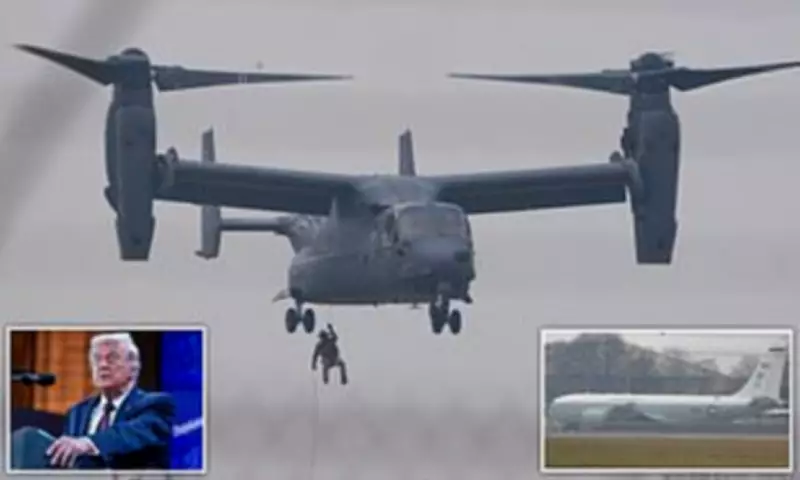
A specialised United States Air Force WC-135R Constant Phoenix aircraft, colloquially known as a 'nuclear sniffer', has arrived at an undisclosed Royal Air Force base in the United Kingdom. This deployment coincides with visible training exercises by American special forces, who have been observed practicing rapid descent techniques—'fast roping'—from a V-22 Osprey tiltrotor aircraft. These developments unfold against a backdrop of escalating rhetoric between Washington and Tehran, with former President Donald Trump reportedly considering a range of military options against Iran.
A Rare and Significant Deployment
The arrival of the WC-135R Constant Phoenix marks a notable event, as it is reportedly only the third such deployment to a UK airbase in four decades. This aircraft is specifically designed to collect atmospheric samples to detect radioactive particles, thereby identifying evidence of nuclear explosions or significant radiation leaks. Its operational history includes missions following the Chernobyl disaster in 1986, the Fukushima incident in 2011, monitoring of North Korean nuclear tests, and initial assessments at the onset of the Ukraine-Russia war in 2022.
The unusual nature of this deployment to a European base, which typically sees these aircraft operating closer to Russian borders, has fuelled speculation regarding its purpose. Many analysts suggest it forms part of broader military preparations related to the ongoing tensions with Iran.

Trump's Warnings and Military Posturing
The aircraft's arrival follows the deployment of a US naval strike group to Middle Eastern waters earlier in the week. Former President Donald Trump has issued stark warnings, stating that the military is 'ready, willing and able' to strike Iran if deemed necessary. He emphasised that 'time is running out' for Iran to negotiate a deal concerning its nuclear programme, which Western powers believe is aimed at developing an atomic weapon. This follows a brief period in June where the US joined Israeli military actions against Iranian nuclear targets.
Reports indicate Trump is actively weighing various options. These reportedly include targeted strikes on Iranian security forces and leadership figures, with an apparent objective of inspiring protesters to challenge government authority. Discussions among his advisors are said to also encompass larger-scale strikes targeting Iran's ballistic missile capabilities or nuclear enrichment facilities.
Iran's Defiant Response and Regional Concerns
In response to the heightened threats, Iranian officials have vowed a forceful retaliation. Iran's army chief, Amir Hatami, promised a 'crushing response' to any attack, with state television announcing the integration of 1,000 'strategic drones' into combat regiments. Senior figures from Hezbollah, the Lebanese group backed by Iran, have warned that the consequences of any American military action would be unpredictable.
The diplomatic climate remains fraught. A senior Iranian official told Reuters that while Iran is 'preparing itself for a military confrontation', it is also utilising diplomatic channels. However, they accused Washington of not showing openness to diplomacy. Iran's mission to the United Nations stated the country is ready for dialogue 'based on mutual respect and interests' but would defend itself 'like never before' if attacked.
Broader Strategic Calculations and Protests
Two US sources familiar with internal discussions suggested Trump's broader goal may be to create conditions conducive to 'regime change' in Iran. The strategy under consideration allegedly involves strikes intended to bolster the confidence of anti-government protesters, potentially enabling them to storm official buildings.
However, this approach is viewed with scepticism by several Arab officials and Western diplomats briefed on the matter. They express concern that military strikes could further weaken a protest movement already reeling from what has been described as the bloodiest state crackdown since the 1979 Islamic Revolution, rather than galvanising public support.

Experts like Alex Vatanka of the Middle East Institute note that without large-scale defections from Iran's military, the protests, while 'heroic', remain 'outgunned'. The situation presents a volatile standoff, with the rare deployment of advanced US detection assets to the UK underscoring the serious and global nature of the current geopolitical tensions.





