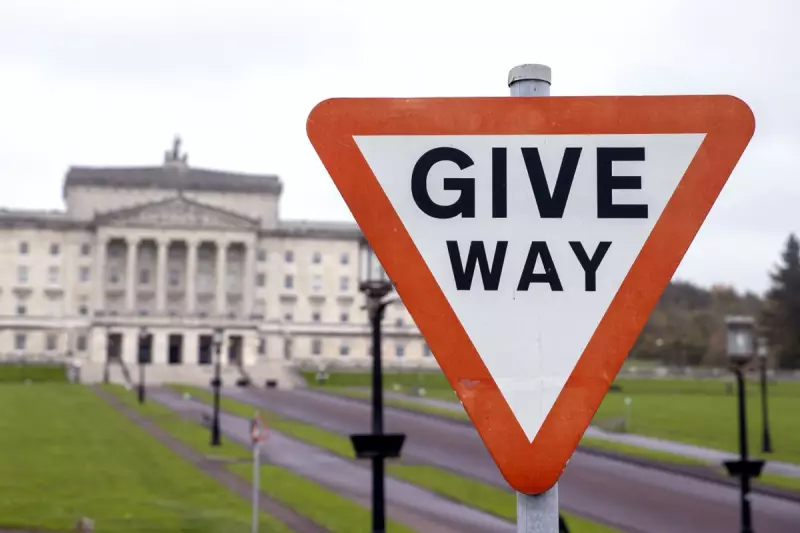
Freshly declassified government documents have shed light on the cautious optimism that surrounded the restoration of Northern Ireland's devolved government in the spring of 2000. Officials at the time declared the region was on the "cusp of a new beginning" with the return of the Stormont institutions, following a brief but significant suspension.
The Path to Restoration and a Crucial Away-Day
The power-sharing Executive and Assembly, established under the historic 1998 Good Friday Agreement, had only begun their work in December 1999. However, by February 2000, the process faced a major crisis. The then Secretary of State, Peter Mandelson, suspended the institutions due to a lack of progress on IRA decommissioning.
The deadlock was broken after the IRA issued a statement pledging to put its arms "completely and verifiably" beyond use. This paved the way for the institutions to be restored in May 2000. Ahead of this pivotal return, senior civil servants convened for an away-day at a hotel in County Antrim. Their central task was to oversee the establishment of the new Office of the First Minister and Deputy First Minister (OFMDFM) as a fully-fledged department.

A "New Beginning" Fraught with Challenges
A briefing paper prepared for that meeting, now held at the Public Record Office in Belfast, captured the moment's fragile hope. It stated that the return of devolution offered the "real prospect of enduring political stability and self-government." The paper also noted society had an opportunity to undergo dynamic changes driven by both global and domestic factors.
Yet, officials were under no illusions about the severe difficulties ahead. The document laid out a stark list of challenges:
- Threats from those opposed to the peace process.
- The major task of healing a society grappling with polarisation and the deep distrust built up over 30 years of conflict.
- The inherent difficulties of an "involuntary coalition" comprising four very disparate political parties.
- High public expectations and intense pressure on returning ministers and officials.
The paper emphasised that the nature of devolution placed a premium on delivering "joined-up and more open government." It also highlighted the significant constitutional changes occurring, with new bodies like the North-South Ministerial Council (NSMC) and the British-Irish Council (BIC) establishing their roles.
A Fragile Peace and Subsequent Collapses
The optimism of May 2000 proved to be short-lived. The political institutions faced further turbulence, being suspended for two short periods in 2001 amid ongoing disputes over paramilitary decommissioning. The power-sharing experiment then collapsed entirely in October 2002 for a protracted five-year period. This followed a police raid on Sinn Féin's Stormont offices as part of an investigation into allegations of an IRA intelligence-gathering operation.
The declassified files from 2000 serve as a poignant historical record, capturing a fleeting moment of hope in Northern Ireland's turbulent journey towards stable devolution. They underscore both the profound aspirations for peace and the formidable, enduring challenges that lay in its path.