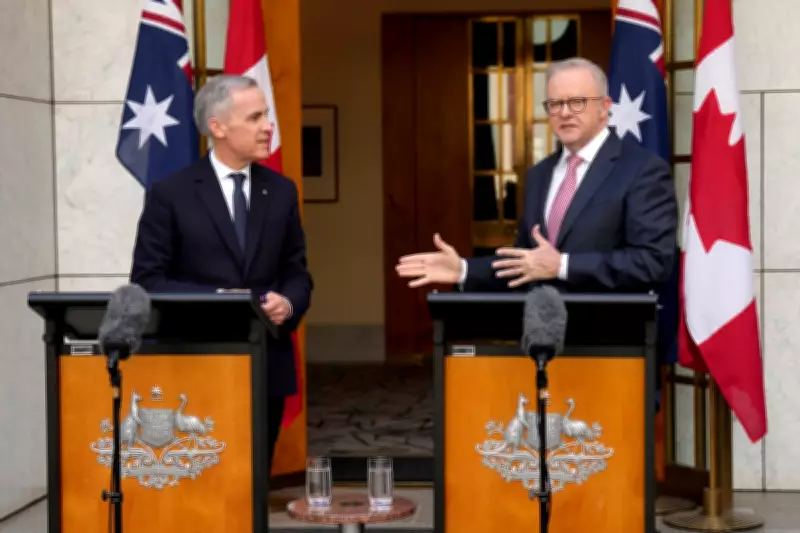
The prime ministers of Canada and Australia have issued a unified call for a de-escalation of hostilities in the ongoing Iran conflict, while firmly asserting that Iran must never be allowed to obtain nuclear weapons. This joint statement was made during a high-level meeting in Canberra, Australia's capital, on Thursday, March 5, 2026.
Leaders Emphasize Need for Broader International Involvement
Canadian Prime Minister Mark Carney and Australian Prime Minister Anthony Albanese discussed the escalating situation in the Middle East, which has seen recent military actions including a U.S. submarine sinking an Iranian warship in the Indian Ocean and NATO defenses intercepting a ballistic missile launched from Iran near Turkish airspace. Both leaders stressed the urgency of reducing tensions through diplomatic means.
Carney's Statement on De-escalation and Nuclear Proliferation
At a press conference, Carney articulated a clear position: "We want to see a broader de-escalation of these hostilities with a broader group of countries than just the direct belligerents involved." He emphasized that this goal is unattainable without addressing Iran's nuclear ambitions and support for terrorism. "We stress that that cannot be achieved unless we're in a position that Iran's ability to acquire a nuclear weapon, develop a nuclear weapon, and to export terrorism, is ended. So that process must lead to those outcomes," Carney added.
Carney further suggested involving the six-nation Gulf Cooperation Council, noting they have shown "tremendous restraint," in the de-escalation efforts. When questioned about potential Canadian military involvement, he did not rule it out, stating, "You've asked a fundamental hypothetical in a conflict that can spread very broadly. So one can never categorically rule out participation. We will stand by our allies when it makes sense."
Albanese's Call for Ceasing Attacks and Nuclear Disarmament
Prime Minister Albanese echoed these sentiments, highlighting the global desire for peace. "The world wants to see a de-escalation and wants to see Iran cease to spread the destinations of its attacks," he said. Albanese pointed out that Gulf states, previously uninvolved, have faced attacks affecting civilian and tourist areas. "But we also want to see the objectives achieved. I want to see the possibility of Iran getting a nuclear weapon removed once and for all," he asserted, reinforcing the commitment to preventing nuclear proliferation.
Context of the Meeting and Broader Implications
The meeting occurred as part of Carney's trade-focused, three-nation tour, which began in India and will conclude in Japan. During his visit, Carney addressed the Australian Parliament, underscoring the importance of international cooperation in addressing global security threats. The leaders' statements reflect a coordinated approach between Canada and Australia, two key Western allies, in responding to the Iran conflict.
This development comes amid heightened tensions in the region, with recent incidents underscoring the risk of broader conflict. The call for de-escalation and opposition to Iran's nuclear ambitions signals a diplomatic push to stabilize the situation, while leaving open the possibility of further action if necessary to support allies.