Putin Accuses Ukraine of Terrorist Attack on Russian LNG Tanker Off Libya
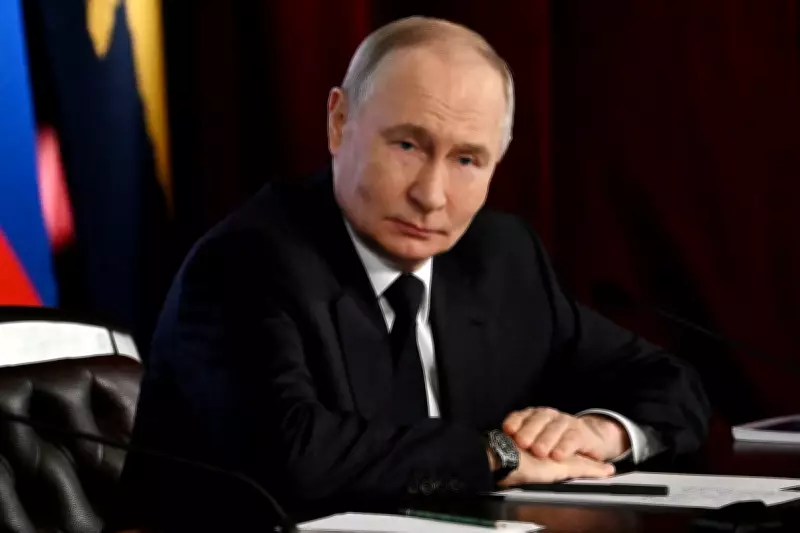
Russian President Vladimir Putin has accused Ukraine of carrying out what he termed a "terrorist attack" on a Russian-flagged liquefied natural gas (LNG) tanker that exploded and sank in the Mediterranean Sea off the coast of Libya. The incident, confirmed by Libyan authorities, involved the Arctic Metagaz tanker, which was carrying 61,000 tonnes of LNG and "completely sank" between Libya and Malta.
Putin stated that the attack "exacerbates the situation on global energy markets, including gas markets." Ukrainian officials did not immediately respond to Moscow's claims. The Libyan Maritime Authority reported "sudden explosions, followed by a massive fire" on Tuesday when the vessel was approximately 240 kilometres off the city of Sirte. All 30 crew members were rescued and transferred to another ship heading to Benghazi.
Russia's transport ministry alleged that the tanker was hit by Ukrainian sea drones launched from the Libyan coast. Previous Ukrainian attacks on Russian ships have reportedly originated from this area, though Kyiv has not publicly confirmed such operations.
Zelensky Says US-Iran Conflict Pauses Ukraine Peace Talks
In a related development, Ukrainian President Volodymyr Zelensky announced that the ongoing military conflict between the United States and Iran has temporarily halted trilateral peace talks aimed at ending the war in Ukraine. Zelensky made these remarks in an evening address, noting that daily engagement with the US continues, but the necessary signals for a trilateral meeting with Moscow and Washington have not yet materialised due to the Middle East situation.
"As soon as the security situation and the broader political context allow us to resume the trilateral diplomatic work, it will be done. Ukraine is ready for it," Zelensky affirmed. He also mentioned discussions with leaders from Bahrain, Kuwait, Jordan, Qatar, and the United Arab Emirates regarding the Iran conflict, highlighting that Ukraine has received requests for help in defending against Iranian drones, similar to those used by Russia.
Russian Army Experiences Slowest Advance in Nearly Two Years
Analysis from the US-based Institute for the Study of War (ISW) indicates that the Russian army has seen its slowest advance on the war frontline in almost two years. Ukrainian forces achieved several localised breakthroughs, particularly along the southern frontline and in the Dnipropetrovsk region, where they pushed back Russian troops.
Despite this slowdown, Moscow continues to advance in the east, moving closer to key hubs like Kramatorsk and Sloviansk in Ukraine's Donetsk region. Russia currently occupies over 19 per cent of Ukrainian territory. Ukrainian troops made significant territorial gains in February, including 61 square kilometres on 15 February and more than 50 square kilometres on both 21 and 23 February.
These advances coincided with a reported reduction in Russian troop movements after Elon Musk allegedly cut Starlink access for Moscow's forces.
Russia Could Profit from Rising Energy Prices Fuelled by Iran War
The escalating conflict in Iran is inadvertently strengthening Russia's financial capacity to fund its war in Ukraine through increased energy profits. Prices for Russian oil exports have surged from under $40 per barrel in December to approximately $62 per barrel. This rise is attributed to pre-war anxieties and the significant disruption of tanker traffic through the Strait of Hormuz, a vital conduit for roughly 20 per cent of global oil consumption.
While Russian crude trades at a discount compared to international benchmark Brent crude, which has climbed above $82 from a pre-attack price of $72.87, its current price now surpasses the $59 per barrel benchmark assumed in the Russian Finance Ministry's 2026 budget plan. Putin has warned that Russia could halt gas supplies to Europe amid this energy price spike, citing European Union plans to ban purchases of Russian gas and LNG.
Ukraine Faces Potential Shortage of US Weapons Amid Iran Conflict
Experts have raised concerns that Ukraine could face a critical shortage of US air defence missiles as the US focuses on its military assault on Iran. Iran retaliated to the US killing of its supreme leader by firing hundreds of ballistic missiles and drones at Gulf nations, which were intercepted using US Patriot missile interceptors. These systems are also critical for Ukraine in defending against Russian missiles.
Serhii Kuzan, head of the Kyiv-based Ukrainian Security and Cooperation Center think tank, noted that the roughly 600 PAC-3 missiles produced yearly by Lockheed Martin are insufficient to cover US needs and those of its Gulf allies, let alone Ukraine's. "It's the very simple mathematics of war," Kuzan told the Japan Times.
Additional Developments
- German intelligence claims Russia's true federal budget deficit in 2025 exceeded 2.36 trillion roubles (£24bn), far above official figures, as Moscow seeks to hide war costs.
- Ukrainian drones damaged civilian sites in Russia's Saratov region, injuring three people and prompting flight closures at several airports.
- Putin accused Ukraine of "blackmailing" Slovakia and Hungary over oil supplies via the Druzhba pipeline, a matter discussed with Hungarian Foreign Minister Peter Szijjarto.
The situation remains fluid, with energy market volatility and diplomatic pauses adding complexity to the ongoing conflict in Ukraine.