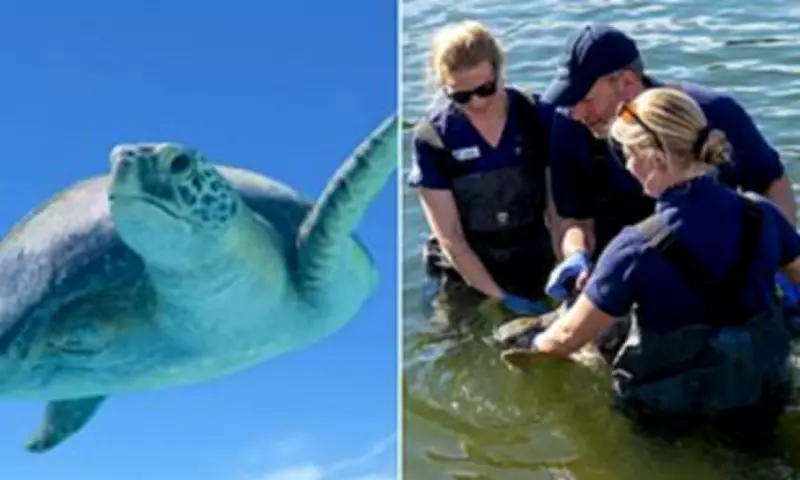
Severely Injured Sea Turtle Returns to Ocean After Remarkable Recovery
In a heartwarming conservation success story, a green sea turtle named Porkchop has been successfully released back into the wild after nearly a year of intensive rehabilitation at the Aquarium of the Pacific in Long Beach, California. The turtle's journey from critical injury to recovery captured public attention and demonstrated the resilience of marine wildlife.
Rescue and Critical Condition
Porkchop was first rescued in March 2025 by volunteers monitoring the San Gabriel River as part of a community science program. The volunteers noticed the turtle had been stuck in the same location for an extended period and was unable to swim away. Upon closer examination, they discovered a fishing line had become tightly wrapped around Porkchop's front flipper, cutting off blood circulation and causing severe tissue damage.
"When this turtle first arrived, we did not know what the outcome would be because of its critical condition," explained Dr. Brittany Stevens, an aquarium veterinarian. "She was very, very seriously injured." The fishing line entanglement had caused approximately 90 percent of the front flipper to become necrotic, requiring immediate medical intervention.

Complex Surgical Procedures
Further examination revealed additional complications. X-rays showed a fishing hook lodged in the back of Porkchop's mouth, necessitating multiple surgical procedures. The initial rescue operation itself took approximately four hours to safely extract the turtle from the river environment.
The rehabilitation process involved two major surgeries. The first procedure, lasting about five and a half hours, involved the complete amputation of the dead portion of Porkchop's front flipper. A second operation removed the embedded fishing hook in about an hour. Jeff Flocken, the Aquarium of the Pacific's regional vice president, described these procedures as potentially life-saving interventions for the turtle's future.
Adaptation and Recovery
Remarkably, Porkchop adapted quickly to life with three flippers during the rehabilitation period. According to the Olive Ridley Project, green sea turtles can survive in the wild with only three flippers, learning to compensate for missing limbs much like humans do. Functions typically performed by front flippers can be accomplished using back flippers instead.
"She thrived very quickly," Flocken noted about Porkchop's recovery. "She was a bit of a ham" who became well-known to visitors at the Southern California aquarium during her nearly year-long stay. The turtle gained strength and demonstrated remarkable resilience throughout the rehabilitation process.
Return to the Wild
The release occurred along the San Gabriel River, approximately 25 miles south of Los Angeles. The aquarium specifically chose this location due to its proximity to a resident green sea turtle population. "The minute we pulled the stretcher out from under her, she just swam right away," Flocken described the emotional release moment, which some observers noted resembled scenes from the animated film Finding Nemo.
The San Gabriel River represents an ideal habitat for Porkchop's return, as it hosts the largest group of green sea turtles in North America. While these turtles do not breed or nest in California waters, they migrate to the state's coastal areas for foraging purposes.
Conservation Significance
This successful rehabilitation story highlights several important conservation issues. Fishing line and hook injuries represent significant threats to marine wildlife, and Porkchop's case demonstrates how human activities can inadvertently harm ocean creatures. The collaboration between community science volunteers and professional aquarium staff proved crucial in saving the turtle's life.
Since her release, Porkchop has already been sighted again by volunteers monitoring the San Gabriel River, indicating a successful transition back to natural habitat. "We thought it was more important that she had an opportunity to go back out in the wild and live the rest of her lifetime in a natural environment," Flocken emphasized regarding the decision to release the rehabilitated turtle.

The Aquarium of the Pacific's extensive rehabilitation efforts, combined with Porkchop's remarkable adaptability, have resulted in what conservationists describe as a textbook example of successful wildlife rescue and release. The story serves as both inspiration and education about marine conservation challenges and solutions.