Cyprus Protests Intensify Against UK Military Bases After Drone Strike
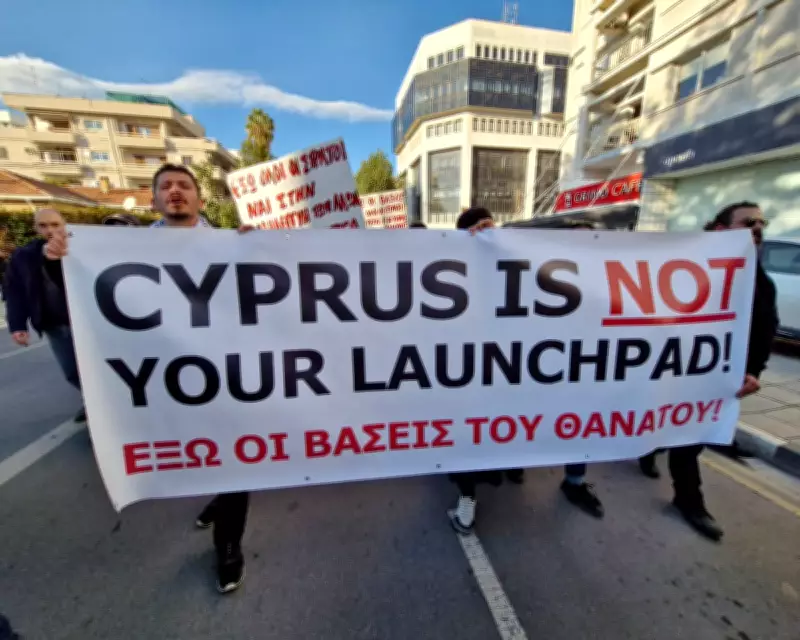
Britain is confronting escalating demands to withdraw its military bases from Cyprus, as local protests surge in response to a recent drone attack on RAF Akrotiri. Demonstrators in Nicosia, the capital, marched through the streets on Saturday, chanting slogans such as "out with the bases of death" and expressing fears that Cyprus could be drawn into broader regional conflicts involving Iran.
Security Concerns and Drone Attack Details
Foreign Minister Constantinos Kombos confirmed to the Guardian that the Iranian-made drone that struck the airbase was launched from Lebanon, home to Hezbollah and Iranian Revolutionary Guard units. Within 12 hours of the attack, two additional combat drones were intercepted off the island, also originating from Lebanon, approximately 150 miles away.
Kombos stated, "Right now it's a fact that we have to be looking towards the Lebanese front. We cannot exclude anything from the broader direction of the north-east. We have to be very careful ... we have to make sure that the systems in place are covering all possibilities of threat."
Historical Context and Local Opposition
The British bases, established in 1960 as part of Cyprus's independence agreement, occupy about 3% of the island's land. Protesters like Mathaios Stavrinides argue that these installations pose a security risk, with Stavrinides declaring, "They are a danger to our security and should never have been here in the first place. We want them closed."
Cypriot officials have long warned the UK about potential threats to the bases, with Kombos noting, "We've consistently communicated that the bases could be a target if things move in a specific direction regionally." However, these warnings were reportedly ignored until the recent attack.
Defence Measures and International Response
In response to the crisis, the UK has deployed additional air defence systems, including Royal Navy Wildcat helicopters and F-35 fighter jets. European states have also sent warships and air assets to bolster defence. Despite these efforts, many locals view the deployments as insufficient and delayed, with the destroyer HMS Dragon not expected to arrive until next week.
Kombos emphasized a "whole-of-Cyprus approach" to defence, while reiterating Cyprus's pursuit of NATO membership, which has been blocked by Turkey. He added, "In the meantime, we are trying to make sure that we have the capacity to be able to link up to the NATO systems and structures as far as possible for someone who is not a member of the alliance."
Ongoing Tensions and Government Stance
President Nikos Christodoulides has assured that Cyprus will not engage in military operations, calling for calm amid what is described as the worst security crisis since Turkey's invasion in 1974. Defence Minister Vasilis Palmas revealed that the drone evaded detection by flying at a low altitude and high speed, complicating radar tracking.
Protests are fueled by lingering resentment over colonial-era bases and confusion about the attack's details. Stavrinides criticized the shifting narratives, saying, "At first we are told it hit a runway, then there's pictures of a hangar being destroyed ... It's lie, after lie. Anything they tell us we have to take with an ocean of salt and that's why these protests will continue."