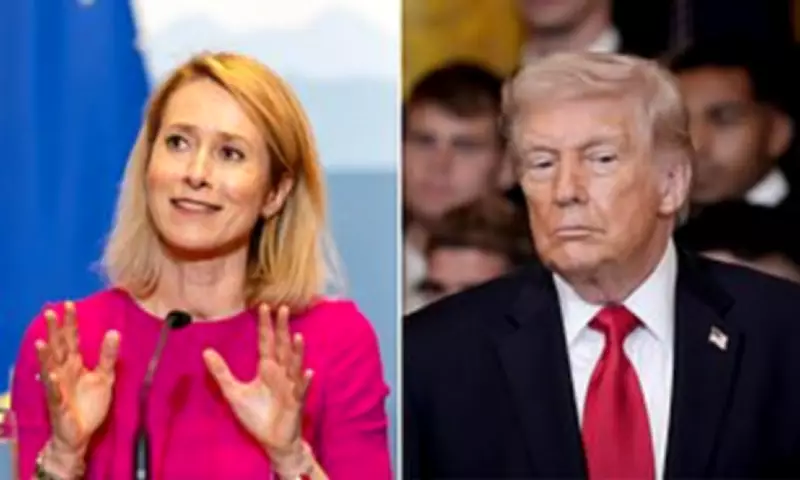
Europe's leading diplomat has openly acknowledged that the European Union is profoundly divided over the Iran crisis, as a bitter public dispute between Spain and Germany erupted yesterday. Kaja Kallas, who heads the EU's diplomatic service, conceded that member states hold 'different views' about the escalating conflict while chairing a critical meeting in Brussels aimed at bridging gaps and forging a unified position.
Bloc Struggles for Coherent Response
When questioned about the acrimonious spat between Madrid and Berlin, Kallas highlighted the formidable challenge of achieving consensus among all twenty-seven member nations. She stated plainly: 'We are in this European Union with 27 countries… so of course we might have different views.' Internal EU sources revealed that officials have been 'tying themselves in knots' in recent days while attempting to formulate a response, following widespread criticism of the bloc's initially sluggish reaction.
Leadership Under Fire
EU Commission President Ursula von der Leyen faced particular ridicule on Saturday, when the conflict first erupted, for announcing that an 'emergency' meeting would not convene until Monday. Although an emergency committee—established during the Brexit and Covid-19 crises—did assemble, it ultimately concluded it lacked the authority to advise EU countries on their strategic stance. Compounding the disarray, member states remain split on the appropriate level of military involvement, and by yesterday afternoon, no coordinated EU evacuation plan for citizens trapped in the region had been initiated, forcing individual governments to devise their own rescue efforts.

Core Divisions Exposed
The deepest fissures have emerged between Germany, France, and Spain. German leader Friedrich Merz has offered unequivocal support for the US-Israeli military action that triggered the conflict, denouncing Iran as a 'terrorist' state. In stark contrast, French President Emmanuel Macron contends that Iran has violated international law and insists Paris 'cannot approve' of the military measures.
Spain's Defiance and US Backlash
Spain has aligned itself with France, taking the provocative step of evicting US military aircraft from its bases. This move incited fury from US President Donald Trump, who threatened to 'sever all trade' with Madrid. Merz has endorsed Trump's long-term objectives of nuclear and ballistic disarmament and declined to defend Spain during his recent visit to Washington.
On Wednesday night, Spanish Foreign Minister José Manuel Albares voiced his frustration on radio station Cadena SER, expressing Madrid's expectation of greater 'solidarity' from Berlin. He further suggested that former German Chancellors Angela Merkel or Olaf Scholz would have championed Spain's position in Washington.
Quest for Diplomatic Resolution
Despite the internal discord, Kallas affirmed that the bloc would continue to advocate for a diplomatic solution to end the war. An EU source underscored the severity of the split, noting: 'France and Germany are completely split. Italy seeks a diplomatic resolution due to its regional alliances. Everyone is tying themselves in knots over their permissible actions.'
The ongoing divisions highlight the EU's struggle to present a cohesive foreign policy front during international crises, with national interests frequently overshadowing collective strategy.