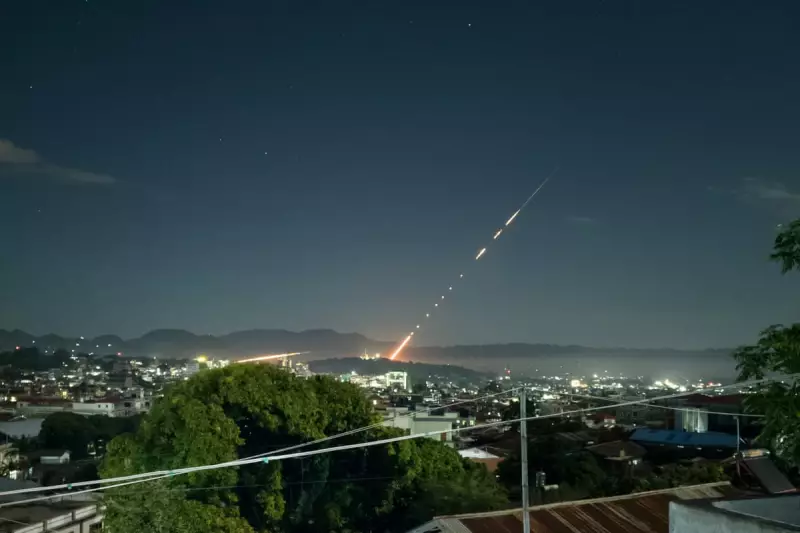
Myanmar's military junta, which seized power in a 2021 coup, is pushing ahead with a widely condemned national election beginning this Sunday. This vote, the first since the coup, is being held as the military manages to regain some momentum in a brutal civil war against a patchwork of opposition forces.
Beijing's Pivotal Influence on the Conflict
Analysts point to one external power as the most significant factor in changing the dynamics of the five-year conflict: China. "This is really all China playing a role in tilting things in favour of the military regime," states Jason Tower, a senior expert on Myanmar at the Global Initiative against Transnational Organized Crime.
Beijing's support has taken multiple crucial forms. It has continued weapons transfers to the junta, including newer drone technologies. Diplomatically, it has boosted the military's international standing by introducing it into platforms like the Shanghai Cooperation Organization Summit. Perhaps most effectively, China has used its leverage along the 2,185km shared border to pressure powerful ethnic armed organisations in northern Shan State.
"The pressure on ethnic armed organisations, reducing the amount of resistance that the junta was facing in the northern part of the country, that's on China," added Tower. By implementing border closures, China pushed these groups to agree to ceasefires and even hand back captured territory to the military, allowing the junta to reclaim some lost ground.
A Strategic Balancing Act, Not a Preferred Ally
China's relationship with Myanmar's junta is complex and driven by self-interest, not affinity. Beijing was initially muted in its response to the 2021 coup but grew increasingly frustrated by the ensuing economic chaos and spiralling conflict, which severely disrupted its major infrastructure investments. These projects aim to build a corridor connecting south-western China directly to the Indian Ocean.
China's displeasure peaked with the explosion of organised crime, particularly scam compounds in border areas. This anger led Beijing to give tacit approval for northern ethnic armed groups to launch a major offensive against the junta in late 2023. The offensive succeeded dramatically, catching the military off guard and seizing vast swathes of territory.
According to Morgan Michaels, a research fellow at the International Institute for Strategic Studies, China then "corrected course." "Did China really ever intend to make those groups so strong that they were going to topple the Myanmar state apparatus? I don't think so – because as soon as that became a possibility, China stepped in," Michaels said. Fearing total state collapse and greater chaos, Beijing used border closures to force the ethnic groups to back down.
A Widely Condemned Election and an Uncertain Future
For now, China has thrown its weight behind the military's election plan, which UN experts and monitors decry as a sham. The Chinese foreign minister, Wang Yi, expressed hope the vote would achieve "domestic peace" and "national reconciliation." China will send election observers, alongside countries including Russia and Vietnam.
The poll offers no true opposition, dominated by the military's proxy Union Solidarity and Development party. Under the constitution, junta chief Min Aung Hlaing is obliged to assume a top role, though few believe he will relinquish real power. The military has sought to reassure Beijing by vowing to crack down on scam compounds and promising that economic projects will proceed.
However, analysts warn China's support is conditional. Jason Tower suggests that if the military squanders chances for ceasefires or fails to show progress on infrastructure within two years, Beijing may pivot away again. While anti-China sentiment rises in Myanmar, Yun Sun of the Stimson Center argues China doesn't need war to exert influence. "I think what the Chinese will say is that they see the situation as a dynamism, that a balance of power will eventually lead to some stability," she said. "Neither side is necessarily the horse that China has picked."