Iran's Supreme Leader Issues Stark Warning to US Over Aircraft Carriers
Iran's supreme leader, Ayatollah Ali Khamenei, has issued a direct threat to sink any American aircraft carriers dispatched to the Middle East, escalating tensions as nuclear negotiations between the two nations proceed in Geneva. The warning comes amidst live-fire military drills conducted by Iran in the strategically vital Strait of Hormuz, a key global oil transit route.
Nuclear Talks Underway Amid Heightened Military Posturing
As Iran's foreign minister, Abbas Araghchi, engages in talks with US envoys Steve Witkoff and Jared Kushner regarding Iran's nuclear programme, Ayatollah Khamenei ramped up rhetoric, stating, "The US president keeps saying 'our military is the strongest military in the world; the world's most powerful military can sometimes receive such a slap that it can no longer stay on its feet." He further emphasized, "OK, of course an aircraft carrier is a dangerous device, but more dangerous than the carrier is the weapon that can send it to the bottom of the sea."
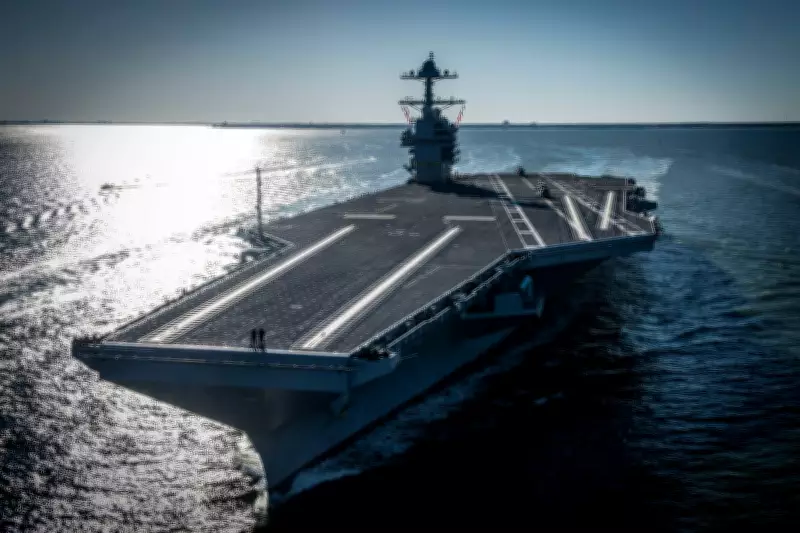
This threat coincides with the deployment of the world's largest aircraft carrier, the USS Gerald R Ford, which has entered the Mediterranean en route to the Middle East to join the USS Abraham Lincoln and guided-missile destroyers already stationed there for over two weeks. Khamenei cautioned the US against "forcing the result of talks in advance," labeling such actions as "wrong and foolish."

Iran's Military Drills and Nuclear Stance
In a show of strength, Iran executed live-fire naval exercises in the Strait of Hormuz, involving test missiles, warships, and helicopters. These drills, announced as the first closure of the waterway since the 1980s, aimed to display the "operational readiness" of the Iranian Revolutionary Guard Corps (IRGC) and plans for reciprocal action against potential threats. The strait is crucial, with approximately one-fifth of the world's oil passing through it.
Despite the aggressive military posture, Foreign Minister Araghchi expressed optimism about the nuclear talks, suggesting a new window for agreement had opened. However, he affirmed Iran's preparedness to defend itself, warning that consequences of any attack would extend beyond its borders. Conversely, Iran's President Masoud Pezeshkian firmly stated that Tehran would never abandon its nuclear programme, which includes uranium enrichment.
Regional Tensions and Historical Context
The situation is further complicated by recent incidents, including US forces shooting down an Iranian drone that approached the USS Lincoln last week, and Iran's attempt to stop a US-flagged ship in the Strait of Hormuz. Gulf Arab nations fear these escalations could spiral into a broader regional conflict.
Negotiations aim to limit Iran's nuclear activities, with the US seeking assurances it will not develop nuclear weapons. Iran maintains it is not pursuing weapons and has resisted demands to halt uranium enrichment or surrender its stockpile of highly-enriched uranium. Talks were previously halted by Israel's 12-day war against Iran in June, during which US bombings likely destroyed centrifuges used for near weapons-grade uranium enrichment. Prior to the conflict, Iran had enriched uranium up to 60% purity, close to weapons-grade levels.
Amidst these developments, Iran is observing a 40-day mourning period for victims of last month's protests, with activists reporting at least 7,015 deaths in the crackdown. This domestic unrest adds another layer of complexity to the international standoff.