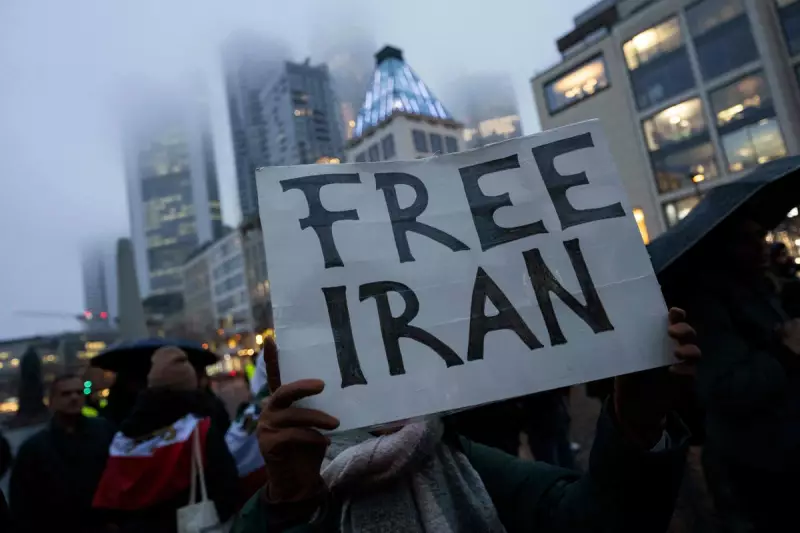
Iran is facing its most severe internal crisis in decades, as nationwide protests demanding the end of the Islamic Republic enter a third week. Anger over a collapsing economy and decades of authoritarian rule has exploded onto the streets of major cities, with demonstrators chanting "death to the dictator".
A Regime Under Siege and a Brutal Response
The government, still weakened from a devastating 12-day war with Israeli and US forces last year, has responded with extreme violence. An official told Reuters that as many as 2,000 people may have been killed and more than 10,000 arrested. A near-total communications blackout remains in effect, but shocking videos have emerged showing hundreds of bodies in a Tehran forensic facility.
The regime blames the deaths on riots and "domestic terrorists". For the first time, however, experts are calling this an existential threat to Iran's clerical rulers. The protests, while massive, have been largely non-violent, and there is no organised rebel army positioned to topple the state, unlike in Syria or Libya. This leaves the powerful Islamic Revolutionary Guard Corps (IRGC) firmly in control of the means of violence.
Four Possible Futures for Iran
As the crisis deepens, several potential outcomes are being debated by analysts and observers. The path Iran takes will depend on the balance of internal resistance, external pressure, and the regime's own calculations.
Scenario One: A Bloodier Crackdown and Stalemate
The most immediate possibility is that the protests are crushed through intensified repression. The fear is that demonstrations could fizzle out amid mass arrests, torture, and killings, especially without external intervention. As analyst Negar Mortazavi notes, while the regime faces a legitimacy crisis, it retains a monopoly on arms and power. Without a clear armed opposition, a sustained, bloody crackdown could allow the current leadership to retain control, albeit with its authority permanently damaged.
Scenario Two: US Military Strikes and Unpredictable Fallout
Former US President Donald Trump has renewed threats of military action and announced sweeping new sanctions, including 25% tariffs on nations trading with Iran. This could cripple Tehran's economy further. The question is whether a US or Israeli strike would help protesters or backfire.
Bilal Y Saab of Chatham House states the effects "could range from disaster to deliverance". A performative strike might harden the regime against demonstrators, who are already accused of being foreign agents. Even if Supreme Leader Ali Khamenei were killed, Iran's constitution has a plan for succession, and the IRGC could formally take over. It is unclear if Trump would commit to the prolonged occupation needed for full regime change.
Scenario Three: Cosmetic Reforms and Negotiations
The regime could seek to survive by offering vague economic reforms and shifting its rhetoric towards nationalism, coupled with direct negotiations with the US to avert strikes. This would fall far short of protesters' demands for overthrow but, combined with fear, could suppress mobilisation. Any hope of external support for the opposition would vanish if Washington is seen dealing directly with Tehran's top brass.
Scenario Four: The Unlikely Return of the Exiled Prince
The most improbable scenario involves the exiled Crown Prince Reza Pahlavi. Some protesters have chanted "long live the Shah", referencing the monarchy overthrown in 1979. Pahlavi, who has lived in the US for decades, has urged people to protest and outlined a 100-day transition plan, insisting it is "not about restoring the past" but securing a democratic future.
He has proposed a constitutional conference to devise a new settlement, potentially including federalism for ethnic minorities like Kurds and Balochis. However, Kurdish opposition figures are firmly against his return. Most experts deem this outcome very unlikely, as it would require enormous external intervention to install him, and his popularity among Iran's 90 million people is unclear.
A Nation at a Crossroads
Iran stands at a critical juncture. The regime is battling for its life against a population pushed to the brink, while external powers weigh intervention. The coming weeks will determine whether the protest movement can survive the crackdown, or if the entrenched power of the Revolutionary Guards will prevail once more. The world watches as one of the Middle East's most pivotal nations decides its fate.