Northern Israeli Town Under Renewed Rocket Fire After Brief Post-War Return
Northern Israel's largest city, Kiryat Shmona, situated directly on the Lebanese border, is once again facing relentless rocket attacks from both Hezbollah and Iranian forces. This renewed assault comes just months after residents had cautiously returned to their homes following the previous conflict's ceasefire.
"Constant War" Atmosphere Returns to Border Community
Gila Pahima represents the heartbreaking cycle facing northern Israeli communities. She returned to her Kiryat Shmona hometown last spring, eighteen months after the population had been evacuated due to Hezbollah rocket fire. Now, air raid sirens sound continuously throughout the day and night, with the constant boom of missiles and interceptors echoing overhead.
"I feel like we're in constant war," Pahima expressed with visible distress. "You feel like you're on a battlefield all day, every day."

From Ceasefire to Renewed Conflict
Israel appeared to have significantly weakened the Iran-backed Hezbollah when their last war concluded with a November 2024 ceasefire. Hezbollah's top leadership had been eliminated, hundreds of members were injured by booby-trapped communication devices, and much of southern Lebanon lay in ruins.
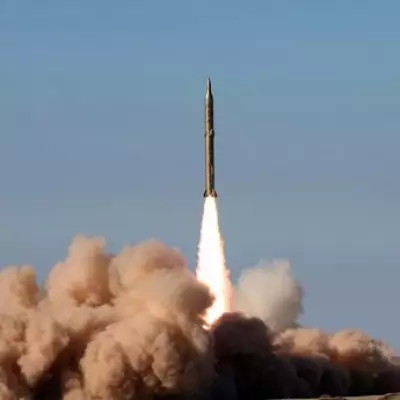
However, Hezbollah resumed rocket fire mere days after Israel and the United States launched attacks against its primary patron, Iran. Iran itself has subsequently launched multiple missile waves targeting Israeli territory.
While most Israelis support the war against Iran, hoping it might bring meaningful change to the Middle East, a profound sense of fatigue has settled across northern communities. Residents repeatedly race to bomb shelters or have taken up permanent residence within them, questioning whether airstrikes or ground incursions can ever establish lasting calm.
Residents Voice Anger and Despair
"You brought us here. You said, 'Hezbollah is weakened,'" declared Avraham Golan, a 79-year-old resident, addressing the Israeli government directly. "Where is it weakened? They are worse than what they used to be."
Golan, who immigrated from Iraq in 1951 and worked in local apple orchards, described nights as particularly harrowing. Explosions feel so proximate they seem to enter one's room directly, preventing more than two hours of consecutive sleep. During daylight hours, people venture out briefly between sirens to secure essential provisions.
The Israeli government evacuated approximately 60,000 people from northern communities when Hezbollah began firing missiles and drones in solidarity with Hamas following the October 7, 2023 attack. Residents only started returning after the Israel-Hezbollah ceasefire over a year later.
Shelter Life Becomes Permanent Reality
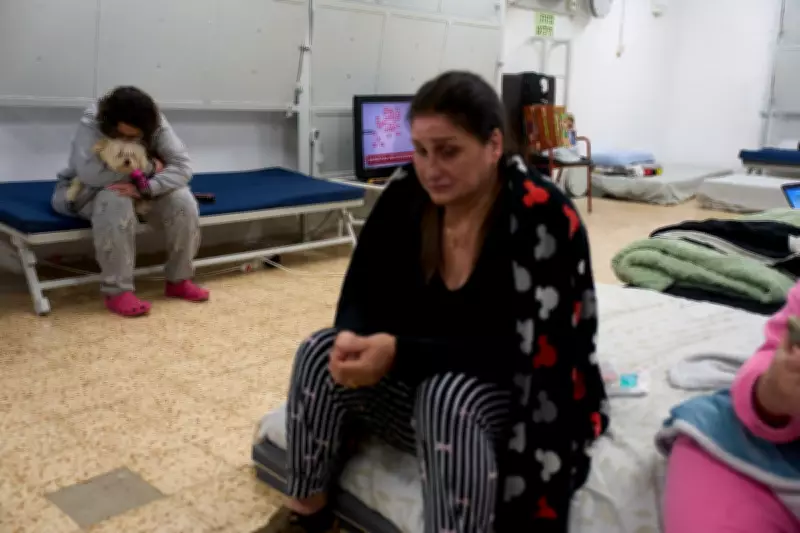
Bruria Danino, 61, moved into a neighborhood shelter with her extended family after breaking her nose while rushing there in darkness during the conflict's early days. For the past two weeks, three families have shared the confined space where steel bunk beds fold down from walls.
When missile alerts interrupt her grandson's online classes, he casually switches to cartoons on his iPad, curling up on an inflatable mattress. "They promised us a few years of quiet, but after ten months, it's the same situation," Danino lamented.
Her daughter, Hodaya, described the experience as resembling a "horror movie," challenging the narrative of Israeli resilience. "People say Israel's homefront is so strong, but we're not strong, we all have post-trauma," she revealed.
Military Response and Humanitarian Consequences
Israel has launched punishing waves of airstrikes targeting southern Lebanon and Beirut's southern suburbs, areas with significant Hezbollah presence but also home to hundreds of thousands of Lebanese civilians. Israeli ground troops have advanced deeper into southern Lebanon while issuing extensive evacuation warnings.
These strikes have killed hundreds of Lebanese citizens, with over one million displaced from their homes. Israeli Defense Minister Israel Katz has declared none will return until northern Israel achieves safety and calm. Meanwhile, Iranian missiles have killed at least twelve people in Israel, with two soldiers lost in southern Lebanon combat.

Uncertain Future for Border Communities
Pahima, who raised four sons in Kiryat Shmona, cherishes the surrounding greenery and the city's tranquil pace, distinct from Israel's bustling center. She now fears the community may never recover its former character.
Many evacuated residents, particularly families with children, never returned. While the city refuses to release official numbers, Pahima and others estimate at least half have remained away. Geographic isolation already challenged Kiryat Shmona, and the conflict has further diminished opportunities for young people.
"Maybe it will calm down for a few years," Pahima speculated with weary resignation. "But then war will come back." This sentiment captures the cyclical despair gripping northern Israel as rockets continue to fly over communities that had just begun rebuilding.