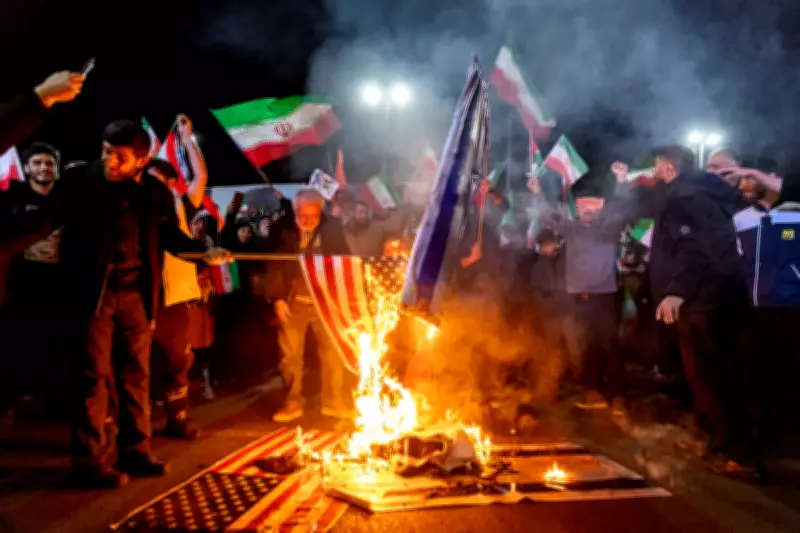
Israel's Strategy of Eliminating Iranian Leaders Under Intense Scrutiny
Israel's ongoing campaign of targeted airstrikes against senior Iranian leadership figures, designed to destabilize and ultimately topple the Islamic Republic, is facing significant critical examination. Historical precedents and expert analysis suggest such decapitation strategies possess inherent limitations and carry substantial risks of backfiring, potentially strengthening rather than weakening adversarial groups.
Historical Precedents Show Limited Long-Term Success
Previous military operations provide cautionary tales. The killing of Hezbollah's leader Hassan Nasrallah did not halt the group's rocket attacks on Israel. Similarly, the systematic elimination of Hamas's top leadership has failed to disarm the organization, which continues to exert control over significant portions of Gaza. These outcomes underscore a recurring theme: while targeted killings offer tangible, short-term victories in conflicts without clear conclusions, they rarely address the foundational grievances that fuel such groups.
Jon Alterman, Chair of Global Security and Geostrategy at the Center for Strategic and International Studies, emphasized this point, noting the impact of such strikes "often fades over time." He highlighted the resilience of Iran's governmental and military structures, which comprise several overlapping institutions that have endured successive waves of punishing strikes from both the United States and Israel. "Even dictators need to rely on entire networks that support them," Alterman stated, suggesting the system often survives the loss of individual figures.

Iran's Response and Leadership Transition
The conflict's opening salvo resulted in the death of Iran's Supreme Leader, Ayatollah Ali Khamenei. He has been succeeded by his son, Mojtaba Khamenei, who is perceived by analysts as an even less compromising figure. Despite the loss of top commanders, Iran's Revolutionary Guard has sustained its military campaign, launching repeated missile barrages at Israel and neighboring Gulf states while effectively restricting traffic through the critical Strait of Hormuz.
Israel possesses a long history of employing targeted killings, yet Palestinian and Lebanese militant organizations have frequently demonstrated an ability to endure, adapt, and sometimes emerge more potent following the loss of senior figures. The case of Hezbollah is instructive. After Israel assassinated its then-leader Abbas Musawi in 1992, the group, under the charismatic leadership of Hassan Nasrallah, evolved into the region's most formidable armed faction, engaging Israel in a brutal stalemate during the 2006 war.
Similarly, Hamas has persisted despite losing generations of leaders, from its founder Sheikh Ahmed Yassin in 2004 to nearly all the architects of its October 7, 2023, attack. Both groups continue their campaigns, driven by deep-seated, decades-old grievances rooted in the Israeli-Palestinian conflict.
Broader Context and Strategic Aims
Israeli Prime Minister Benjamin Netanyahu has framed the elimination of Iran's leaders as a strategy to weaken the Tehran government, theoretically enabling a popular uprising that could overthrow the regime and install a pro-Western administration. However, no significant internal revolt has materialized since the war's onset, following the Iranian government's suppression of mass protests earlier in the year.
Former U.S. President Donald Trump has occasionally suggested the conflict aims to elevate a more moderate Iranian leader. However, experts warn the potential outcomes could instead be a more radical leadership or outright state collapse and chaos, drawing parallels to historical interventions in Congo, Libya, and Iraq that led to prolonged instability.

Expert Analysis on Efficacy and Risks
Yossi Kuperwasser, former head of Israel's military intelligence research division, described targeted killings as an effective tool but "not a cure for all problems." He acknowledged that such operations alone do not dramatically cripple an organization's operational capacity but are important for weakening enemies. He noted Israel's campaigns have "reshaped the leadership structure in lasting ways" in Gaza, Lebanon, and Iran, suggesting a "change in regime" personnel, if not full regime change.
Conversely, the strategy carries significant risks. Max Abrahms, a political scientist at Northeastern University, cited data from multiple conflict zones showing that violence against civilians often increases following targeted killings. "Leadership decapitation is risky," Abrahms explained. "When you take out a leader that prefers some degree of restraint... there's a very good chance that, upon that person's death, you're going to see even more extreme tactics." Eliminating leaders can radicalize followers, elevate more extreme successors, or transform the deceased into powerful martyrs.
Mohanad Hage Ali, Deputy Director of the Carnegie Middle East Center in Beirut, stressed that creating leadership vacuums only leads to meaningful change when paired with a coherent political strategy. "You can decapitate an organization or defeat it militarily, but if you don't follow through politically, it doesn't work," he stated, expressing skepticism about the current campaign's potential for further strategic success.
A senior Israeli intelligence official, speaking anonymously to The Associated Press, contended that Israel's decapitation strikes in Iran have degraded the political leadership's ability to command the military and formulate policy. Nonetheless, the overarching consensus among analysts indicates that while targeted killings can deliver tactical blows, they are an incomplete and potentially counterproductive instrument for achieving lasting strategic objectives in complex geopolitical conflicts.