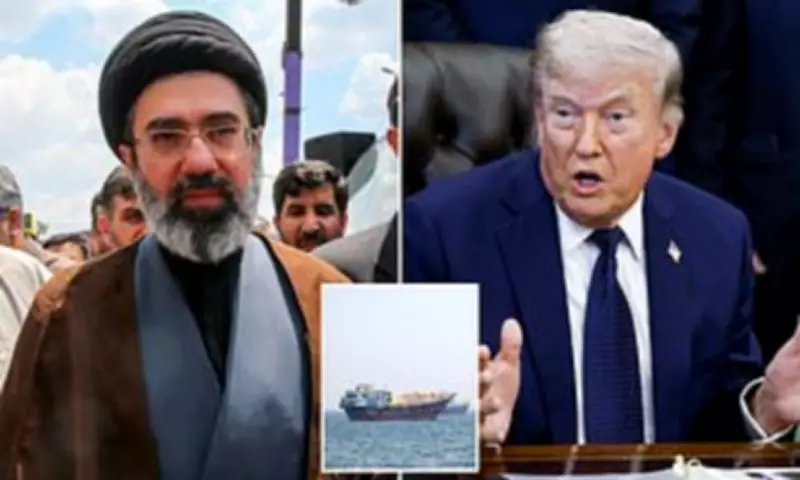
Ayatollah Mojtaba Khamenei has declared the 'only place' for the US in the Persian Gulf is at the 'bottom of its waters' as he insisted the US has suffered a 'disgraceful defeat.' Iran's Supreme Leader claimed a new chapter for the Gulf and Strait of Hormuz has been taking shape without America following what he described as the US's 'shameful failure' over the waterway.
Khamenei's Statement
In a published written message to commemorate National Persian Gulf Day, Khamenei said: 'Today, two months after the largest military deployment and aggression by the world's bullies in the region, and the United States' disgraceful defeat in its plans, a new chapter is unfolding for the Persian Gulf and the Strait of Hormuz.'
'We and our neighbours across the waters of the Persian Gulf and the (Gulf) of Oman share a common destiny. Foreigners who come from thousands of kilometres away to act with greed and malice there have no place in it - except at the bottom of its waters,' he added.

US Bases and Regional Security
Khamenei, who hasn't been seen or heard since he was appointed the supreme leader following the death of his father Ali, also said US bases in the region 'lack even the capacity to ensure their own security, let alone provide any hope of securing their allies.' He hailed what he called Iran's 'new legal framework and management' of the strategic Strait of Hormuz, a key energy chokepoint, as a means to bring 'comfort and progress' for countries in the region.
Khamenei also lauded the people of Iran who he said 'consider all national capacities - identity, spiritual, human, scientific, industrial, and advanced technologies from nano and bio to nuclear and missile - as their national capital'. He referred to America as the 'Great Satan', a long hurled insult by Iranian leaders towards the US since the 1979 Islamic Revolution.
US Military Plans
It comes as the US military will brief Trump on new plans for potential strikes on Iran aimed at ending the stand-off which has resulted in the effective closure of the Strait of Hormuz to commercial shipping. US news outlet Axios reported that Donald Trump is considering launching more strikes on Iran to break the peace talks deadlock.
CENTCOM chief Admiral Brad Cooper is set to present a plan for a 'short and powerful' wave of strikes against Iran that would likely target key infrastructure. The aim of this would be to either break the deadlock on peace talks, or deliver a killing blow against Iran.
Hypersonic Missiles and Blockade
US Central Command is pushing to deploy Dark Eagle hypersonic missiles to the Middle East, a source told Bloomberg. They want a long-range option capable of striking Iranian ballistic missile launchers located deep within the country. The Dark Eagle, has a reported range of 1,725 miles and is deliberately made for 'long range conventional precision strike capability' against 'time-sensitive and heavily defended targets.' If greenlit, this would be the first time the US has deployed a Dark Eagle hypersonic missile of which there are no more than eight, according to the source.
Trump is also being presented a plan to take over part of the Strait of Hormuz with the US military in order to restore global shipping. This plan may require US soldiers to be sent to the Middle East, Axios reports. On Tuesday, the State Department sent an internal cable to US embassies calling on diplomats to convince governments around the world to join the 'Maritime Freedom Construct,' a US-led bloc to share information, coordinate diplomatically, and enforce sanctions to unblock the vital waterway, the Wall Street Journal has reported. The coalition will see the State Department serving as a 'diplomatic operations hub' and the US Central Command providing 'real-time maritime domain awareness.'

Another plan that is being discussed is a possible special forces operation to secure Iran's stockpile of enriched uranium. Trump also warned that a US naval blockade against Iran could last months, leading oil prices to spike to their highest level in more than four years. International benchmark Brent crude soared more than 7 percent to $126 a barrel on Thursday, but then eased in midday trading in London. 'The world is facing the biggest energy crisis in history,' International Energy Agency chief Fatih Birol said at a high-level meeting on the energy transition at IEA headquarters in Paris, adding that oil prices were 'putting a lot of pressure in many countries'.
Iran's Response
Meeting oil executives, Trump contended that the blockade of Iranian ports - which Tehran has demanded must end before any deal - was more effective than bombing. The President has told national security officials to prepare for a long blockade of Iran's ports in order to compel Tehran to give up its nuclear programme, according to the Wall Street Journal. Trump, according to the report, does not believe that Iran is negotiating in good faith and hopes it can be forced to suspend uranium enrichment for 20 years and accept tight restrictions thereafter.
Meanwhile, Iran's President Masoud Pezeshkian claimed the US naval blockade on Iranian ports is 'doomed to fail'. Pezeshkian said targeting Iran's ports will deepen disruptions in the Gulf and fail to achieve its targets. 'Any attempt to impose a maritime blockade or restrictions is contrary to international law… and is doomed to fail,' he said in a statement. He also blamed the US and Israel for the ongoing blockade in the Strait of Hormuz, again defending the decision to keep out 'hostile countries'. In a message commemorating National Persian Gulf Day on state media, Pezeskhian said the waterway was 'a symbol of the great Iranian nation’s resistance'.
Iran further threatened to 'respond' if the blockade continues. On Wednesday, the military adviser to Mojtaba Khamenei reiterated the warning, without elaborating. 'We will not tolerate the naval blockade. If it continues, Iran will respond,' Mohsen Rezaei, a former commander-in-chief of Iran's Revolutionary Guards who was named as a military adviser by Khamenei in March told state television. He also warned against a new round of fighting between the US and Iran, saying it could possibly see US ships sunk and 'its soldiers will be killed.' 'If the US starts another war, it should expect that we take a large number of them prisoner,' he added.