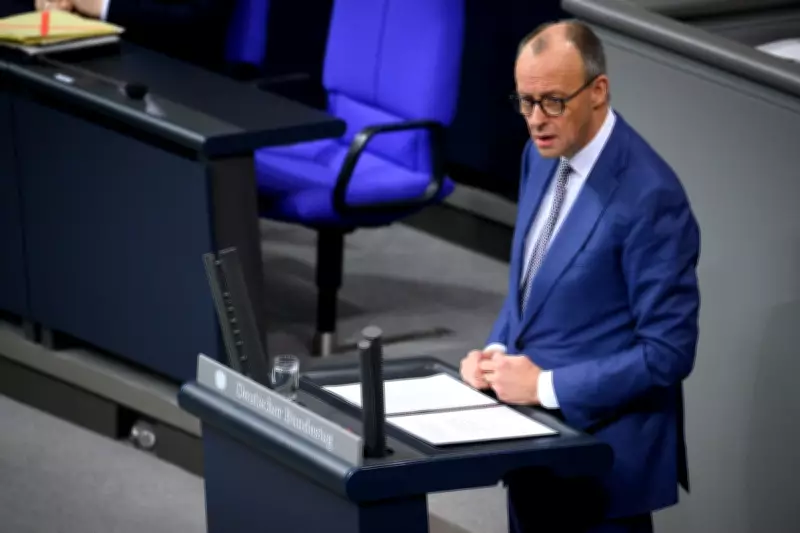
German Chancellor Friedrich Merz has delivered a robust defence of the European Union's global role, characterising the bloc as a vital "alternative to imperialism and autocracy" in an era marked by intensifying great power rivalry. Addressing the Bundestag on Thursday, Merz outlined a vision for a Europe that asserts itself through partnerships based on mutual respect while strengthening its own strategic autonomy.
A European Model for a Changing World
Merz observed that the international landscape is shifting decisively towards a "world of great powers," where a "harsh wind is blowing." He argued that this challenging environment simultaneously presents significant opportunities for the EU. Democracies with open and expanding markets, he suggested, are actively seeking what Europe can provide: reliable partnerships founded on trust and reciprocal respect.
"We should not underestimate how attractive this European model can be for new partners and new alliances," Merz told German lawmakers. He emphasised that the EU represents a "normative alternative" to authoritarian systems, positioning its values and cooperative framework as a compelling global offer.
Asserting Sovereignty and Unity
The Chancellor pointed to recent events as evidence of European resilience. He highlighted the EU's collective response to external pressure, specifically noting that the bloc had agreed "not to be intimidated again by tariff threats." This statement followed the recent withdrawal of US tariff threats against Germany and seven other European nations, which had been linked to US ambitions regarding Greenland.
Merz stressed the indispensable value of unity within the often-fractions 27-nation union, praising its demonstrated capacity for swift action. However, he also issued a call for Europe to master the "language of power politics" to secure its interests. This entails assuming greater responsibility for its own security, pursuing enhanced "technological independence," and fostering stronger economic growth.
Navigating Trans-Atlantic Relations
While advocating for a more assertive Europe, Merz reaffirmed the enduring importance of the NATO alliance and trans-Atlantic cooperation. He underscored that Europe is committed to intensifying its defence contributions within NATO and will "always reach out the hand of cooperation to the United States of America."
Nevertheless, he firmly stated that this partnership must be one of equals. "The basis of this guiding principle remains... as democracies, we are partners and allies and not subordinates," Merz declared, subtly pushing back against any perception of European subordination.
Defending Allied Contributions
The Chancellor also addressed recent controversies surrounding NATO's mission in Afghanistan. Without directly naming former US President Donald Trump, Merz countered assertions that non-US NATO troops avoided frontline duties. He noted the sacrifice of 59 German troops who died and over 100 wounded during Germany's nearly two-decade deployment.
"We will not allow this deployment, which we also performed in the interest of our ally, the United States of America, to be disparaged and demeaned today," Merz stated, defending the contributions and sacrifices of European allies.
Forging New Economic Partnerships
Aligning with his vision of a proactive EU, Merz expressed strong support for expanding the bloc's network of trade agreements. He cited ongoing negotiations with South America's Mercosur bloc and a newly struck deal with India as exemplars of this strategy. These agreements are framed as part of Europe's effort to build alliances with like-minded partners across the globe.
Merz concluded by balancing the pursuit of new alliances with the preservation of existing ones, remarking that "trans-Atlantic trust is a value in itself even today." His speech collectively painted a picture of a European Union poised to navigate a turbulent world order by leveraging its democratic values, economic strength, and renewed political unity as its defining assets.