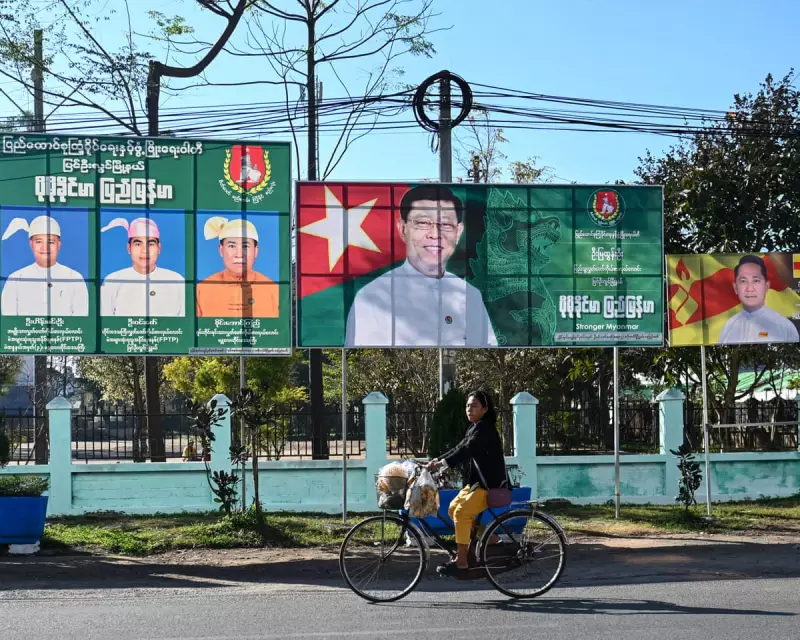
Myanmar's military rulers are preparing to hold a general election this Sunday, 28 December, in a move widely condemned by the international community as a sham designed to legitimise their grip on power. It will be the first vote since the military seized control in a coup in 2021.
A Vote Designed for Legitimacy, Not Democracy
The election is not seen as a step towards democracy but as a strategic ploy by the ruling generals. The military has rejected criticism, with junta spokesperson Zaw Min Tun stating the vote is "for the people of Myanmar, not for the international community." However, pro-democracy activists and analysts strongly disagree.
"This is not for the people, this is for themselves," said Pai, a 25-year-old who fled Myanmar after the coup. "They are looking for a way out of the trap they are in." The military hopes the poll will repair its image as an international pariah, though Western governments and the UN have dismissed it as illegitimate.
Exclusions, Repression, and a Hollow Ballot
The electoral process is marred by severe restrictions and repression. Aung San Suu Kyi's National League for Democracy (NLD), which won a landslide in 2020, has been dissolved. According to the monitoring group Anfrel, 57% of parties from the 2020 election no longer exist, despite having won over 70% of votes.
Only six parties are running nationwide, with the military-backed Union Solidarity and Development Party fielding the most candidates. A new election protection law imposes a minimum three-year prison sentence, or even the death penalty, for criticising the vote. Since July, over 200 people have been arrested, including for liking social media posts.
Furthermore, voting will not occur in 56 of 330 townships, with cancellations in an additional 3,000 wards. Analysts estimate roughly one-third of the country will be excluded, illustrating the significant territory the junta has lost to opposition groups since the coup.
Intensifying Conflict and Foreign Backing
The run-up to the election has seen the conflict intensify. Data from Acled shows military air and drone strikes increased by about 30% from 1 January to 28 November 2025 compared to 2024. Civilian infrastructure, including schools and hospitals, are frequent targets.
In a desperate bid to boost its ranks, the military has increased conscription-related abductions by 26%. Young people in cities like Yangon are fleeing to avoid forced service. Despite this, support from China has been crucial for the junta. Beijing, viewing the election as a path to stability, has helped the military regain momentum by cutting supplies to ethnic armed groups in northern Shan state.
Richard Horsey, senior Myanmar adviser at the Crisis Group, stated the military is determined to claw back lost territory. Any post-election ceasefires would be tactical, allowing it to concentrate forces elsewhere. "This isn't about a new civilian government shifting to a more soft approach," he said.
The election, held in three phases, is set against a backdrop of widespread violence and fear, with the junta's ultimate goal being the consolidation of its authority rather than a genuine democratic transition.