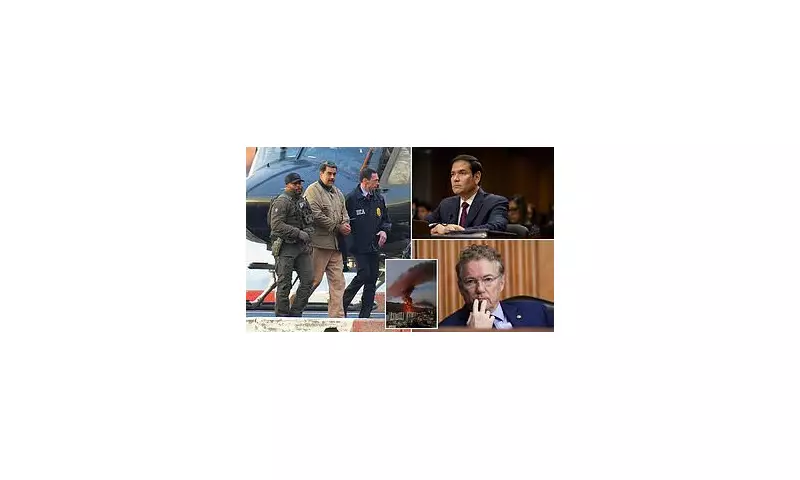
Senate Hearing Erupts Over Venezuela Operation Definition
Republican Senator Rand Paul launched a pointed critique of Donald Trump's foreign policy approach during a tense Senate Foreign Relations Committee hearing on Wednesday. The Kentucky lawmaker directly challenged Secretary of State Marco Rubio over the United States' controversial capture of Venezuelan leader Nicolas Maduro earlier this month.
Hypothetical War Scenario Questioned
Paul posed a provocative hypothetical scenario to Rubio, asking: "If a foreign country bombed our air defense missiles, captured and removed our president, and blockaded our country, would that be considered an act of war?" This question directly referenced Operation Absolute Resolve, the January 3rd operation that resulted in Maduro's capture alongside his wife, Cilia Flores.
The Department of Justice has consistently described the mission as a law enforcement operation targeting individuals indicted on drug trafficking charges, rather than a military action against Venezuela's government. Maduro and his wife were subsequently transported to New York to face these charges, which they continue to deny.
Rubio Defends Administration's Position
Secretary Rubio firmly pushed back against Paul's characterization, arguing that the senator was presenting an unlikely hypothetical situation. "It's hard for us to conceive that an operation that lasted about four and a half hours and was a law enforcement operation to capture someone we don't recognize as a head of state indicted in the United States," Rubio stated during the hearing.
Paul countered this defense by questioning the broader implications, suggesting that what the administration called a "drug bust" could potentially "lead to chaos." He pressed further: "My question would be if it only took four hours to take our President. It's very short. Nobody dies on the other side. Nobody dies on our side. It's perfect. Would it be an act of war?"
Constitutional Definitions and War Powers
Rubio maintained the Trump administration's official line, insisting: "We just don't believe that this operation comes anywhere close to the constitutional definition of war." This exchange occurred against the backdrop of Paul's ongoing efforts to restrain presidential military authority, having recently co-sponsored a War Powers resolution with Democratic Senator Tim Kaine.
That resolution reached a full Senate vote earlier this month but resulted in a tie, preventing it from moving forward. President Trump has criticized such legislative moves, claiming they "greatly hamper American Self Defense and National Security, impeding the President's Authority as Commander in Chief."
Diplomatic Developments and Future Engagement
During his testimony, Rubio expressed optimism about renewed diplomatic engagement with Venezuela, revealing that he expects the US embassy in Caracas to reopen soon. "I can tell you right now with full certainty we are not postured to, nor do we intend or expect to, have to take any military action in Venezuela," the Secretary of State assured committee members.
He added: "The only military presence you'll see in Venezuela is our Marine guards at an embassy." This statement followed the State Department's recent appointment of senior diplomat Laura Dogu as the top US official for Venezuela and an assessment mission to the Caracas embassy compound.
Political Fallout and Congressional Criticism
The operation has drawn significant criticism from Democratic committee members. Senator Jeanne Shaheen, the panel's top Democrat, noted that the mission has cost "at least hundreds of millions of dollars" while questioning its effectiveness, stating that "the Maduro regime is essentially still in power."
Senator Chris Van Hollen went further, suggesting potential ulterior motives by referencing President Trump's meetings with oil executives and questioning whether the operation was ordered for personal benefit. "By any measure, this is the most corrupt administration in American history," Van Hollen declared during the hearing.
Venezuela's Response and Leadership Transition
Following Maduro's capture, interim president Delcy Rodriguez has delivered her first annual address to Venezuela's National Assembly. Rodriguez has insisted that she has "had enough of orders from Washington" while simultaneously working to encourage US oil investment and secure the unblocking of sanctioned Venezuelan funds.
Venezuelan officials claim the operation resulted in more than 100 fatalities among Venezuelan and Cuban personnel who attempted to protect Maduro. Secretary Rubio, however, characterized the tactical operation as successful precisely because no American lives were lost.
Opposition Dynamics and Future Meetings
President Trump initially appeared dismissive of Venezuela's democratic opposition leader Maria Corina Machado, describing her as a "very nice woman" who didn't command "respect." However, his position shifted following her White House visit, during which she presented him with her Nobel Peace Prize—an honor Trump has publicly coveted.
Rubio, a Cuban-American senator known for his criticism of Latin American leftist governments, has historically championed opposition forces aligned with Machado. Following Wednesday's testimony, the Secretary of State is scheduled to meet with Machado again in a closed-door session, signaling continued engagement with Venezuela's political opposition despite the complexities of the current situation.