Mexican President Weighs Legal Response to Elon Musk's Cartel Allegations
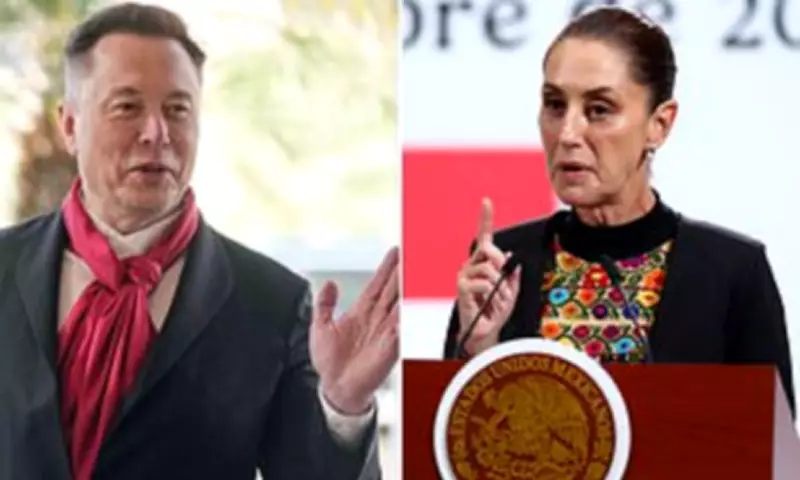
Mexican President Claudia Sheinbaum announced on Tuesday that she is contemplating legal measures in response to comments made by billionaire entrepreneur Elon Musk. Musk alleged on his social media platform X that Sheinbaum has connections to drug cartels, a claim she strongly denies.
Controversial Social Media Post Follows Major Security Operation
The controversy erupted after Mexican security forces captured and killed Nemesio Oseguera, known as 'El Mencho,' the leader of the Jalisco New Generation Cartel (CJNG). Following this operation, Musk responded to a 2025 video of Sheinbaum discussing cartel violence by asserting she was 'saying what her cartel bosses tell her to say.' He provided no evidence to support this allegation.
'We are considering whether to take legal action,' Sheinbaum stated during her regular morning press conference. She confirmed that government legal teams are currently reviewing the matter to determine the appropriate course of action.

Legal Hurdles in Potential Defamation Case
Legal experts suggest Sheinbaum would face significant challenges pursuing a defamation case against Musk in United States courts. American law provides robust protections for free speech, making such cases difficult to win. To succeed, Sheinbaum would need to demonstrate that Musk knowingly made false statements or acted with reckless disregard for the truth.
Tesla, the automotive company founded by Musk, has not yet responded to requests for comment regarding Sheinbaum's statements about potential legal action.
Sheinbaum's Security Strategy and Cartel Violence Context
In the 2025 video referenced by Musk, Sheinbaum argued against returning to a 'war on drugs' approach, stating that such strategies fall 'outside the framework of the law.' She referenced the military offensive against cartels initiated by former President Felipe Calderón in 2006, which many analysts believe led to increased violence as criminal organizations fragmented and fought for territory.
Sheinbaum expressed confidence that security would continue to normalize in Mexico despite coordinated roadblocks and arson attacks by cartel members following the operation against Oseguera. She emphasized that her administration seeks 'peace, not war,' even when detaining high-profile criminal suspects.
Political Reactions and Broader Implications
Luisa Alcalde, president of the ruling MORENA Party, criticized Musk's comments on social media, urging him to use his platform to combat drug consumption, addiction, and misinformation instead of promoting what she called 'narco culture.' She asserted that 'wealth does not give moral authority' and highlighted the human cost of drug-related violence.
Mexico continues to grapple with significant violence linked to drug cartels, with over 130,000 people currently missing. Much of this violence is connected to cartels that sell products to and obtain firearms from the United States.
Operation Against 'El Mencho' and Aftermath
The operation that killed Nemesio 'El Mencho' Oseguera Cervantes involved Mexican federal forces acting on intelligence from both Mexican and US agencies. Authorities tracked the cartel leader to a secluded forest cabin in Tapalpa, a mountain retreat in western Jalisco state, where he was meeting a girlfriend.
Early on Sunday morning, elite Mexican army and National Guard special-operations soldiers descended on the area. A confrontation ensued when El Mencho's bodyguards, armed with rocket launchers, fired on the troops. Eight people died in the exchange, including El Mencho and two of his operatives who later succumbed to injuries while being transported by military helicopter.
General Ricardo Trevilla, Mexico's Defense Secretary, explained that intelligence gathering was 'very complex' and required information from multiple national and international sources. The operation resulted in the seizure of heavy weapons, ammunition, two rocket launchers, and eight vehicles used by cartel members.

Cartel Retaliation and Government Response
Following El Mencho's death, cartel members coordinated attacks across at least 20 Mexican states, plunging regions into chaos. Over 50 people died during this counteroffensive. Sheinbaum praised the military operation while emphasizing that all planning and execution was handled by Mexican forces without direct US involvement on the ground.
'There is calm, there is government, there are armed forces, and there is a lot of co-ordination,' Sheinbaum stated, reiterating her commitment to peace and security across Mexico. The United States had offered a $15 million bounty for El Mencho, highlighting his status as one of Mexico's most wanted criminals and the CJNG's reputation as one of the country's most feared criminal organizations.