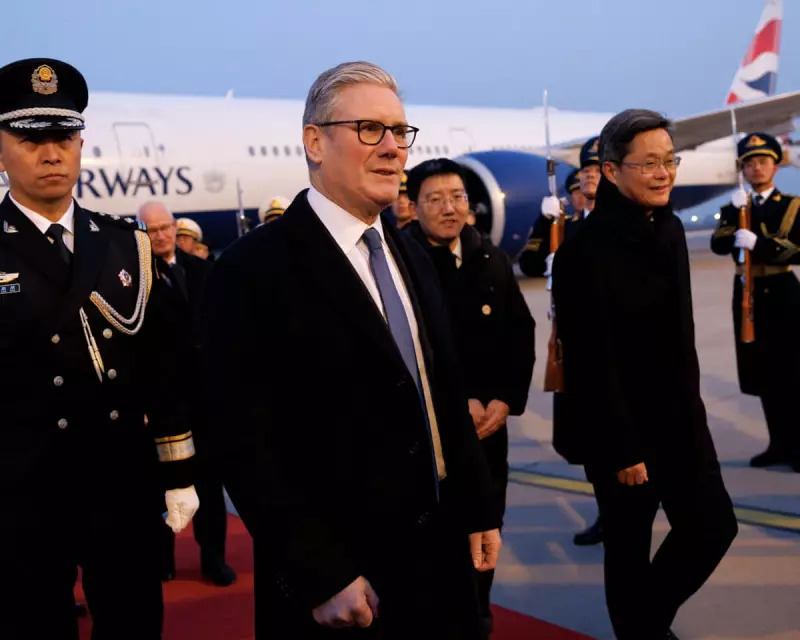
Prime Minister Keir Starmer's arrival in Beijing on 28 January 2026 marks a significant moment in UK-China relations, representing the first visit by a British prime minister to the Chinese capital in eight years. The trip underscores a delicate diplomatic balancing act, as Sir Keir seeks to engage with a global superpower while navigating profound political and ethical contradictions.
The Strategic Imperative for Engagement
China's formidable economic and technological stature makes dialogue not just desirable but essential. Accounting for nearly a fifth of global GDP, with manufacturing output surpassing the combined total of all G7 nations, China is an undeniable powerhouse. Its leadership in artificial intelligence and green energy technology further cements its position as a critical player on the world stage.
Sir Keir has rightly pointed out that Britain had become an outlier in Europe by allowing such a lengthy gap between prime ministerial visits. Refusing to engage would be irrational, given the scale of commercial opportunity. Critics from the Conservative benches, who have accused the prime minister of performing a "kowtow" to President Xi Jinping, often fail to propose viable alternatives to cautious engagement.
The Complex Backdrop of Global Politics
The visit occurs against an ominous geopolitical backdrop. The challenges posed by China's rise are compounded by the unpredictable behaviour of the United States under Donald Trump. His administration's sabotage of NATO and imposition of scattergun tariffs have scrambled traditional strategic calculations, leaving the UK to navigate a more independent path.
Historically, Britain's relationship with Beijing has been anchored by its alliance with Washington. With that anchor now less reliable, Sir Keir faces the difficult task of establishing a UK-China dynamic that serves British interests without compromising fundamental values.
Points of Profound Disagreement
Engagement must not come at the expense of principle. Several critical issues demand attention and cannot be brushed aside in pursuit of investment:
- The systematic dismantling of civil rights in Hong Kong
- The imprisonment of Jimmy Lai, a pro-democracy businessman and British citizen
- The repression of the Uyghur minority, which some Labour MPs previously described as genocide
- Beijing's support for Vladimir Putin's war on Ukraine
- Aggressive espionage activities described by a former MI6 chief as a "full press"
- Intimidation of dissidents within Britain's Chinese diaspora
Sir Keir has pledged to "raise what needs to be raised" with President Xi – a standard diplomatic formulation that allows for the mention of delicate topics without guaranteeing substantive discussion.
The Inevitable Tensions of Dual Objectives
In a foreign policy exposition last year, the prime minister insisted that engagement with China would never lead him to "trade off security in one area, for a bit more economic access somewhere else." This represents a fine ambition, but in practice, the drive for commercial intimacy and the requirement for strategic wariness will inevitably create tensions.
Sir Keir has previous form when it comes to denying the existence of such conflicts of interest. He refuses to accept, for example, that his courtship of President Trump and his reset of relations with the European Union pull Britain in different directions.
The contradiction between upholding democratic values and befriending President Xi is even more stark. This is not a reason to refuse engagement, but it will take more than pre-summit assurances from the prime minister to prove that he can successfully navigate this diplomatic tightrope.
The Beijing visit represents both opportunity and risk. While commercial engagement with China's growing economy offers potential benefits for Britain, the prime minister must demonstrate that he can pursue these opportunities without compromising on security or values. The world will be watching to see if Sir Keir Starmer can achieve what he has promised: a balanced approach that serves British interests while maintaining principled stands on critical issues.