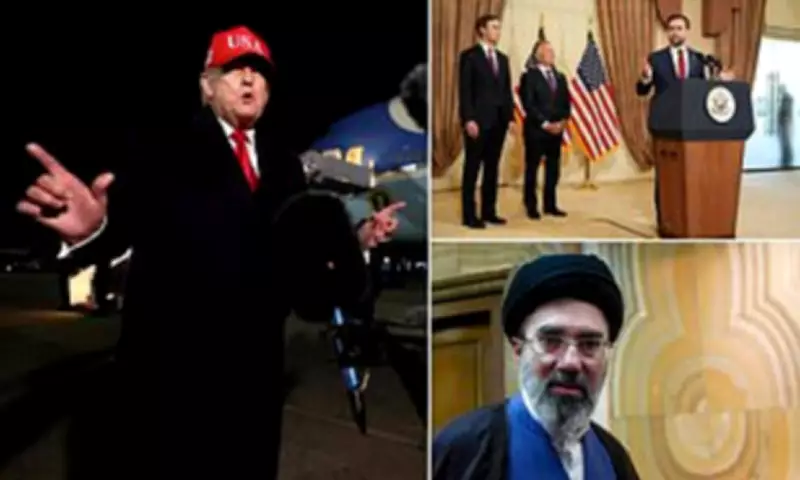
President Donald Trump disclosed on Sunday evening that Iran exhibited desperation during recent peace negotiations, with discussions collapsing after Tehran insisted on acquiring nuclear weapons. Speaking to reporters at Joint Base Andrews upon exiting Air Force One, Trump asserted his unwavering commitment to preventing Iran from obtaining nuclear capabilities.
Nuclear Demand Derails Islamabad Talks
Trump revealed that Iranian officials made their nuclear ambitions explicit during talks in Islamabad, Pakistan. "They still want it, and they made that clear the other night," the commander-in-chief stated regarding discussions involving Vice President JD Vance. "I think Iran is in very bad shape. I think they're pretty desperate. Iran will not have a nuclear weapon."
This stance follows Iran's inclusion of uranium enrichment rights in a ten-point peace proposal submitted ahead of the weekend negotiations. White House Press Secretary Karoline Leavitt later clarified that the publicly released Iranian proposal differed from what was presented to the president, emphasizing that Trump's "red lines, namely the end of Iranian enrichment in Iran, have not changed."

Vance's Diplomatic Efforts
Vice President JD Vance traveled to Islamabad with Special Envoys Jared Kushner and Steve Witkoff for the peace talks. A US official familiar with the deliberations told The Daily Mail that Iranian negotiators initially misunderstood America's core objective: ensuring Iran never obtains nuclear weapons. Vance reportedly corrected this misunderstanding and probed Iranian assessments of their positions.
Despite the breakdown, Vance reportedly believes a deal remains possible, contingent on Iranian acceptance. When questioned about Iran's potential return to negotiations, Trump responded dismissively: "I don't care if they come back or not. If they don't come back, I'm fine."
Strait of Hormuz Blockade Announced
In response to the failed talks, Trump announced a US blockade of ships attempting to enter the Strait of Hormuz, scheduled to commence at 10am ET on Monday. The narrow waterway facilitates approximately one-fifth of global oil transportation. Vessels traveling to and from non-Iranian ports will not be impeded.
Trump instructed the US Navy "to seek and interdict every vessel in International Waters that has paid a toll to Iran," warning on Truth Social: "No one who pays an illegal toll will have safe passage on the high seas. Any Iranian who fires at us, or at peaceful vessels, will be BLOWN TO HELL!"
Iranian Retaliation Threats
Iranian Supreme Leader Mojtaba Khamenei swiftly countered, claiming Iran possesses "large, untouched levers" to retaliate against the blockade, dismissing "tweets and imaginary plans." Parliament Speaker Mohammad Bagher Ghalibaf, who led Iranian negotiations with Vance, warned Americans would soon "be nostalgic for $4-$5 gas," according to The New York Times.
Tehran has also cautioned about possible antiship mines, urging vessels to follow new coastal routes with Revolutionary Guard guidance and threatening destruction of unauthorized ships entering the strait.
Oil Prices Surge Following Announcement
Oil prices rose sharply in early Sunday night trading after the blockade announcement. US crude oil increased eight percent to $104.24 per barrel, while Brent crude oil, the international benchmark, rose seven percent to $102.29. Brent crude has experienced dramatic fluctuations during the month-long Iran conflict, rising from approximately $70 per barrel before late February hostilities to over $119 at times.
Rachel Ziemba of the Center for a New American Progress suggested negotiation opportunities have diminished: "The de-escalation window for the global economy, such as it was, is over for now. Iran is betting they can hold out longer than the US and the global economy."
Military Assessments and Risks
Trump claimed the Iranian Navy threat is "gone" from the waterway following US military actions since February 28, stating: "Their military is destroyed. Their whole navy is underwater. You know that 158 ships are gone? Their navy is gone. Most of their mine-droppers are gone."

However, experts warn smaller Iranian boats controlling the strait remain operational. David Des Roches, a former Department of Defense director for Persian Gulf policy, noted these vessels are adept at controlling the chokepoint through missiles, mines, and commercial ship harassment. This poses significant risks to US servicemen in the narrow, approximately 35-kilometer-wide waterway.
Lloyd's List Intelligence reported all traffic through the strait ceased following Trump's announcement, with two vessels turning around instead of exiting.
NATO Relations Strained
During a Fox News Sunday Morning Futures interview, Trump claimed NATO would "begrudgingly" support US efforts to secure the strait, while calling the alliance "shameful" for inadequate support. He reiterated these criticisms Sunday night, suggesting America's financial commitment to NATO would undergo "very serious" examination.
"I'm very disappointed in NATO," Trump told reporters. "They weren't there for us. We pay trillions of dollars for NATO and they weren't there for us." He dismissed subsequent NATO offers of assistance as too late, asserting: "Now they want to come up, but there's no real threat anymore."
Despite these tensions, Trump noted the contentious two-week ceasefire—established to halt fighting in exchange for opening the strait—was "holding well."