Trump Proposes 'Friendly Takeover' of Cuba as Iran War Winds Down
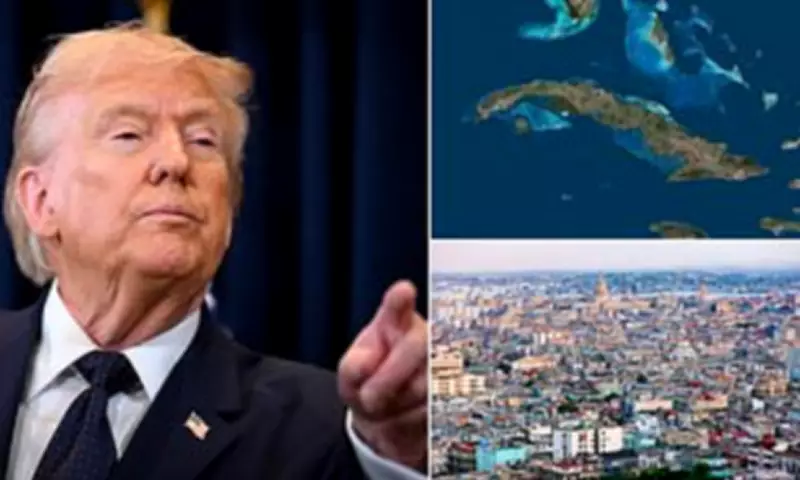
Former President Donald Trump has injected fresh geopolitical shockwaves by floating the prospect of a 'friendly takeover' of Cuba during a Monday night press conference. The remarks came as he provided updates on military developments in Iran, suggesting that conflict was nearing its conclusion.
Cuba as Next Foreign Policy Priority
Trump framed Cuba as the next major focus of American foreign policy once the Iran conflict subsides, describing the communist-run island's leadership as weakened and economically desperate. The Caribbean nation sits just 90 miles south of Florida at its closest point.
'It may be a friendly takeover. It may not be a friendly takeover. It wouldn't matter,' Trump said of Cuba. 'They're down to as they says "fumes." They have no energy. They have no money. They're in deep trouble on a humanitarian basis.'
The former president suggested Washington could press for sweeping political change with or without Havana's full cooperation, stating: 'They're going to make a deal or we're going to do it - just as easy anyway.'
Rubio's Potential Role and Domestic Politics
Trump indicated that Secretary of State Marco Rubio could soon play a central role in Cuba policy, portraying the Florida Republican as uniquely positioned to influence events. He suggested Rubio could help guide Cuba away from communist rule toward what he described as a more pro-US system.
'Those people are very important to me,' Trump said, referencing support from Cuban-American voters. He noted that Cubans 'trust' Rubio and that he speaks Spanish, 'which is always nice and always helpful.'
Iran Conflict Timeline Remains Fluid
While discussing Cuba, Trump also provided updates on the conflict with Iran, though his timeline appeared fluid. 'I think the war is very complete, pretty much. They have no navy, no communications, they've got no Air Force,' he stated.
During the evening press conference, Trump said the war would end 'soon,' though likely not within the coming week.
Cuba's Current Situation and Historical Context
Cuba's government has stated it is not engaged in any high-level talks with the United States, though it has not directly denied press reports suggesting American officials may be holding informal discussions with Raul Guillermo Rodriguez Castro, the grandson of former Cuban President Raúl Castro.
The island nation has long occupied a fraught place in US foreign policy. A decades-old American trade embargo first imposed during the Cold War after Fidel Castro's communist revolution remains in effect, shaping economic and diplomatic relations to this day.
In recent years, Cuba has endured:
- Severe economic strain
- Large-scale migration
- Periodic public protests
- Shortages and financial pressures
Shifting US Policy and Current Investigations
US policy toward Cuba has shifted sharply between administrations. The Biden administration eased some restrictions, while Trump during his earlier term tightened sanctions and re-designated Cuba as a state sponsor of terrorism.
Federal law enforcement continues to devote significant attention to Cuba-related matters. The FBI's Miami field office maintains a dedicated Cuba group and in 2024 helped secure the arrest of former US Ambassador Victor Manuel Rocha on charges alleging he acted for decades as a secret agent for Cuba.
Cuba policy has also resurfaced in Congress. Several Miami-area Republicans, along with Florida Senator Rick Scott, have urged the Trump administration to reopen its criminal investigation into the 1996 shootdown of two civilian planes operated by anti-communist exile groups.
In a February 13 letter to Trump, lawmakers including Reps. Maria Elvira Salazar and Carlos Gimenez cited historical reports indicating that Raúl Castro - then head of Cuba's military - ordered the attack. 'We believe unequivocally that Raúl Castro is responsible for this heinous crime,' the lawmakers wrote. 'It is time for him to be brought to justice.'
Terrorism Designation and Regional Significance
The Trump administration has accused Cuba of failing to cooperate with US counterterrorism efforts, citing the country's harboring of American fugitives and refusal to extradite certain Colombian rebel leaders who had been involved in peace negotiations.
These concerns underpin its designation of Cuba as a state sponsor of terrorism - a label it shares with a small group of nations including North Korea and Iran.
While Cuba may no longer dominate national security debates in Washington, it remains a central issue in South Florida, where political, economic and cultural life is heavily influenced by Cuban-American exiles. Many exiles, largely concentrated in Miami, have long hoped to see the communist government fall.