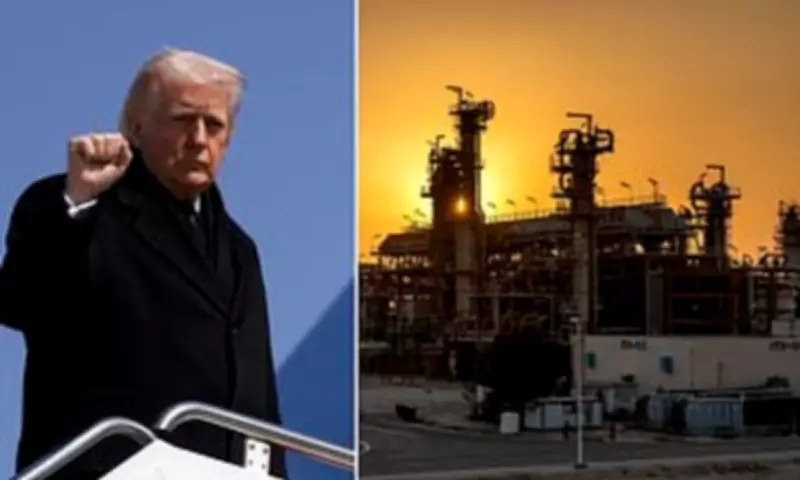
Former US President Donald Trump has issued a stark threat to Iran, vowing to "massively blow up the entirety" of its South Pars gas field in response to escalating attacks across the Middle East. This warning came after Israel targeted the Iranian gas facility, prompting Tehran to retaliate by bombing a major natural gas plant in Qatar and striking other sites in Saudi Arabia and the United Arab Emirates.
Trump's Red Line and Retaliation Warning
In a social media post on Wednesday, Trump declared that Israel would make no further attacks on the South Pars field, describing it as an "extremely important and valuable" asset. However, he set a clear condition: if Iran attacks Qatar again, the United States would unleash devastating force. "The United States of America, with or without the help or consent of Israel, will massively blow up the entirety of the South Pars Gas Field at an amount of strength and power that Iran has never seen or witnessed before," Trump stated.
He acknowledged the long-term implications of such destruction but emphasized, "I will not hesitate to do so." Trump also claimed the US had no prior knowledge of Israel's strike on South Pars, asserting Qatar was uninvolved, though reports from Axios and the Associated Press suggest the attack was coordinated with White House approval.

Global Market Turmoil and Energy Crisis
The conflict has roiled global markets, with oil prices surging over five percent to more than $110 a barrel on Wednesday. Asian shares dropped as investors reacted to Iran's warning that energy sites in Gulf states are now "direct and legitimate targets." Eskandar Pasalar, an Iranian regional governor, proclaimed the situation has escalated to a "full-scale economic war."
US stocks also declined due to inflation concerns exacerbated by the war, while Treasury yields rose and the dollar strengthened. The disruption to the Persian Gulf's energy industry has sparked fears of a supply crunch, potentially surpassing the 1970s oil crisis. Natural gas is critical for Iran, providing about 80 percent of its power generation, according to the International Energy Agency.
Regional Diplomacy and Military Buildup
Saudi Arabia's Foreign Minister, Prince Faisal bin Farhan, stated that trust with Tehran has been shattered after Riyadh was hit by Iranian ballistic missiles. He reserved the right to take military action if necessary. Meanwhile, the Pentagon has requested $200 billion in funding for the war in Iran, as Trump considers deploying thousands more troops to the region.
Options under discussion include securing safe passage for oil tankers through the Strait of Hormuz, potentially involving ground forces on Iran's shoreline or Kharg Island, which handles 90 percent of Iran's oil exports. Military experts note that controlling Kharg Island might be preferable to destroying it, despite risks from Iranian missiles and drones.
War Toll and Political Risks
The US military has conducted over 7,800 strikes since the war began on February 28, damaging or destroying more than 120 Iranian vessels. Thirteen US troops have been killed, with about 200 wounded, mostly with minor injuries. Trump's goals include degrading Iran's military, ensuring safe navigation in the Strait of Hormuz, and preventing nuclear weapon development.
However, deploying ground troops carries significant political risks, given low public support for the Iran campaign and Trump's past promises to avoid new Middle East conflicts. A White House official confirmed no decision has been made on sending troops, but all options remain on the table. The administration is also exploring ways to secure Iran's stocks of highly enriched uranium, though no specific plans have been finalized.