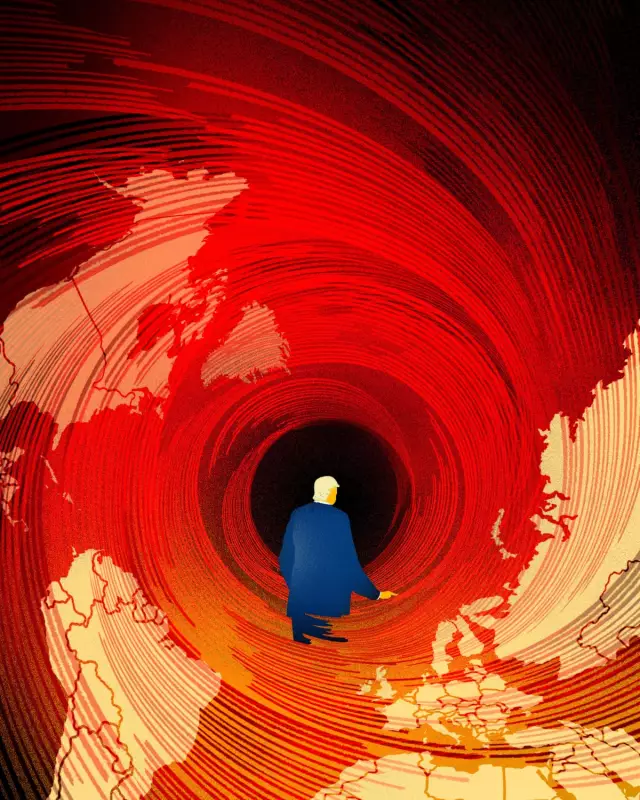
The post-Second World War system of international rules and institutions is confronting an unprecedented crisis of legitimacy and credibility, as the United States under President Donald Trump actively turns its back on the order it helped create. This dramatic shift, warned of by Trump's own officials, is plunging the world into a period of dangerous instability where coercive power is replacing legal norms.
The End of an Era: America First in Practice
In 2025, Western leaders perceive themselves to be living through a profound transitional period. The Italian Marxist philosopher Antonio Gramsci's observation about interregnums—where "the old world is dying" and "the new world struggles to be born"—has gained fresh relevance. During such times, he noted, morbid phenomena flourish, and the current crisis of legitimacy for international law is a prime example.
The US Secretary of State, Marco Rubio, laid out the administration's stance with stark clarity during his Senate confirmation hearing in February. He declared the post-war global order not merely obsolete but "a weapon being used against us." Rubio argued that the foundational assumption—that nations would converge into a democratic, Western-led community—was a "dangerous delusion." This philosophy is echoed in the US National Security Strategy, which renounces the role of propping up the world order "like Atlas" and warns of European cultural erasure.
In practice, Trump's foreign policy is marked by confusion, where a formal non-interventionist ideology clashes with sporadic actions. The approach is highly personal and unpredictable, described by observers as a "catherine wheel of disconnected explosions." This unpredictability leaves allies clinging to false hope that the historic break is not permanent.
Targeting Law, Embracing Coercion
Amid the chaos, one consistent target has emerged: the constraints of international law. The Trump administration is pursuing what critics call "mobster diplomacy," relying on sheer coercive power, shakedowns, and deal-making. This is evident in its approach to Ukraine, where forging a profitable relationship with Vladimir Putin appears to take precedence over expelling Russian forces, despite having the military means to aid Kyiv sufficiently.
The sovereignty of resource-rich nations like Venezuela, with its 303 billion barrels of crude oil, has also attracted the administration's "marauding eye." When questioned on social media about potential war crimes from bombing boats, US Vice-President JD Vance brazenly replied, "I don't give a shit what you call it." The Pentagon later offered the implausible legal justification that stranded sailors could be targeted as combatants.
Free trade rules are being shredded as the US uses its market size to extort money and policy changes from allies. A country's standing is now judged not by democratic values but by its leader's personal relationship with Trump and his inner circle, creating a blatantly monarchical dynamic.
Institutions Under Assault and a Descent into Disorder
The assault extends to the institutions upholding international law. Nicolas Guillou, a French judge at the International Criminal Court (ICC), detailed how US sanctions imposed for issuing an arrest warrant for Benjamin Netanyahu have devastated his daily life, closing his accounts with companies like Amazon and PayPal. European banks and companies, cowed by US pressure, have complied, while European institutions look the other way.
The US has left or undermined UN bodies like the Human Rights Council and UNESCO, cutting an estimated $1 billion in funding and firing 1,000 related staff. At the UN General Assembly, the US seems to relish its isolation. Former Vice-President John Kerry lamented that under Trump, America turned "from leader to denier, delayer and divider," allowing China to fill the void.
The situation in Gaza has further stripped bare the supposed universality of international norms. Majed al-Ansari, foreign policy adviser to Qatar's Prime Minister, stated we are in "an age of disgusting impunity," where diplomacy is reduced to begging aggressors to "kill fewer people" rather than uphold the law. He predicts a move "from a world order to disorder," where anyone with the power to wreak havoc can act with impunity.
Academics debate whether international law can bear the weight of public faith placed upon it. Professor Thomas Skouteris describes a "fin de siècle mood," where law's lexicon is ubiquitous but its power to settle disputes feels weakened, becoming mere "performance."
Despite the bleak outlook, figures like Christoph Heusgen, former adviser to Angela Merkel, urge defence of the system based on the UN Charter. He warns the rules-based order is easy to destroy but hard to rebuild. As Tom Fletcher of the UN's Ocha agency asked diplomats, what action will future generations say was taken to stop the atrocities witnessed today? The answer, for now, remains painfully unclear.