Trump's 'Beautiful Armada' Signals Return to Gunboat Diplomacy in Iran Standoff
In a dramatic escalation of tensions, former US President Donald Trump has announced the deployment of what he termed a "beautiful armada" toward the Middle East, specifically targeting Iran. This move represents a stark return to traditional gunboat diplomacy, raising immediate concerns about potential military confrontation while simultaneously offering Tehran a pathway to negotiations.
Military Buildup and Regional Panic
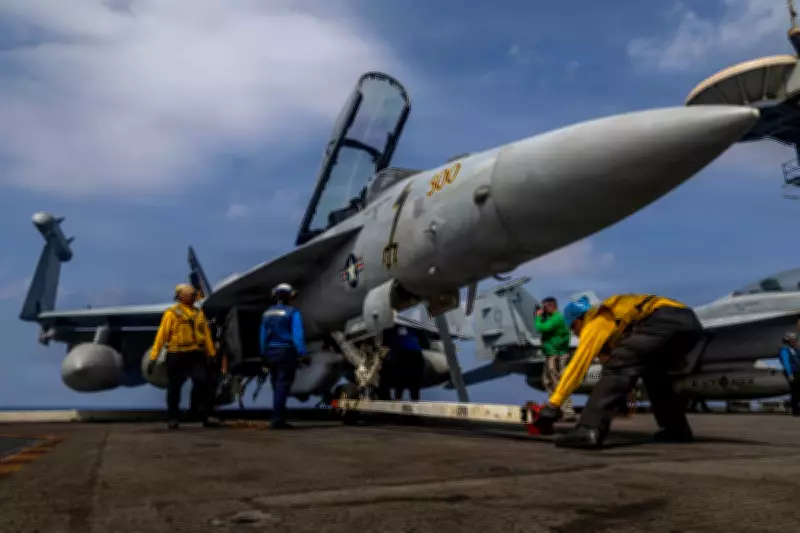
Speaking at a rally in Iowa, Trump declared: "There's another beautiful armada floating beautifully toward Iran right now." Military analysts tracking the deployment have confirmed significant US naval assets converging on the region, including the aircraft carrier USS Abraham Lincoln and supporting vessels. This substantial show of force has prompted a predictably belligerent response from Iranian officials, with the foreign minister stating that Iranian armed forces were "with their fingers on the trigger."
The military buildup has triggered alarm across the Middle East and among European allies, who fear an imminent US-Iran conflict could destabilise the entire region. However, Trump's rhetoric contained both threat and opportunity for Tehran's leadership.
The Negotiation Ultimatum
Trump outlined specific conditions under which military action might be avoided, demanding that Iran's leaders "come to the table" and "negotiate a fair and equitable deal – NO NUCLEAR WEAPONS." This represents a continuation of his administration's previous stance, albeit with renewed military pressure. The implied offer suggests Iran's current regime could maintain power temporarily, but only under significantly constrained regional influence and with strict limitations on its nuclear programme.
This approach mirrors Trump's earlier withdrawal from the Joint Comprehensive Plan of Action (JCPOA), commonly known as the Iran nuclear deal, during his first term. That decision, taken against UN and European advice, led to re-imposed sanctions that many analysts believe contributed to economic discontent and subsequent protests within Iran.
Venezuela Parallels and Strategic Calculations
Observers have noted striking parallels between Trump's current approach to Iran and his previous Venezuela operation. In that instance, Trump employed a combination of diplomatic overtures and military threats before ultimately seizing the Venezuelan president and his wife, leaving behind what he described as a "headless and shellshocked administration" more amenable to Washington's influence.
Trump himself has drawn this comparison, boasting that the naval force now heading toward the Gulf region is substantially larger than that deployed against Venezuela. This suggests a potential playbook for dealing with adversarial regimes: maximum pressure through military posturing followed by negotiations on American terms.
Strategic Consistency Amid Apparent Contradictions
Trump's approach appears contradictory on the surface – having previously offered support to Iranian protestors seeking to overthrow the regime, he now engages directly with the same leadership. However, this reflects what analysts describe as Trump's consistent methodology: maximalist rhetoric combined with pragmatic action calibrated to achievable outcomes.
This pattern has been evident across multiple foreign policy arenas, from tariff negotiations with China to the Greenland territorial dispute. In each case, dramatic threats served as opening gambits for subsequent negotiations rather than preludes to immediate military action.
Limited Military Engagement and Strategic Realism
Trump's military deployments have consistently avoided long-term ground commitments in favour of precisely calculated, limited engagements. The Venezuela operation, while dramatic, stopped short of full regime change, instead focusing on decapitating the existing leadership structure. Similarly, Trump has rejected proposals to install exiled opposition figures in either Venezuela or Iran, citing uncertainty about their domestic support bases.
This cautious approach appears informed by lessons from previous US interventions in Afghanistan, Iraq, and Libya, where regime change led to prolonged instability. The current strategy prioritises American interests through a combination of military deterrence and negotiated settlements, always with what Trump terms "America First" as the guiding principle.
Broader Foreign Policy Implications
The Iran standoff reflects broader themes in Trump's foreign policy approach as outlined in official documents like the National Defense Strategy. While maintaining a position of strength, this approach explicitly avoids seeking to "dominate, humiliate or strangle" adversaries like China, instead pursuing "a decent peace, on terms favourable to Americans" that opposing nations can accept.
What emerges is a foreign policy doctrine where power relationships remain paramount, but military action represents the last resort rather than the preferred option. Adjustments in strategy – such as the apparent shift from supporting Iranian protestors to negotiating with the regime – reflect not inconsistency but what might be termed Trump-style realism: recalibrating approaches based on changing assessments of what serves American interests while maintaining maximum negotiating leverage.
The coming weeks will reveal whether Iran's leadership interprets Trump's "beautiful armada" as an existential threat requiring military response or as sufficient pressure to return to negotiations on Washington's terms. Either outcome will significantly reshape Middle Eastern geopolitics and America's role in the region.