Trump's 'Near-Victory' Declaration on Iran War Met with Confusion and Anxiety
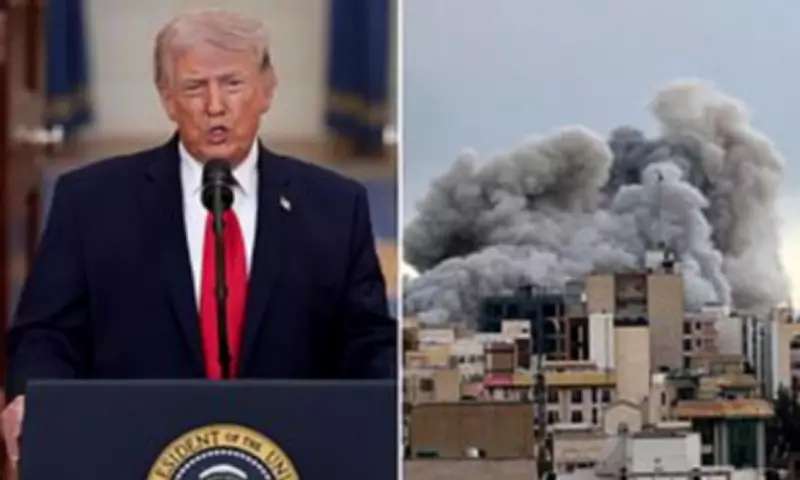
President Donald Trump asserted a position of 'near-victory' in the ongoing military campaign against Iran during a subdued address from the White House this week. However, his bold proclamation has plunged many Iranians into a state of desperation and uncertainty, as the speech lacked concrete details on critical issues.
Ambiguous Rhetoric and Missing Details Fuel Regional Tensions
Despite Trump's claims of approaching triumph, his remarks were shrouded in ambiguity, leaving observers across the region anxious about the volatile path forward. The President sought to justify the military efforts by highlighting the Islamic regime's history of violence against Americans, Israelis, and its own citizens, labeling it the 'most violent and thuggish regime on earth.' He insisted Tehran would never be allowed to hide behind a 'nuclear shield.'
Notably, Trump avoided addressing key concerns. He provided no update on peace negotiations with Tehran, offered no concrete plan for a leadership transition, and did not clarify fears about potential US ground force deployments to the Gulf. This omission has particularly worried Iranians on the ground, who are seeking clear alternatives to the current government.

Leadership Succession and Opposition Figures Add to Complexity
The situation is further complicated by recent developments in Iran. Mojtaba Khamenei, the second son of the late Ayatollah Ali Khamenei who was killed in air strikes, has been announced as his successor. Nicknamed 'The Butcher,' Khamenei is said to be even more brutal than his father. Meanwhile, Crown Prince Reza Pahlavi remains the only major opposition figure promising a democratic transition, though Trump has stopped short of endorsing him, calling Pahlavi a 'nice guy' but suggesting an 'inside' figure might be better suited.
Trump claimed that while regime change was not his explicit goal, it has 'already occurred.' Yet, for those hoping for a clear alternative, his rhetoric missed the mark. One Iranian told the Daily Mail, 'Trump's speech was a little disappointing,' expressing worry when Trump referred to the new regime as 'moderate,' adding, 'There is no moderate or someone with actual common sense within this terrorist government.'
Communication Blackouts and Emotional Reactions Highlight Desperation
For many Iranians, even accessing the President's words was a struggle due to a total internet blackout. Leyla, a resident of Isfahan, had to call relatives in Europe for updates. She shared, 'I heard from my family what the President said. We don't have any direction on what to do next, especially not from our own government. Iranians are hanging on to every word Trump is saying. I feel afraid… like we might be betrayed.'
Another anonymous source inside Iran criticized the potential for future negotiations, saying, 'If they truly negotiated with the mullahs again, after three years when Trump will leave office, they are going to rise again and do their terrorist attack on our own people and the world.'
Mixed Reactions and Strategic Interpretations Emerge
Trump highlighted the regime's brutality, stating, 'This murderous regime also recently killed 45,000 of their own people, 45,000 dead. For these terrorists to have nuclear weapons would be an intolerable threat.' Some Iranians viewed this as a tactical show of support for the resistance. One source noted, 'When he talks about 45,000 killed in two days, he's siding with us. It's time to support the people's takeover.'
Not all reactions were negative. An Iranian observer in Armenia with family in Tehran found Trump's assessment 'pretty accurate' and remained hopeful, explaining, 'This war is definitely an investment. I hope it ends with a true decapitation of the regime.'
Legacy and Historical Context Frame the Conflict
As the world watches to see if 'Operation Epic Fury' is truly nearing its end, Trump framed the conflict as a long-overdue reckoning, lamenting, 'This situation has been going on for 47 years, and should have been handled long before I arrived in office.' With the fog of war still thick over the Gulf, the President is betting his legacy on a 'short' conclusion to a decades-old nightmare.

However, for millions of Iranians currently in the dark, the fear persists that a 'near-victory' for the administration could still mean a devastating betrayal for those who risked everything for a chance at liberation. The speech, while assertive, has left a nation grappling with uncertainty and a desperate need for clarity in a volatile geopolitical landscape.