Trump's Midnight Declaration Upends Half-Century of US Foreign Policy
In a dramatic late-night social media broadcast, former President Donald Trump has fundamentally altered America's approach to the Middle East, drawing immediate comparisons to what historians consider one of the worst foreign policy decisions in modern history.
The Unconventional Announcement
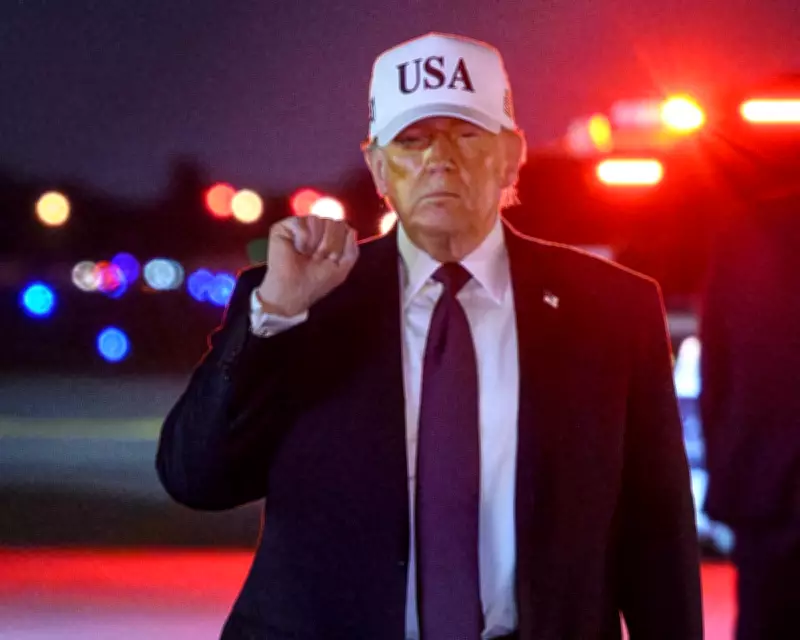
At 2:30am on Saturday morning, while most Americans slept, Trump appeared on his Truth Social platform wearing his signature "USA" cap and standing before the presidential seal. The eight-minute video from his Mar-a-Lago residence marked a stark departure from traditional presidential addresses, delivered not to Congress or the nation in prime time, but directly to his social media followers during what has become his characteristic late-night posting hours.
This unconventional delivery method contrasted sharply with historical precedent, where presidents like Franklin Roosevelt addressed joint sessions of Congress during moments of national significance. Trump's approach reflected his continued preference for direct communication through his own channels, bypassing traditional media and political institutions.

Historical Parallels and Policy Reversal
The substance of Trump's announcement drew immediate comparisons to President George W. Bush's 2003 invasion of Iraq, which the Council on Foreign Relations recently identified as the worst foreign policy decision in American history. Like Bush's Iraq war, Trump's action represents another significant military intervention in the Middle East aimed at regime change.
However, there were crucial differences in approach. While Bush attempted to build international consensus through the United Nations and presented evidence to justify his actions, Trump offered minimal explanation to Congress or the American public before military operations commenced. The president had amassed substantial naval forces in the region with little public discussion, and mentioned Iran only briefly during his recent State of the Union address.
The Justification and Its Gaps
In his video statement, Trump outlined a familiar litany of grievances against Iran, including:
- The 1979 hostage crisis
- The 1983 Marine barracks bombing
- The attack on the USS Cole
- Iranian involvement in attacks against US forces in Iraq
- Iran's status as "the world's number one state sponsor of terror"
- Recent domestic crackdowns on Iranian protesters
- Iran's nuclear ambitions
Despite this extensive historical review, Trump failed to address the fundamental question of timing: why military action was necessary at this specific moment. His explanation that "we can't take it anymore" provided little specific justification for immediate military intervention rather than continued diplomatic or economic pressure.
A Call for Regime Change
The most remarkable aspect of Trump's address came in his direct appeal to the Iranian people. After warning civilians to seek shelter because "bombs will be dropping everywhere," Trump urged Iranians to "take over your government" once military operations concluded.
"This will be, probably, your only chance for generations," he declared. "For many years, you have asked for America's help, but you never got it. No president was willing to do what I am willing to do tonight."
This explicit call for regime change marked a significant departure from Trump's previous rhetoric criticizing foreign interventions and nation-building. The statement aligned him more closely with neoconservative foreign policy advocates he had frequently criticized during his political career.
Strategic Questions and Political Reactions
Trump acknowledged the potential human cost of military action, stating that "the lives of courageous American heroes may be lost" and that "we may have casualties." He framed the mission as necessary "for the future" rather than immediate security concerns.
This admission drew sharp criticism from political opponents. Democratic Senator Ruben Gallego, an Iraq war veteran, responded on social media: "Draft dodger is willing to sacrifice working-class kids. How charitable of him."

Former Obama administration official Ben Rhodes tweeted that "Trump's second term has been the worst-case scenario," reflecting broader concerns among foreign policy experts about the long-term strategic implications of the action.
A Pattern of High-Stakes Gambles
The Iran intervention continues a pattern of high-risk foreign policy moves during Trump's presidency, including:
- Moving the US embassy to Jerusalem
- Ordering the killing of Iranian commander Qassem Suleimani
- Imposing sweeping tariffs on trading partners
- Attempting to capture Venezuelan President Nicolás Maduro
Each previous action generated warnings of catastrophic consequences that failed to materialize at predicted levels, potentially emboldening Trump to take increasingly significant risks. However, experts note that military action against Iran represents a gamble of substantially greater magnitude with potentially far-reaching regional and global consequences.
The fundamental question remaining is what long-term strategy guides this action beyond immediate military objectives. As the Iraq war demonstrated, regime change represents only the beginning of complex challenges, with nation-building and stabilization often proving more difficult than initial military operations.
Trump's midnight announcement has placed America on a new course in the Middle East, one whose ultimate consequences remain uncertain but whose immediate impact has already reshaped decades of foreign policy precedent.