Venezuela's Political Future Hangs in Balance Between Two Formidable Women
As Venezuela navigates the turbulent aftermath of Nicolás Maduro's dramatic removal from power, a compelling battle for the nation's political soul has emerged between two strikingly different women. This high-stakes confrontation pits a Nobel Peace Prize-winning opposition figure against a former regime stalwart who has executed a remarkable political transformation to secure Washington's backing.
The Contenders: Machado Versus Rodriguez
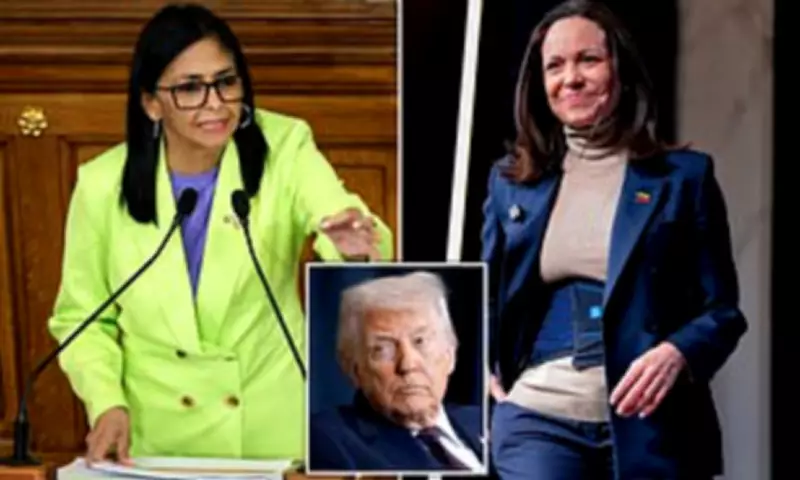
In one corner stands Maria Corina Machado, the 58-year-old industrial engineer and mother of three who has served as the courageous face of Venezuela's opposition for decades. Hailed by supporters as a 'Paladin of righteousness' dedicated to restoring democracy, Machado's elite background and unwavering principles have defined her political career. However, her steadfast approach has recently seen her sidelined by the Trump administration, creating a significant rift at a critical juncture in Venezuela's history.
Opposing her is Delcy Rodriguez, the 56-year-old daughter of a Marxist martyr who rose through the ranks of Maduro's government to become what diplomats describe as 'the ultimate schemer and manipulator.' Once branded by opponents as an 'architect of torture,' Rodriguez has performed an extraordinary political pivot, winning over the White House to be sworn in as interim president while her former mentor remains incarcerated in a New York jail.
Washington's Calculated Embrace of Rodriguez
The speed of Rodriguez's transformation from fiery critic of 'Yankee imperialism' to Washington's preferred partner has left seasoned diplomats astonished. According to sources familiar with the transition, Rodriguez recognized the shifting political winds with remarkable acuity. 'After about 24 hours of consideration, when basically Trump said, 'You're my b**** now,' she pivoted,' revealed a diplomat with seven years of experience at the Caracas embassy.
This strategic realignment has yielded tangible diplomatic rewards. President Trump has confirmed speaking with Rodriguez by phone, announcing that Americans will soon be able to visit Venezuela and that US planes will have access to Venezuelan airspace. The White House has further confirmed that Rodriguez is expected to travel to Washington 'soon' for what former state department officials describe as a formal 'blessing' of her interim presidency.
Contrasting Philosophies and Approaches
The philosophical gulf between the two women could hardly be wider. Rodriguez, despite her public claims to 'detest the West,' displays what observers describe as a 'performative radicalism' that masks a ruthlessly pragmatic core. US Diplomat Brett Bruen recalls Rodriguez's university days in London, where she would perform a bizarre morning ritual of berating her toothpaste as a 'capitalist product' before using it. 'She is a tried and true socialist,' Bruen acknowledges, 'But as with any regime, the first priority is survival.'
Since assuming power, Rodriguez has governed with this survivalist pragmatism, replacing revolutionary rhetoric with messages of 'order and stability' designed to pacify Maduro's base while quietly assuring American oil executives that production will continue uninterrupted.
Machado's Diminishing Political Capital
Meanwhile, Machado faces a dwindling political half-life despite maintaining significant support among Venezuelan expatriates and certain congressional circles. Her fall from grace in Trump's orbit accelerated following clashes with Ric Grenell, Trump's envoy to Venezuela, who found Machado 'inflexible' during secret pre-ouster talks in Caracas.
'Maria Machado refused to meet with him,' explained a US diplomat who worked with Grenell. 'We heard she did not want to deal with him, and did not like what he stood for.' This reluctance, stemming from what sources describe as a mix of 'arrogance and inflexibility,' has proven costly as Trump prioritizes what one diplomatic insider calls 'peace through business' and swift access to Venezuelan oil reserves.
The Personal Networks Behind the Power
Rodriguez's political position appears bolstered by strategic personal connections, particularly through her husband Yussef Abou Nassif Smaili, a businessman of Lebanese descent who operates in the shadows of the regime's finances. Described as a 'tie between Venezuela and Iran's proxies' destabilizing the wider Middle East, Smaili provides Rodriguez with crucial financial networks. 'If she has to move something, her husband makes the move,' revealed a university contemporary familiar with Rodriguez's operations.
This contrasts sharply with Machado's more transparent political approach, though some critics describe her as a 'complicated' outlier who 'pisses people off' when they don't share her exact vision for Venezuela's democratic restoration.
Diverging Paths Forward
Currently in Washington D.C., Machado continues to work the halls of Congress and the White House, though her efforts have widened the rift with the Trump administration. Her public opposition to Trump's mass deportation plans and warnings that Rodriguez's interim government remains unsafe for returnees directly contradict the 'mission accomplished' narrative emerging from the White House.
As one diplomat familiar with both women summarizes: 'For Trump, dealing with Delcy is calculated. He thinks it is easier to deal with Delcy than it is with Machado. Kind of on a personality basis. He also doesn't like strong women like Machado. More importantly, though, I think what he's decided is he doesn't want to focus on democracy and human rights. He's trying to basically pursue peace through business.'
This fundamental difference in approach—between Machado's principled democratic advocacy and Rodriguez's pragmatic realpolitik—now defines Venezuela's uncertain political landscape, with ordinary citizens watching anxiously as these two formidable women chart competing courses for their nation's future.