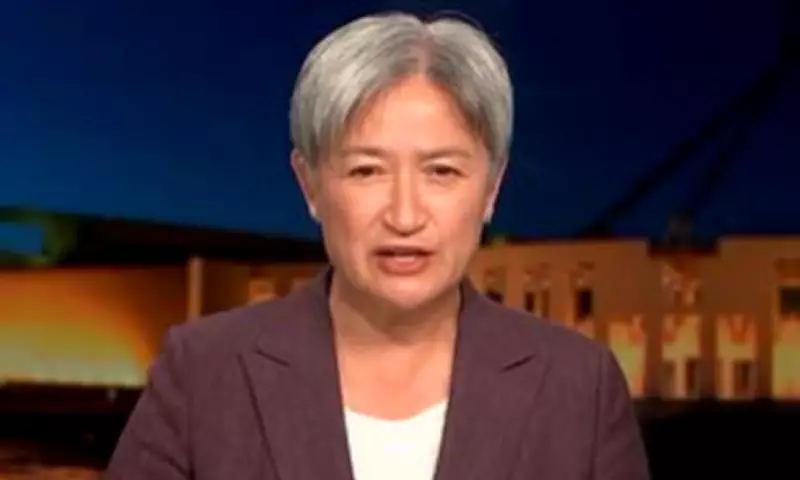
Foreign Minister Penny Wong has publicly endorsed Prime Minister Anthony Albanese's appeal for greater transparency from the United States regarding the conclusion of the protracted war in Iran. Wong emphasised the significant economic toll of the conflict, particularly on Australian households, while cautiously welcoming signals from President Donald Trump about potential diplomatic engagement.
Economic Strain and Diplomatic Signals
"There is a very substantial economic cost to this war," Wong stated, highlighting the direct consequences for Australians, especially evident in rising fuel prices at the bowser. She noted, "We welcome the indication from President Trump that he wants to engage in dialogue." However, Wong underscored that ultimate control over the conflict's resolution lies with the key belligerents: "Ultimately, the only people who know when it will end is the US, Iran and Israel."
Government's Stance on US Actions
Since the outbreak of hostilities, the Australian federal government has consistently supported American military initiatives, arguing they are essential to prevent Iran from obtaining nuclear weapons and to curb its ability to undermine global security through proxy groups. This backing comes despite escalating domestic concerns over the war's economic repercussions.

Albanese's Detailed Critique of War Objectives
Wong's comments follow fresh remarks from Prime Minister Anthony Albanese, who has urged President Trump to clearly articulate America's war aims and commit to a de-escalation strategy. Albanese pointed out that while Trump's three initial objectives have largely been met—including halting Iran's nuclear ambitions and degrading its military capabilities—the absence of a clear endgame is problematic.
"I want to see more certainty in what the objectives of the war are and I want to see a de-escalation," Albanese asserted on Monday. He elaborated on the initial goals: "At the beginning of the conflict, the objectives were outlined as: one, stopping Iran getting a nuclear weapon - agree. And clearly that has been achieved. Secondly, degrading the opportunity that Iran has for engaging in military action either overt or through its proxies in Hezbollah, Hamas, and the Houthis. Clearly there has been substantial degrading of Iran's position."
Challenges of Regime Change
Albanese expressed skepticism about the feasibility of externally imposed regime change in Iran, citing historical precedents. "Very clearly history tells us that regime change imposed from outside is very difficult … because military action against a nation will tend to promote nationalism," he explained. Despite his personal disdain for the Iranian regime, which he described as "abhorrent and reprehensible," Albanese called for a coherent strategy if such a goal is pursued.
"I would like to see the Iranian regime that I regard as abhorrent and reprehensible replaced and I certainly stand with the Iranian people who've been subject to abuse, human rights atrocities, and oppression for a long period of time. I think that clearly whether that is going to occur or not is something that I think needs to be outlined," he added, emphasising the need for clarity in US planning.
The coordinated messages from Wong and Albanese reflect growing Australian unease over the prolonged conflict, balancing support for US security efforts with pressing demands for a transparent roadmap to peace to mitigate economic and humanitarian impacts.