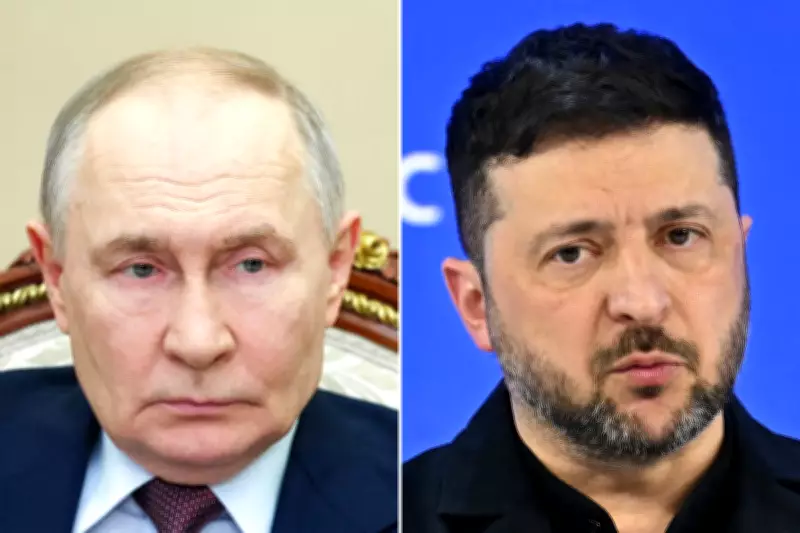
Ukrainian President Volodymyr Zelensky has issued a stark warning that Russian forces are preparing a "new massive strike" as trilateral peace negotiations are set to resume this Sunday. The Ukrainian leader emphasised that any such attack would severely discredit the diplomatic process, urging international partners to recognise the gravity of the situation.
Staggering War Casualties Revealed
A comprehensive new study from the Center for Strategic and International Studies (CSIS) has revealed the devastating human cost of the nearly four-year conflict. The report indicates that total military casualties could approach two million by the coming spring, marking the heaviest battlefield losses for any major power since the Second World War.
Russian Losses Unprecedented in Modern Warfare
According to the CSIS analysis, Russian forces have suffered approximately 1.2 million casualties between February 2022 and December 2025. This staggering figure includes up to 325,000 troop deaths, representing the majority of fatalities in the conflict.
"No major power has suffered anywhere near these numbers of casualties or fatalities in any war since World War II," the report stated, noting that these losses have occurred despite what it described as "remarkably slow" battlefield advances by Russian forces.
Ukrainian Military Casualties
The study estimates that Ukrainian forces, with their smaller population and military, have sustained between 500,000 and 600,000 military casualties. This includes up to 140,000 deaths among Ukrainian troops defending their territory against the Russian invasion.
Kremlin Dismisses Casualty Figures
The Kremlin has firmly rejected the CSIS findings, with spokesperson Dmitry Peskov stating that such reports "cannot and should not be viewed as reliable information." Peskov insisted that only casualty figures released by the Russian defence ministry should be trusted, despite widespread international scepticism about Moscow's official statistics.
Russia has maintained a policy of rarely releasing detailed casualty information throughout the conflict, with independent analysts consistently suggesting that official figures represent significant understatements of actual losses.
Civilian Attacks and Diplomatic Developments
President Zelensky has accused Vladimir Putin of terrorism following a Russian drone attack on a Ukrainian passenger train that killed at least five people. "In any country, a drone strike on a civilian train would be regarded in the same way – purely as an act of terrorism," Zelensky declared.
The attack comes as peace talks between Russia, Ukraine, and the United States are scheduled to resume in Abu Dhabi on Sunday. These negotiations follow what participants have described as "constructive" preliminary discussions over the previous weekend.
Territorial Disputes Remain Central
US Secretary of State Marco Rubio has confirmed that active work is underway to resolve the contentious issue of Donetsk in the peace negotiations. Rubio described the territorial disagreement as one of the central remaining challenges, acknowledging it as "very difficult" to settle.
Vladimir Putin has repeatedly insisted that Russia will seize Ukraine's entire Donbas region by force if Kyiv does not surrender the territory through diplomatic means. Meanwhile, the United States has indicated that security guarantees for Ukraine would be contingent upon agreement regarding the Donbas, where Russian forces currently control approximately 90 percent of the territory.
International Support and Winter Challenges
French President Emmanuel Macron has announced that France will send power generators to Ukraine following Russia's latest attacks on Kharkiv, which left most of the city without electricity. Macron affirmed France's commitment to supporting Ukraine "for as long as necessary" in its defence against Russian aggression.
This assistance comes as Ukrainians face particularly harsh winter conditions, with temperatures expected to plunge below -20 degrees Celsius in northern and eastern regions. The situation is exacerbated by Russia's systematic targeting of Ukraine's energy infrastructure, which has left millions without reliable heating and electricity during the coldest months.
Recruitment Strategies and Foreign Involvement
Moscow has implemented a desperate recruitment drive to replenish its forces while avoiding another nationwide mobilisation. The strategy involves luring foreign nationals to the frontlines with promises of work, competitive pay for average Russian wage earners, freedom for prisoners, and simplified citizenship paths for immigrants.
The conflict has also seen increased foreign combatant involvement, with North Korea reportedly sending thousands of soldiers to assist Russian forces following a mutual defence treaty in 2024. This development highlights the expanding international dimensions of what began as a regional conflict.
Diplomatic Concerns and Knowledge Gaps
Concerns have emerged about the preparedness of some US negotiators involved in the peace process. According to officials involved in the talks, a senior US envoy engaged in negotiations to end the war demonstrated significant gaps in basic knowledge about the conflict.
The envoy reportedly referred to the head of Ukraine's presidential office as the country's vice president – a position that doesn't exist under Ukraine's constitutional framework. When asked about efforts to conclude the war by its fourth anniversary on 24 February, the envoy admitted not knowing when the full-scale invasion began.
Furthermore, the negotiator incorrectly claimed that Russia's war against Ukraine has lasted longer than the Second World War, stating: "I think it's the longest war now. It was longer than World War II. At this point, it's been going on."
These revelations come as Donald Trump's administration, represented by his son-in-law Jared Kushner and real estate developer-turned-peace envoy Steve Witkoff, leads the American negotiating team in what could prove to be pivotal discussions for ending Europe's most devastating conflict in decades.