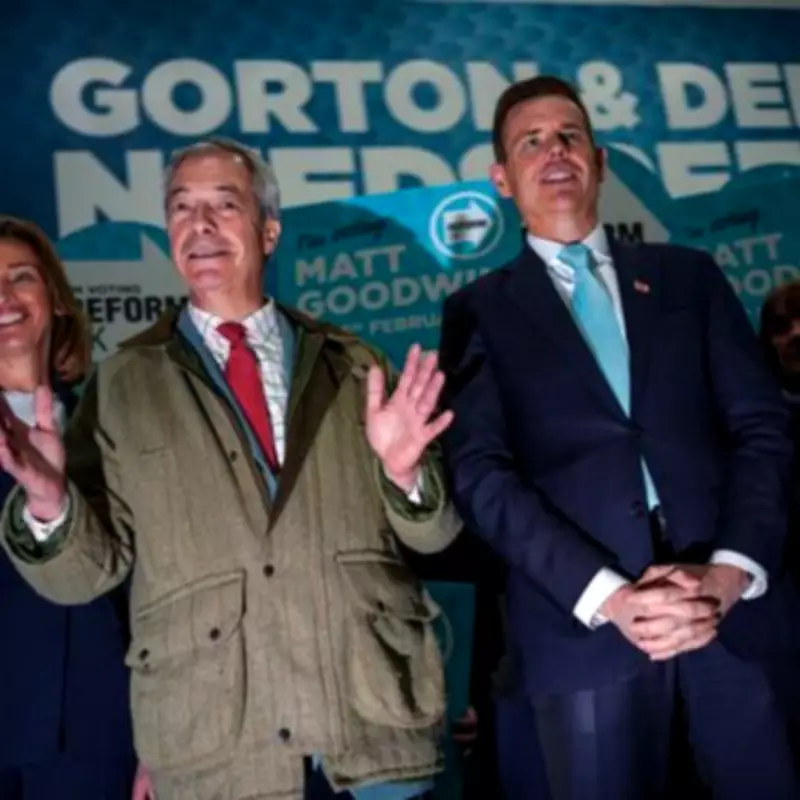
Voters in Gorton and Denton are being urged to reject the importation of Donald Trump's brand of divisive politics into British democracy, as Nigel Farage and Reform UK seek to establish a firmer foothold in the constituency. Having witnessed firsthand the corrosive impact of Trump's rise in America, observers warn that Britain must not allow similar politics of grievance, billionaire-backed populism, and confrontation to take root.
The American Blueprint: A Warning from History
On a June day in 2015, inside a Fifth Avenue skyscraper where opulence seemed to radiate from every surface, a reality television star descended a golden escalator to launch his presidential campaign. Few grasped the profound threat Donald Trump represented at that moment. His rhetoric framed migrants as criminals and transformed grievance into a twisted form of patriotism. What appeared as mere political theatre was, in reality, the calculated unveiling of a dangerous strategy that would redefine modern populism.
From that pivotal moment forward, Trump refined a political playbook built on permanent confrontation. He cast himself as the champion of "forgotten" Americans while systematically painting institutions—courts, journalists, civil servants—as corrupt enemies. Immigration was elevated from policy debate to cultural battleground, with a border wall becoming a potent symbol and deportations marketed as proof of strength.

Economic Realities Behind the Populist Veneer
Despite promises to restore dignity to working families, Trump's defining legislative achievements disproportionately benefited corporations and the wealthy. His billionaire associates prospered, some even escaping justice, while many workers saw wages struggle to keep pace with rising costs. Trade wars launched in the name of protecting domestic industry strained international alliances under the "America First" banner, with every setback blamed on outsiders and every criticism framed as sabotage.
This approach has left America deeply polarized, with institutional trust eroded and communities hardened against one another. The early energy of rallies and resonant slogans gave way to a legacy where economic policy tilted decisively toward the already affluent, and division became not collateral damage but the organizing principle of governance.
Parallels in British Politics: Farage's Reform UK
The similarities between Trump's method and the approach championed by Nigel Farage and Reform UK are striking and deeply concerning. Farage has never disguised his admiration for the former US president, consistently praising him, defending his actions, and mirroring his language. He recognized in Trump's ascent validation that outrage could be weaponized into political power, and has assembled a team reflecting this confrontational approach.
Businessman Zia Yusuf, positioned as a fresh face for Reform, joins perennial political wanderer Richard Tice and disaffected Tory figures like Robert Jenrick and Suella Braverman who appear increasingly comfortable in Farage's orbit. Others including Andrew Rosindell, Nadhim Zahawi, and Lee Anderson demonstrate a migration not just of people but of rhetoric, united less by policy detail than by political opportunity.
Shared Themes and Strategies
Immigration stands at the heart of Reform UK's message, much as it did for Trump, with calls for drastic reductions in migration, tougher border enforcement, and withdrawal from international frameworks presented as simple solutions to complex challenges. In both cases, immigration transforms from policy into symbol—a test of national will.
National sovereignty represents another shared theme, with Trump's "America First" doctrine and Farage's focus on reclaiming authority from European allies both expressing hostility toward global institutions. On trade, Trump imposed tariffs claiming globalization hollowed out American industry, while Farage criticizes EU trade structures and advocates for looser regulation and greater national flexibility.

Economic parallels sharpen further, with Trump's corporate tax cuts and regulatory rollbacks mirrored by Reform UK's promotion of lower taxes and sweeping deregulation. Both frame smaller government as freedom while benefiting from financial backing rooted in wealth. Energy policy echoes similarly, with Trump expanding fossil fuel production and Farage attacking net-zero targets and green levies as burdens on households.
The Greater Danger: Tone Over Substance
Perhaps the most urgent danger lies not in policy alignment but in tone and methodology. Trump mastered provocation, transforming controversy into currency and weaponizing social media to make politics performative. Farage has long understood the value of headline-grabbing rhetoric and insurgent positioning, allowing personality to eclipse policy and loyalty to overshadow detail.
This approach has proven electorally successful but governanceally disastrous. Once division becomes the foundation of power, governing becomes extraordinarily difficult, economic populism easily masks policies favoring the wealthy, and institutions weaken under the banner of reform.
The Gorton and Denton Decision
For voters in Gorton and Denton, this is not abstract political analysis. It represents a concrete choice about what kind of politics should represent their community. Frustration is understandable—many families feel squeezed by the cost of living, public services are stretched, and economic uncertainty lingers. The temptation to embrace disruption, to believe that tearing down the system represents the fastest route to change, is powerful.
Yet disruption carries profound consequences. The American example demonstrates that while grievance can win elections, it creates governance nightmares once in power. Reform UK presents itself as the authentic voice of ordinary voters while promoting an economic agenda that, in the American context, disproportionately benefited the affluent and rhetoric that deepened rather than resolved divisions.
A Signal Beyond One Constituency
Gorton and Denton may represent just one parliamentary constituency, but this vote sends signals far beyond its borders. It indicates whether Britain will lean further into confrontation politics or insist on steadier, more constructive approaches. When Trump stepped off that golden escalator, many dismissed it as spectacle rather than recognizing it as a blueprint. Voters in South East Manchester have the benefit of hindsight—they have watched that blueprint unfold with both its mobilizing energy and its damaging aftermath.
Democracy demands more than anger; it requires judgment and foresight. As ballots are cast in Gorton and Denton, that judgment matters profoundly. The choice extends beyond individual candidates to the very direction of British political culture. For the sake of cohesion, stability, and fairness, voters must weigh their decision carefully, recognizing that Britain's parliamentary traditions and constitutional structures, while distinct from America's presidential system, remain vulnerable when incendiary words normalize division and anger becomes an organizing principle.
Britain has historically thrived on fairness, resilience, and unity. The nation stands stronger than any political movement built on imported outrage and manufactured grievance. The polling stations of Gorton and Denton now offer an opportunity to prove this enduring truth.