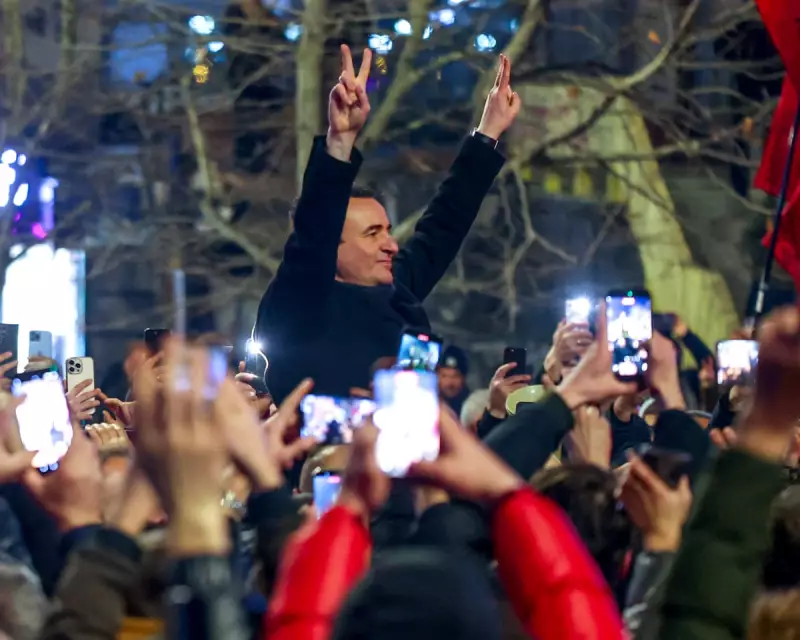
Kosovo's Prime Minister, Albin Kurti, has secured a resounding victory in a snap parliamentary election, decisively ending a prolonged political stalemate that had paralysed Europe's youngest state.
A Landslide Victory and a Shattered Opposition
With nearly all votes counted from Sunday's poll, Kurti's Self-determination party (VV) commanded over 49% of the vote. This emphatic win means he will need only minor coalition partners to form a stable majority government, marking a dramatic turnaround from the political gridlock that followed the inconclusive February election.
Political commentator Ilir Deda described the result as a "political earthquake that has shattered the opposition parties". He suggested the outcome signals a shift towards a model of strong government and weak opposition in Kosovo, mirroring trends seen elsewhere in the Western Balkans.

Ending the Costly Deadlock
The snap election was called to break a nine-month impasse where parliament failed to function for most of 2025. This blockade had severe consequences, delaying the delivery of approximately €1 billion in vital international funding for one of Europe's poorest nations.
Voters like Tahir Shabani, 58, who returned from Germany to cast his ballot in Pristina, expressed widespread frustration. "We are tired of this nine-month blockade that has cost us our nerves, cost Kosovo millions of euros, and set back our development," he said.
Domestic Agenda and International Challenges
The victory strengthens Kurti's mandate to pursue an ambitious domestic agenda, including welfare expansion and higher salaries for public sector workers. However, his new administration faces significant hurdles:
- Strained relations with Serbia, which does not recognise Kosovo's independence.
- Healthcare and education systems that lag behind regional neighbours.
- The crucial task of mending ties with international allies and advancing Kosovo's European Union membership bid.
Tensions with Serbia flared violently in 2023, leading the EU to impose sanctions on Kosovo—partly due to Kurti's policies towards the Serb minority in the north. These measures are estimated to have cost the country hundreds of millions of euros. Notably, as campaigning began this month, the EU signalled it would lift these sanctions, a move analysts believe boosted Kurti's standing with voters.
Skender Halimi, a 52-year-old voter in Pristina, highlighted the immediate tasks ahead: "Institutions must be established and the state must continue to function... The budget must be approved, we must approve international agreements, and progress must be made."
The Diaspora Factor
The timing of the election, held during a holiday period when Kosovo's large diaspora typically returns home, appears to have significantly aided Kurti. An exit poll by Ubo Consulting indicated that a striking 61.7% of diaspora voters supported his party. Kurti, who served briefly as PM in 2020, has held the role continuously since March 2021.
Kosovo, with a population of 1.6 million, declared independence from Serbia in 2008 with US backing, following the 1998-99 war. While over 100 countries recognise its statehood, Serbia, Russia, Spain, Greece and several others do not, presenting a persistent diplomatic challenge for Kurti's government.