Myanmar's Final Election Round Concludes Amid Military Control Certainty
Voting has commenced in the final round of Myanmar's general election, marking the conclusion of a nearly month-long electoral process. This third and final stage caps a sequence that has already guaranteed the country's military rulers and their political allies will command a parliamentary majority to form a new government.
Critics Decry Polls as a Sham to Legitimise Military Rule
Critics assert the polls are neither free nor fair, describing them as a calculated effort to legitimise the military's power following the February 2021 coup that ousted the elected civilian government of Aung San Suu Kyi. The army-backed Union Solidarity and Development Party (USDP) has already secured most seats contested in the first two voting rounds. With twenty-five percent of parliamentary seats constitutionally reserved for the military, its control over the legislature, alongside its allies, is assured.
Security Concerns and International Scepticism
The election has been conducted under the shadow of a civil war triggered by the 2021 takeover. Security concerns have prevented voting in more than one-fifth of the country's 330 townships, a key reason the process is labelled as unfree and unfair. Internationally, the Association of Southeast Asian Nations (ASEAN), of which Myanmar is a member, has declined to send observers or certify the election. Malaysian Foreign Minister Mohamad Hasan cited concerns over the lack of inclusive and free participation, marking the first clear statement that the regional bloc will not recognise the results.

Observers have been dispatched from nations including Russia, China, Belarus, Kazakhstan, Nicaragua, Vietnam, Cambodia, India, and Japan. Notably, Aung San Suu Kyi, the 80-year-old former leader serving a 27-year prison term, and her dissolved National League for Democracy party are not participating. Other parties have refused to register or run under conditions they deem unfair, with opposition groups calling for a voter boycott.
Election Conduct and Legal Restrictions
A new Election Protection Law has imposed harsh penalties for public criticism of the polls, with authorities charging over 400 people recently for activities like leafleting or online commentary. The previous two voting rounds were disrupted by armed groups opposed to military rule, who carried out attacks on polling stations and government buildings, reportedly killing at least two officials.
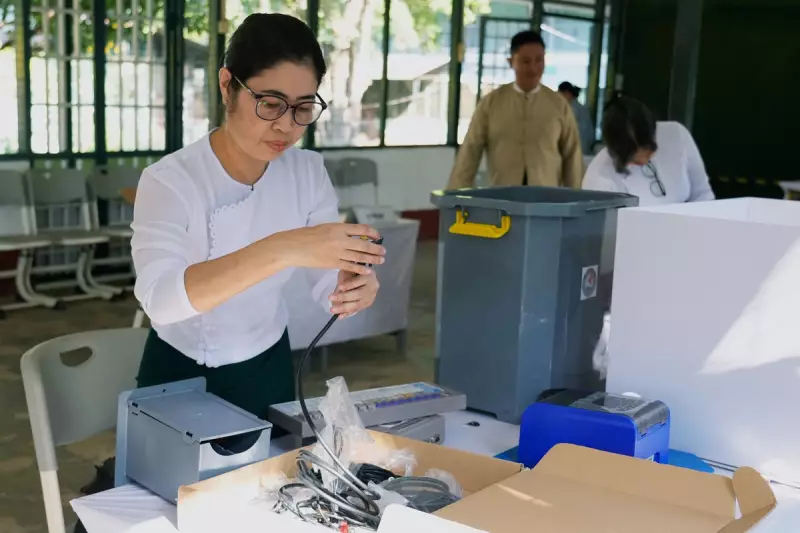
Voting on Sunday began at 6 a.m. in 61 townships across six regions and three states, including many areas that have seen recent clashes. The election was held in three phases due to the armed conflict, with the first two rounds on December 28 and January 11. A total of 67 townships, mostly controlled by armed opposition groups, did not participate, reducing the original seats in the 664-member national parliament to 586.
Expected Outcomes and Political Landscape
Final results for all parliamentary seats are anticipated later this week. The military government has announced Parliament will convene in March, with the new government taking up duties in April. The party with a majority in the combined houses can select the new president, who then names a Cabinet.
Figures released after the first two rounds show the USDP won 233 seats. Combined with the military's allocated 166 seats, they hold just under 400 seats, comfortably surpassing the 294 needed for power. Seventeen other parties have won a small number of seats, ranging from one to ten. Over 4,800 candidates from 57 political parties are competing, though only six are contesting nationwide. The military government stated there are over 24 million eligible voters, about 35% fewer than in 2020, with turnout in the first two rounds between 50% and 60%.