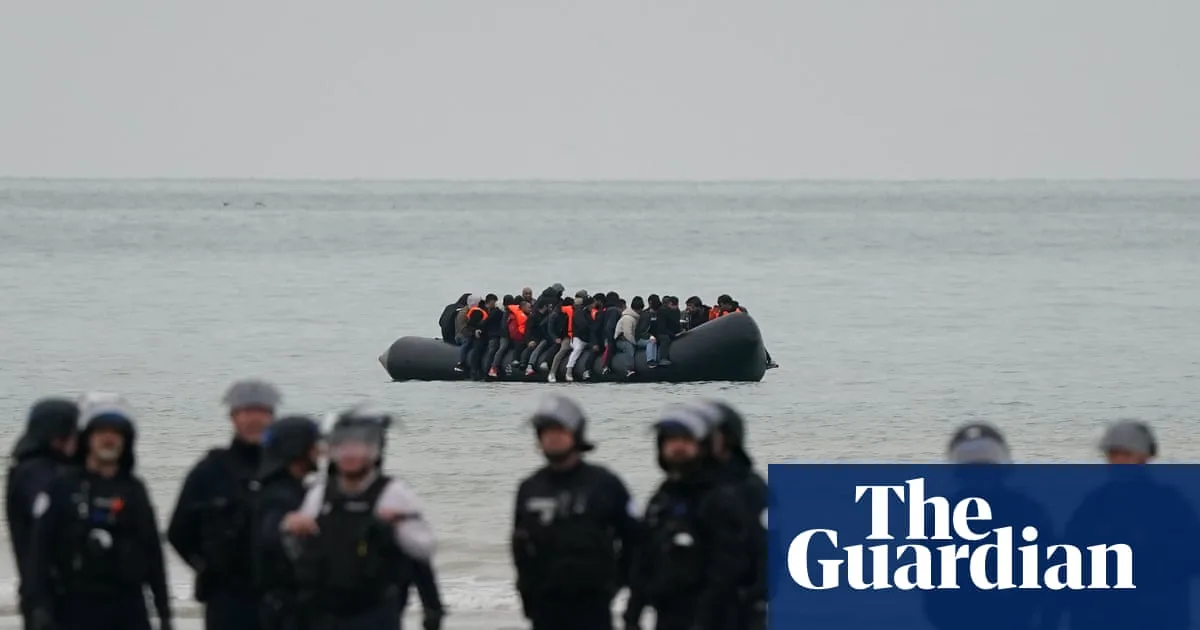
Border Security Commander Departs After Failing to Reduce Channel Crossings
The head of the United Kingdom's Border Security Command, Martin Hewitt, is set to step down at the conclusion of March following an inability to stem the relentless surge in small boat crossings across the English Channel. The Home Office has officially confirmed that Hewitt will vacate his role as border security commander after serving for eighteen months in the position.
Appointment and Unfulfilled Mandate
Sir Keir Starmer, upon assuming the office of Prime Minister, appointed Mr Hewitt, a former senior police officer, with the explicit mandate of curbing the number of small boats making the perilous journey from France to the United Kingdom. Since his appointment in September 2024, however, crossings have persisted at alarmingly elevated levels, with a staggering 58,910 individuals undertaking the voyage during his tenure.
His period in office also witnessed the second-highest annual total of Channel crossings on record, with 41,472 people arriving in the UK via small boat last year alone. It is understood that he will formally depart at the month's end, with an interim replacement to be appointed 'in due course' by the government.
Political Blame and Criticism
Shadow Home Secretary Chris Philp has placed the blame for the ongoing small boats crisis squarely on the shoulders of the Prime Minister and the Home Secretary, Shabana Mahmood. He asserted, 'The Government's complete failure on small boats isn't down to Martin Hewitt. It's because Keir Starmer and Shabana Mahmood are too weak to take the necessary action - such as coming out of the European Convention on Human Rights and deporting all illegal immigrants within a week of arrival.'
Philp further criticised Labour's decision to cancel the Rwanda removals plan, labelling it a disaster, and noted that since the election, 67,000 illegal immigrants have crossed the Channel, representing a 45 per cent increase compared to the same period prior.
Hewitt's Own Assessment and Legacy
In an interview conducted last year, after three months in the role, Mr Hewitt explicitly requested to be judged on his ability to reduce crossing numbers. He stated, 'Definitely judge us on the impact we've had on the number of crossings. Because that is absolutely clear to me from the Prime Minister, from the Home Secretary and I'm sure from the Foreign Secretary. That's what my job is here to try and deliver. So that's absolutely, that is the measure.'
A Home Office spokesman expressed gratitude for Hewitt's service, saying, 'We would like to thank Martin Hewitt CBE QPM for his dedicated leadership since the creation of the Border Security Command. Over the past 18 months, the Border Security Command has brought government agencies, law enforcement and international partners together to tackle people smuggling gangs, as well as seeing the Border Security, Asylum and Immigration Act into law.'
Background and Current Context
Prior to his appointment as border security commander, Martin Hewitt served as chairman of the National Police Chiefs' Council, where he coordinated Britain's police forces during the enforcement of Covid lockdown rules. His career also includes roles as assistant commissioner of the Metropolitan Police and seven years of service with the Royal Artillery.
In his capacity as commander, he was responsible for integrating law enforcement and intelligence agencies to combat the people smuggling networks facilitating the small boat crossings. In October 2025, he informed MPs that the continued crossings were 'frustrating' but maintained that deterring individuals from making the journey was 'always going to take time'.
Official figures reveal that so far this year, 3,863 people have arrived in the UK via small boat, including 144 individuals in two boats just yesterday. This development occurs concurrently with Labour rebels intensifying their campaign against Home Secretary Shabana Mahmood's immigration reforms, threatening to force a parliamentary vote.
Internal Labour Party Divisions
The rebels aim to compel a 'symbolic' division on the Home Secretary's proposal to double the time required for immigrants to qualify for indefinite leave to remain (ILR), from five to ten years. This plan has sparked significant controversy, particularly as it would apply retrospectively to migrants already in the country, affecting approximately 2.2 million people who have arrived since 2021.
Former deputy prime minister Angela Rayner has emerged as a prominent critic of the proposal, describing it as 'un-British' and arguing that it 'undermines our sense of fair play' by 'moving the goalposts'. Critics within the Labour Party are reportedly preparing to utilise a seldom-used parliamentary procedure to force a symbolic vote on these measures in the coming months.
Communities Secretary Steve Reed has emphasised that Labour was elected with a manifesto commitment to reform the immigration system. However, he acknowledged the existence of a 'robust' debate within the party regarding this specific policy, highlighting the deep internal divisions over the government's approach to immigration and border security.