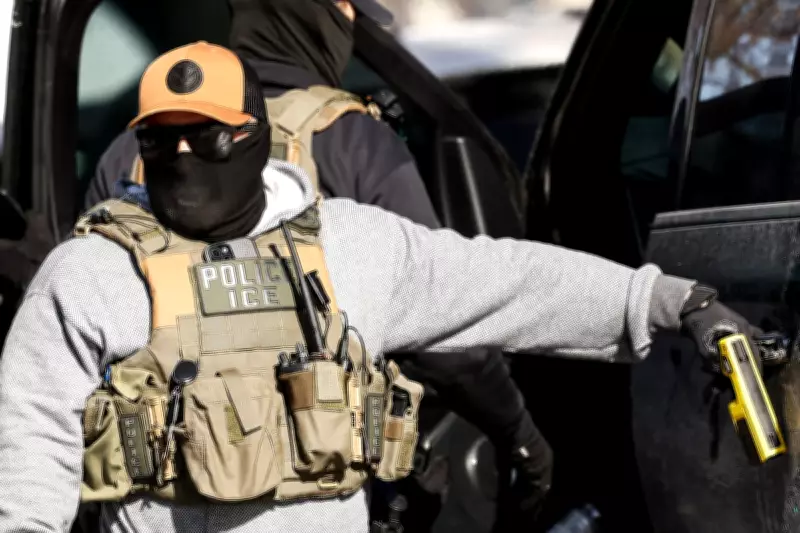
Massive Expansion of ICE's 287(g) Program Under Trump's Second Administration
A staggering surge in local police involvement with Immigration and Customs Enforcement (ICE) has been documented in a new report, revealing that as many as 15,800 officers and sheriff's deputies are now deputized to enforce immigration laws. This represents a dramatic escalation from previous administrations, with profound implications for communities across the United States.
Explosive Growth in Law Enforcement Partnerships
According to analysis from FWD.US, a nonpartisan policy organization, more than 760 local law enforcement agencies have partnered with ICE since Donald Trump returned to office. This brings the total number of agencies working with ICE to nearly 1,200, a remarkable increase from just 135 during Joe Biden's administration and 150 at the conclusion of Trump's first term.
The 287(g) "task force" program, which authorizes local police to stop and arrest individuals they suspect of being in the country illegally, has been fueled by at least $137 million in new federal funding to police departments. At current participation rates, ICE could inject more than $3 billion into local law enforcement agencies to deputize nearly 30,000 officers nationwide by 2027.
Historical Context and Community Impact
Felicity Rose, vice president of criminal justice research and policy at FWD.US, warns that this represents "by far the largest infusion of federal funding into local law enforcement since the 1990s COPS grants." She notes that similar programs have historically increased low-level arrests without significantly impacting crime rates.
"This program is a confluence of two bad ideas that should be left in the past where they belong," Rose stated, adding that the 287(g) model has caused "massive harm to communities while failing to reduce crime."
The program's revival marks a significant policy reversal. The Obama administration abandoned the "task force" model in 2012 following allegations of racial profiling in Maricopa County, Arizona, where former sheriff Joe Arpaio was accused of targeting Latino residents based on their legal status. A federal judge later determined Arpaio violated detainees' constitutional rights, and he was convicted of criminal contempt for continuing immigration detentions despite court orders.
Financial Incentives and Resistance
The Trump administration restarted the program in early 2025 with substantial new funding through the president's One Big Beautiful Bill Act, making ICE the highest-funded law enforcement agency with a budget surpassing most nations' militaries. ICE offers participating agencies $7,500 per trained officer for equipment, $100,000 for new vehicles, and overtime pay of up to 25 percent of officers' salaries.
Federal funding also includes "performance" bonuses tied to immigration arrests, creating financial incentives for agencies to detain individuals suspected of living in the country illegally. State and local law enforcement are expected to receive up to $2 billion this year under Trump's domestic spending bill.
Despite these incentives, significant resistance exists. Many local law enforcement agencies fear their departments are already stretched too thin to perform federal duties while responding to critical incidents. Notably, none of the police departments in the top 10 U.S. cities—including Dallas, Houston, and San Antonio—have joined the 287(g) program.
Geographic Distribution and Detention Expansion
Florida leads the nation with at least 342 law enforcement agencies having 287(g) agreements, followed by Texas with 296 agreements. Tennessee has 63, Pennsylvania has 58, and Alabama has 52, according to the FWD.US analysis.
Simultaneously, the Trump administration is expanding immigration detention capacity with a nearly $40 billion plan to detain tens of thousands of immigrants in retrofitted warehouses. ICE plans to purchase 16 buildings to convert into "processing" centers holding up to 1,500 immigrants each, plus eight larger warehouses capable of holding 10,000 people at once as "primary locations" for removal from the country.
These facilities add to an already expansive federal immigration detention system comprising dozens of jails, mostly operated by private firms, in a country with one of the world's highest incarceration rates.
Administration Promotion and Community Concerns
Administration officials actively promote the program, with Homeland Security assistant secretary Tricia McLaughlin stating, "We would love for state and local law enforcement to sign 287(g) agreements to help us remove criminal illegal aliens—partnerships with law enforcement are critical to having the resources we need."
However, immigrant advocacy groups express deep concerns. The Immigrant Legal Resource Center warns the expansion "further fuels Trump's mass deportation agenda by expanding the dragnet for putting people into the arrest to deportation pipeline."
FWD.US president Todd Schulte added, "Federal incentives to target and profile will harm immigrant communities and have spillover effects on other communities already targeted by local law enforcement impacting immigrants and citizens alike."