Federal Judge to Decide Fate of Minnesota Refugee Protections
A federal judge is set to hear crucial arguments on Thursday regarding whether to extend a protective order that shields lawfully present refugees in Minnesota from arrest and deportation. This legal battle centers on Operation PARRIS, a controversial immigration enforcement initiative that has drawn significant scrutiny and legal challenges.
The Legal Standoff Over Operation PARRIS
U.S. District Judge John Tunheim issued a temporary restraining order on January 28, blocking the government from targeting these refugees. In his ruling, Judge Tunheim stated that the plaintiffs were likely to succeed in their claims that their arrests and detentions, along with the underlying policy, were unlawful. This order is scheduled to expire on February 25 unless the judge grants a more permanent preliminary injunction following Thursday's hearing.
The case stems from a lawsuit filed by refugee rights groups in January, challenging Operation PARRIS. This initiative, launched in mid-December by the Department of Homeland Security and U.S. Citizenship and Immigration Services, aimed to reexamine the cases of 5,600 Minnesota refugees who had not yet obtained permanent resident status, commonly known as green cards. Authorities cited fraud in public programs in Minnesota as justification for the operation.

Background and Impact of the Enforcement Operation
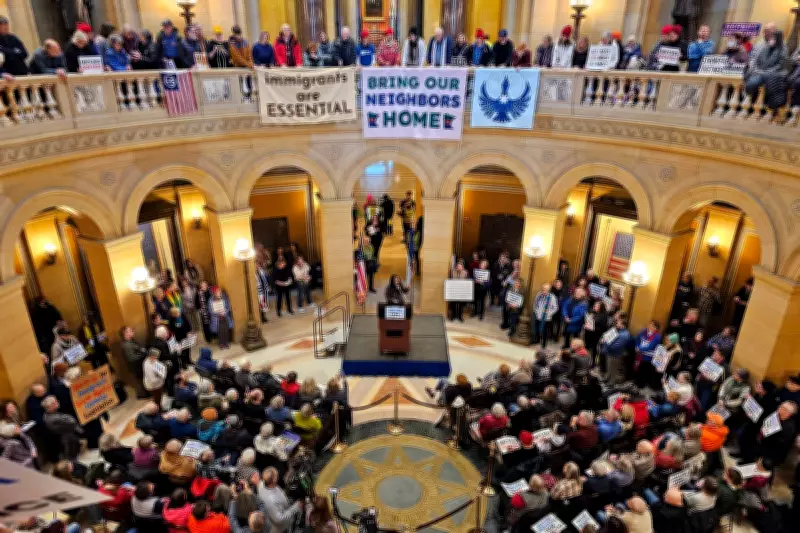
Operation PARRIS was part of a broader immigration crackdown under the previous administration, which included deploying thousands of federal officers to Minnesota. Homeland Security described it as the largest immigration enforcement operation in its history. The initiative sparked mass protests, particularly following the shooting deaths of Renee Good and Alex Pretti, which heightened tensions around the enforcement actions.
Recently, White House border czar Tom Homan announced that the surge of federal officers was ending, though a small presence would remain. However, the legal and humanitarian concerns persist, as highlighted by the ongoing court proceedings.
Allegations and Judicial Findings
The lawsuit alleges that under Operation PARRIS, ICE officers conducted door-to-door arrests of refugees, detaining them without access to attorneys and transporting them to detention centers in Texas. Some detainees were reportedly released onto Texas streets and left to find their own way back to Minnesota, raising serious questions about due process and humane treatment.
Judge Tunheim firmly rejected the government's argument that it had the legal authority to arrest and detain refugees who had not obtained green cards within a year of arrival. He deemed this position illogical, noting that refugees cannot apply for permanent residency until they have been in the U.S. for at least one year. In his order, which applies exclusively to Minnesota, the judge emphasized that refugees undergo extensive vetting by multiple agencies before resettlement.
He further pointed out that none of the arrested individuals had been deemed a danger to the community or a flight risk, nor had any been charged with crimes that could justify deportation. The judge cited specific cases, including that of a refugee identified only as U.H.A., who was admitted in 2024 and arrested by ICE while driving to work on January 18. According to the judge, U.H.A. was pulled over, handcuffed, and detained without a warrant or apparent justification, despite having no criminal history.
Broader Implications and Judicial Reasoning
Judge Tunheim stressed that the refugees affected by his order were admitted to the U.S. due to persecution in their home countries. He prohibited further arrests under Operation PARRIS and ordered the release and return to Minnesota of all detainees still in custody from the operation. In his written opinion, he articulated a powerful defense of refugee rights, stating that these individuals are not committing crimes or illegally crossing borders.

He wrote, "Refugees have a legal right to be in the United States, a right to work, a right to live peacefully—and importantly, a right not to be subjected to the terror of being arrested and detained without warrants or cause in their homes or on their way to religious services or to buy groceries." The judge added, "At its best, America serves as a haven of individual liberties in a world too often full of tyranny and cruelty. We abandon that ideal when we subject our neighbors to fear and chaos."
In a follow-up order on February 9, Judge Tunheim denied a government motion to lift the temporary restraining order, reinforcing his stance on the issue. As the hearing approaches, the outcome will have significant implications for immigration policy, refugee protections, and the rule of law in Minnesota and potentially beyond.