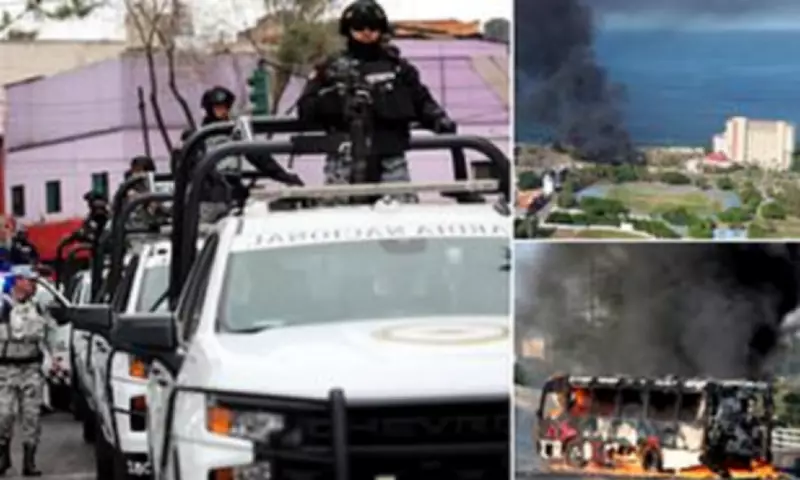
Mexico Plunged into Violent Turmoil Following Death of Notorious Cartel Leader
Mexico has erupted into widespread violent chaos after federal forces eliminated the country's most powerful cartel leader, triggering a devastating wave of destruction across multiple states just four months before the nation prepares to host the FIFA World Cup. The killing of Jalisco New Generation Cartel (CJNG) leader Nemesio Oseguera Cervantes, known as El Mencho, has unleashed retaliatory violence that has paralyzed tourist destinations and World Cup host cities.
Tourist Havens Transformed into War Zones
Catastrophic scenes have emerged from the popular tourist destination of Puerto Vallarta, where buses have been set ablaze and homes torched in coordinated attacks following Sunday's operation. Similar destruction has spread across twenty Mexican states, with cartel members burning vehicles to block major highways and create impenetrable smoke screens. In Guadalajara, scheduled to host four World Cup group matches this summer, terrified residents have locked themselves indoors while stranded tourists received urgent shelter-in-place warnings.
The United Kingdom's Foreign Office issued a stark advisory on Monday morning, stating: 'Authorities in Puerto Vallarta have issued a public advisory to stay indoors. Routes to airports may be blocked. You should exercise extreme caution, follow local authorities' advice, including orders to stay indoors and avoid non-essential travel in affected areas.' The United States Embassy in Mexico echoed these warnings, urgently advising American citizens to shelter in place as the violence escalated.

High-Stakes Military Operation Eliminates Billionaire Kingpin
The 59-year-old cartel leader was killed during a joint Mexican military operation supported by United States intelligence in Tapalpa, a mountainous town in Jalisco state. Cervantes was protected by heavily armed loyalists equipped with sophisticated heat-seeking grenade launchers capable of penetrating tank armor. According to high-ranking officials speaking with local publications, the operation resulted in a fierce confrontation that left four cartel members dead and three others wounded, including Cervantes himself, who died during aerial transport to Mexico City.
Mexican authorities confirmed that three soldiers sustained injuries during the operation, while two individuals were detained. Security forces seized rocket launchers designed to shoot down aircraft and destroy armored vehicles at the scene, highlighting the cartel's military-grade capabilities.
Cartel's Vast Criminal Empire and Global Reach
Nemesio Oseguera Cervantes headed one of Mexico's most formidable criminal organizations, playing a pivotal role in trafficking methamphetamine and fentanyl to the United States. His brutal control of drug-trafficking routes from Latin America to the U.S., utilizing speedboats and submersibles to transport cocaine and methamphetamine from Colombia and Ecuador via the Pacific, reportedly generated billions in illicit revenue.
The Jalisco cartel, founded around 2009, became Mexico's fastest-growing criminal enterprise, innovating in violence with drones and improvised explosive devices while expanding into fuel theft, extortion, and timeshare fraud. Cervantes faced multiple indictments in the United States, with the U.S. State Department offering a $15 million reward for information leading to his arrest before the Trump administration designated his organization as a foreign terrorist entity.
World Cup Preparations Overshadowed by Security Crisis
With Guadalajara scheduled to host World Cup matches from June 11 to June 26, including a potential encounter between Ireland and South Korea should both teams qualify, the current violence raises serious security concerns. Footage from Guadalajara International Airport showed smoke rising from runways as panicked travelers sought cover inside the terminal. Public transportation in Puerto Vallarta has been suspended indefinitely, while hotels across affected regions are advising guests to remain indoors as businesses temporarily close.

Jalisco Governor Pablo Lemus Navarro announced on social media platform X: 'Federal forces carried out an operation in Tapalpa a few hours ago, which has led to confrontations in the area. Also, as a result of this operation, in various points of that region and in other parts of Jalisco, individuals have burned and blocked vehicles to hinder the action of the authorities.' He immediately activated security committees and implemented red code emergency protocols.
Geopolitical Implications and Future Uncertainty
The elimination of Cervantes represents the highest-profile blow against Mexican cartels since the recapture of former Sinaloa cartel boss Joaquín 'El Chapo' Guzmán a decade ago. Security analysts suggest the operation could strengthen Mexico's position in dealings with the U.S. Trump administration, which has threatened tariffs or unilateral military action if Mexico fails to demonstrate results against cartels.
Former DEA chief of international operations Mike Vigil stated that Mexico had sent 'a strong message to Donald Trump's administration that they are fighting aggressively and effectively' against powerful cartels. U.S. Deputy Secretary of State Christopher Landau, former ambassador to Mexico, applauded the operation, declaring 'The good guys are stronger than the bad guys.'
Power Vacuum Creates Dangerous Uncertainty
The leadership void created by Cervantes' death presents significant challenges. The Jalisco cartel maintains presence in at least twenty-one of Mexico's thirty-two states and operates extensively throughout the United States, according to DEA assessments. Vigil noted that 'El Mencho controlled everything; he was like a country's dictator,' suggesting his absence could initially weaken the organization against rival Sinaloa cartel factions.
Security analyst David Saucedo warned that if Cervantes' relatives assume control, the current violence could persist indefinitely. Alternatively, new leadership might seek to continue operations with reduced confrontation. The greatest concern remains the potential for indiscriminate narcoterrorism attacks reminiscent of Colombia's 1990s crisis, including car bombs, assassinations, and aircraft attacks targeting government institutions.
As Mexican authorities work to contain cartel retaliation and reinforce security nationwide, the international community watches anxiously, with World Cup preparations now unfolding against a backdrop of unprecedented criminal violence and national security challenges.