Mexican Forces Eliminate Most Powerful Cartel Leader in Major Security Victory
The Mexican army has achieved a significant victory in its long-running battle against organized crime by killing the country's most powerful cartel leader and one of the United States' most wanted fugitives. The operation, which took place on Sunday, represents the highest-profile blow against Mexican cartels in a decade.
Nationwide Violence Erupts Following Cartel Leader's Death
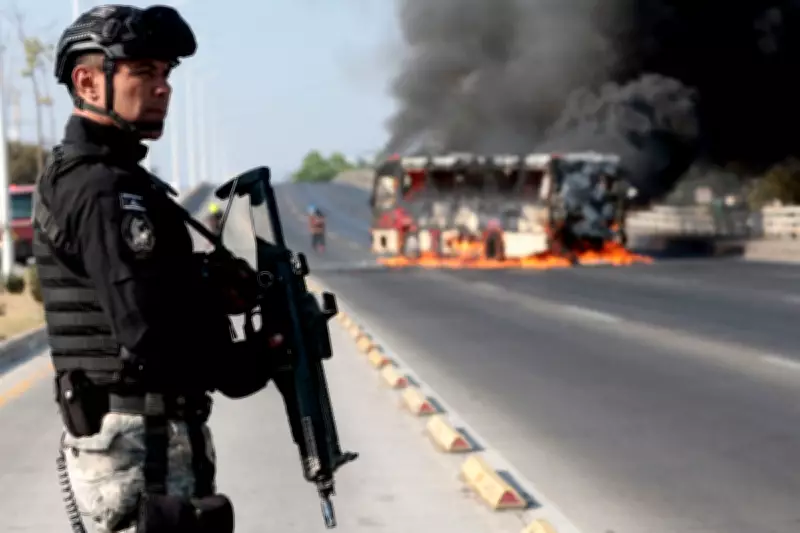
Following the death of Jalisco New Generation Cartel leader Nemesio Oseguera Cervantes, known as "El Mencho," cartel members unleashed a wave of violence across Mexico. In nearly a dozen states, burning vehicles blocked major roadways, sending thick plumes of smoke into the air. Residents of Guadalajara, Mexico's second-largest city and capital of Jalisco state, locked themselves in their homes as security forces were placed on high alert nationwide.
Schools were canceled in multiple states on Monday as authorities braced for further retaliation. The security concerns extended beyond Mexico's borders, with Guatemala reinforcing its border security in response to the escalating situation.

Profile of a Criminal Mastermind
Oseguera Cervantes, aged 59 and originally from Michoacan state, had been involved in organized crime for at least three decades. His criminal career included a 1994 conviction for heroin trafficking in the United States, which resulted in a three-year prison sentence. Upon returning to Mexico, he rapidly ascended through the ranks of the country's drug trafficking underworld.
Around 2009, he founded the Jalisco New Generation Cartel, which quickly became Mexico's fastest-growing criminal organization. The cartel diversified its operations beyond traditional drug trafficking, moving cocaine, methamphetamines, fentanyl, and migrants to the United States while innovating in violence through the use of drones and improvised explosive devices.
The organization earned particular notoriety for brazen attacks on Mexican security forces, including downing a military helicopter in Jalisco in 2015 and attempting to assassinate Mexico City Police Chief Omar García Harfuch, who now serves as Mexico's federal security secretary.
Geopolitical Implications for U.S.-Mexico Relations
The successful operation could provide significant diplomatic benefits for Mexico in its dealings with the United States. The Trump administration has been pressuring Mexico to demonstrate tangible results in combating cartels, with threats of tariffs or unilateral military action if progress remained insufficient.
Oseguera Cervantes faced multiple indictments in the United States, with the U.S. State Department offering a $15 million reward for information leading to his arrest. The Trump administration had designated his cartel as a foreign terrorist organization a year prior to his death.
U.S. Deputy Secretary of State Christopher Landau, former ambassador to Mexico during the first Trump administration, praised the operation on social media, stating "The good guys are stronger than the bad guys. Congratulations to the forces of law and order in the great Mexican nation."
Power Vacuum and Future Security Concerns
The death of "El Mencho" creates a substantial power vacuum within Mexico's criminal landscape. The Jalisco cartel maintains operations in at least 21 of Mexico's 32 states and has established a presence throughout the United States, according to the U.S. Drug Enforcement Administration.
Mike Vigil, former chief of international operations for the DEA, described Oseguera Cervantes as controlling "everything, he was like a country's dictator." His absence could potentially slow the cartel's rapid expansion and weaken its position against the rival Sinaloa cartel in several contested regions.
Security analyst David Saucedo warned that the transition of power could lead to continued violence, particularly if family members of Oseguera Cervantes assume control of the organization. The most concerning scenario would involve the cartel turning to indiscriminate violence, potentially creating "a scenario similar to what Colombia lived in the 1990s" with car bombs, assassinations, and attacks on aircraft.

Vigil emphasized that Mexico should seize this opportunity to launch "an effective frontal assault based on intelligence," adding that "This is a big opportunity for Mexico and the United States if they work together."
The long-term impact on Mexico's security situation remains uncertain, but the elimination of the country's most powerful cartel leader represents a watershed moment in the ongoing battle against organized crime.