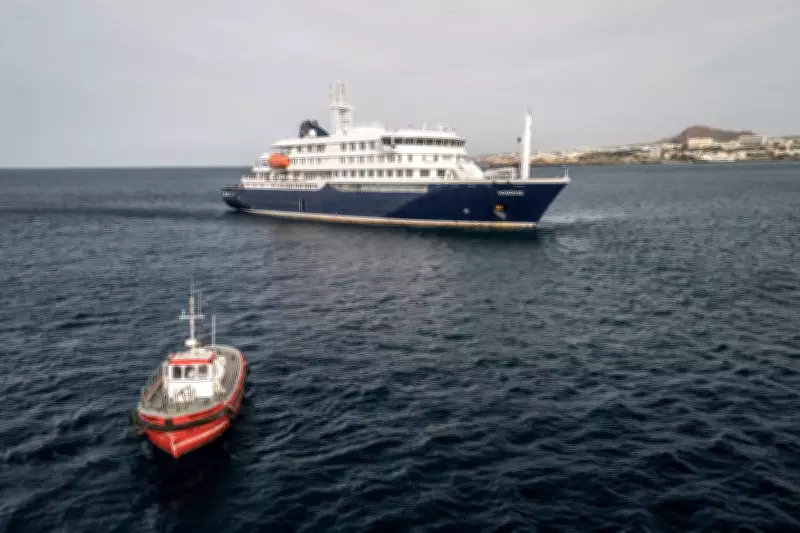
‘Why us?’ Tenerife locals fear hantavirus cruise ship arrival will repeat Covid pandemic ordeal
The Spanish government sparked a furious backlash after saying that the virus-stricken MV Hondius would dock in Tenerife by the end of the week. Islanders tell Graham Keeley that the arrival of the ship evokes memories of the pandemic in 2020.
David Hernández was gripped by fear and anxiety when he heard the news that the virus-stricken MV Hondius would dock in Tenerife, where he works as an intensive care nurse at one of the island’s two hospitals.
“I thought, ‘Why us?’ Everyone will be scared by the uncertainty of the situation. This is bringing back flashbacks of the Covid-19 pandemic. We had a terrible time in the hospital then,” the 29-year-old told The Independent.

Three passengers have died and at least four people are sick on the ship in what health officials say is an outbreak of hantavirus, which usually spreads by inhaling contaminated rodent droppings. The World Health Organisation (WHO) believes rare human-to-human transmission may have taken place aboard the vessel.
After the outbreak of the virus, Cape Verde was due to be the ship’s last port of call, but the West African nation refused to let passengers disembark. The Spanish government subsequently announced that the ship could dock in Tenerife in three days, sparking a furious backlash.
On Wednesday, Canary Islands leader Fernando Clavijo sought to block the ship from docking, saying authorities could not guarantee public safety. Madrid said it had agreed to admit the ship to port following instructions and advice from the WHO. Mr Hernández said the news had evoked memories of 2020, when the island became a focal point for the spread of Covid-19. Tenerife saw cases rise throughout the year, peaking in December. Lockdown restrictions had a devastating impact on tourism, the island’s main source of income.
“The population on the island has grown by about a million on the island since the pandemic and we have the same 24 beds in the intensive care unit. I don’t think we can cope,” he said. “I am human and understand we all could have been on that cruise ship, but there must be some protocols. We have been overcrowded for years. It is getting crazy.”
Brian Harrison, a British businessman who has lived in Tenerife for more than 40 years, said there was a feeling of uncertainty among islanders.
“This is a virus, so there might be a quarantine. Will people be allowed to move around freely?,” he said. “The origin of the virus is from rodents. Obviously, you can control points where humans can move but you cannot control rodents. So, it is a very grey area.”
The Canary Islands depends on tourism, and 6.5 million Britons travelled to the Spanish archipelago last year. Tenerife is the most popular destination for UK holidaymakers, but there are fears that the tourism industry could be severely impacted by the docking of the ship. Roberto Gómez, a businessman who works in the health industry, said: “My brother works in tourism as does my brother-in-law. This image of a cruise ship with passengers who have suffered and, in some cases, died from this virus, could be damaging.
“On the other hand, we always like to be welcoming and to show humanitarian solidarity towards others. So we must think of that.”
The spat between the Canary Islands and Madrid has also reignited debates over the balance and concentration of power in the country. Mr Clavijo has demanded an “urgent meeting” with Spanish prime minister Pedro Sánchez to discuss the issue, but Madrid has shown no signs of backing down. Francesca Borges, a retired teacher, said residents in Tenerife felt once again the islands were being used by the central government to deal with an unwelcome problem.
“We think, ‘Why us again?’. During Covid lots of cruise ships were stranded here. One ship was allowed to come and dock here,” she said.
“In the late 19th century there was a cholera epidemic which began with an Italian ship which was allowed to dock here. People were locked down here.”

Ms Borges, 65, added: “There is a history of the Canary Islands having to take responsibility for a European problem. There is a sense that the Spanish government has always had this attitude that the Canary Islands is treated like a colony when it is in a situation like this.”