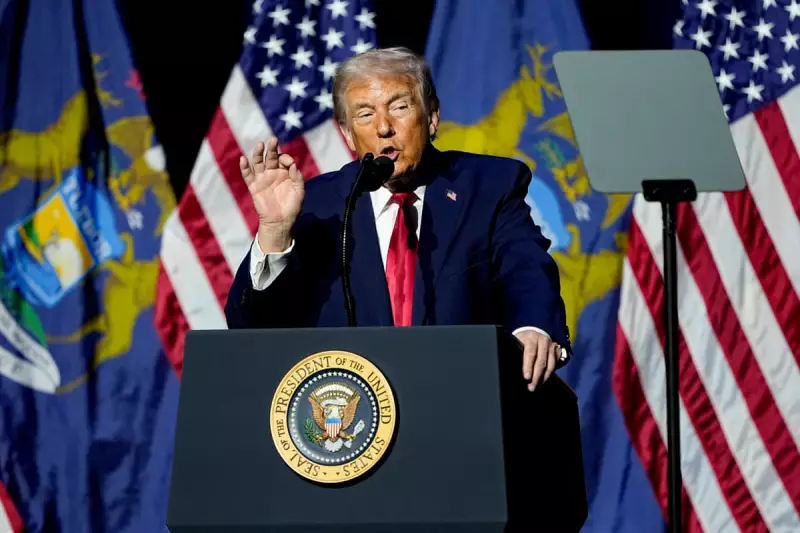
In a combative speech that veered from economic policy to immigration, former President Donald Trump has reignited a contentious political battle by declaring a sweeping halt to federal funding for so-called sanctuary jurisdictions.
A Hardline Declaration in Detroit
Speaking at the Detroit Economic Club on Tuesday, 13 January 2026, Trump announced that from 1 February, the federal government will cease all payments to sanctuary cities or any state containing them. He justified the move by claiming these jurisdictions "do everything possible to protect criminals at the expense of American citizens." The announcement came shortly after a separate incident where Trump was photographed giving a middle finger to a heckler at a Ford plant in the city.
The policy represents a significant escalation, extending financial penalties not just to individual cities but to entire states that host them. A current Department of Justice list identifies 11 states and the District of Columbia, all under Democratic control, as areas that hinder federal immigration enforcement, alongside 18 cities and three counties.
Immediate Backlash and Legal Challenges
Critics were swift to condemn the move. Chicago's Democratic Mayor, Brandon Johnson, pledged immediate legal action, calling Trump's plan "blatantly unconstitutional and immoral." In a defiant statement, Johnson said, "Those are funds that belong to the people of Chicago, not the president... Our message is simple: 'We'll see you in court.'"
The Department of Homeland Security (DHS) took to social media to defend the decision, arguing that sanctuary policies force its officers to find "released criminal illegal aliens on the streets" without local law enforcement support. The DHS post framed the conflict as one between politicians protecting immigrants and an administration fighting for victims of crime.
This is not the first attempt by Trump to leverage funding against political opponents on this issue. In August, a district judge in San Francisco issued a preliminary injunction, blocking a similar effort to deny funds to over 30 cities, labelling it a "coercive threat." A federal appeals court is still reviewing that ruling.
A Pattern of Financial Pressure on Democratic States
Trump's Detroit announcement fits a broader pattern of using federal spending to target political rivals. Just last week, the administration froze more than $10 billion in childcare and family assistance funds to California, Colorado, Illinois, Minnesota, and New York, though a district court judge temporarily blocked that order over the weekend.
Furthermore, in October, the White House moved to cancel $7.6 billion in clean energy grants allocated to 16 states that voted for Kamala Harris in the 2024 election. A federal judge, Amit Mehta, recently blocked those terminations, stating in a 17-page order that they appeared based primarily on the states' voting patterns.
During his wide-ranging Detroit address, which was intended to focus on economic affordability, Trump also made controversial remarks about the Somali community in the US. He vowed to "reverse [the] citizenship of any naturalized immigrant from Somalia" convicted of defrauding citizens, a proposal legal experts say has no basis except in cases of naturalisation fraud. Earlier on Tuesday, the White House confirmed it was ending Temporary Protected Status (TPS) for Somalis living in the US, a status covering approximately 705 people as of March 2025.
The renewed push to defund sanctuary cities sets the stage for a protracted legal and political fight, centring on states' rights, immigration enforcement, and the use of the federal purse as a weapon in America's deep partisan divide.