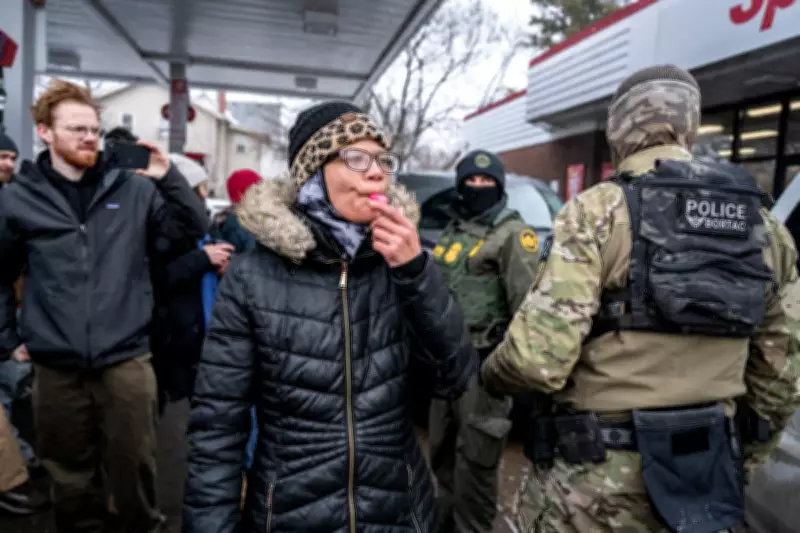
Whistles as a Symbol of Resistance Amid Trump's ICE Crackdown
Over the past year, whistles have become a powerful emblem of collective resistance among ordinary Americans standing up to federal immigration enforcement. As the Trump administration expands its immigration crackdown across cities and towns in the United States, communities are increasingly relying on whistles to alert neighbors about the presence of Immigration and Customs Enforcement (ICE) agents. However, not all activists agree on their effectiveness, with some organizers arguing that whistles can heighten panic and create unnecessary confusion, particularly for children, the elderly, and individuals with disabilities.
The Rise of Whistle Activism
In Chicago's Pilsen neighborhood, a historically Mexican area with deep activist roots, volunteers began distributing bright plastic whistles at an annual art fair in late August. This initiative was inspired by similar efforts in Los Angeles, where activists had started using whistles as an instant community alert system during ICE raids. Teresa Magaña, a co-founder of the Pilsen Arts and Community House, explained that the whistles provided a tangible response to feelings of helplessness amid threats of federal occupation. Initially ordered in bulk online, the effort soon saw local 3D printing enthusiasts stepping in to produce whistles, leading to the distribution of close to 30,000 units across roughly 25 states within six months.
The movement has also produced nearly 100,000 copies of a bilingual zine detailing how the alert system works: short blasts indicate ICE is "driving or lurking," while continuous blowing signals "if ICE is abducting someone." Listeners are advised to seek safety or "follow the sound, form a crowd, and stay loud." According to Veronica, a lead organizer with Migra Whistle in Portland, Oregon, these whistles have strengthened community ties and helped families in real time by alerting neighbors to unmarked ICE vehicles, often prompting agents to retreat due to the unwanted attention.
Divergent Views on Whistle Efficacy
Despite the success stories, not all advocates support the use of whistles. In Shoreline, Washington, a recent incident highlighted potential drawbacks. When ICE agents detained Ivan Guzman, a Mexican immigrant father, volunteers arrived with whistles, causing his toddler to panic and cry as the sharp sounds pierced the air. Advocates from the Washington Immigrant Solidarity Network (WAISN) reported that the noise made it harder to capture crucial details for legal support and escalated the situation, leading to more aggressive behavior from agents.
Brenda Rodríguez López, an executive director at WAISN, emphasized that their strategies are informed by nearly a decade of organizing and direct conversations with communities. Families have expressed heightened anxiety when whistles are used during already fraught encounters with immigration enforcement. In rural areas like Basin City, Washington, where homes are spread out and hostility toward immigrants can be high, whistles may be ineffective or even draw unwanted attention, with over a quarter of detentions occurring during highway traffic stops where whistles would go unheard.
Strategic Adaptability in Social Movements
Fernando Tormos-Aponte, a professor at the University of Pittsburgh who studies social movements, views the whistle debate as a sign of healthy tactical adaptability. He notes that strong movements must adjust to regional nuances, with strategies varying based on local needs. Rodríguez López echoes this sentiment, stating that strategies should not be "copy-and-paste" but focused on defending communities and building power. The key question for WAISN is not whether whistles are inherently good or bad, but whether they center the needs of those most affected by immigration enforcement.
As enforcement intensifies, disagreements over tactics like whistle use are fostering change within the broader movement. Organizers hope that these debates will not fracture solidarity but instead encourage diverse approaches to resistance, ensuring that all voices are heard and respected in the fight for immigrant rights.