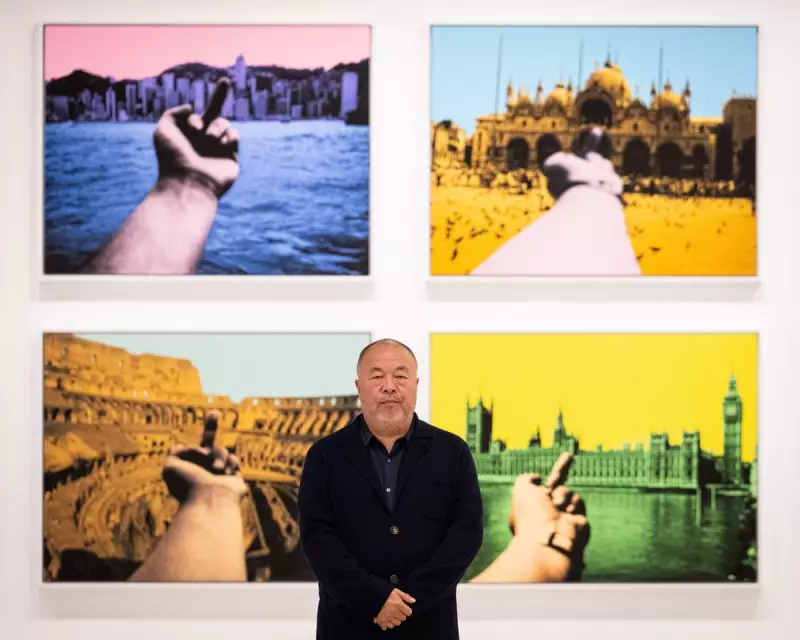
Iconoclastic Chinese artist and activist Ai Weiwei has launched a new literary provocation with his book On Censorship, published by Thames & Hudson. The work represents his distilled perspective on a subject he has experienced firsthand through decades of confrontation with authorities, arguing that censorship extends far beyond China's borders into Western democracies.
A Lifetime of Artistic Provocation
Ai Weiwei's career has been defined by challenging authority and testing the boundaries of acceptable expression. From his early involvement with the Stars artist group in late 1970s Beijing, which demanded "Political Democracy and Artistic Freedom," to his controversial photographic works like Study of Perspective showing him raising a middle finger to global landmarks, Ai has consistently positioned himself against systems of control.
His artistic provocations have included the notorious Dropping a Han Dynasty Urn photographic sequence from 1995, which questioned who represented greater cultural vandalism: the artist or the state. This was followed by his involvement in the 2000 Shanghai exhibition titled Fuck Off, with the Chinese subtitle translating to "Ways to Not Cooperate."

The Personal Cost of Dissent
The artist's confrontational approach has come at significant personal cost. Between 2005 and 2009, his blog featuring posts with titles like How Could We Have Degenerated To This? was removed from the internet by authorities. He has experienced repeated hacking of his email and bank accounts, the demolition of a studio complex he designed, violent police treatment resulting in emergency brain surgery, and an 81-day period of detention and house arrest.
Ai references his poet father Ai Qing's suffering under different political regimes, noting how his family endured punishment alongside him. The fuller story of this family history appears in Ai's 2021 memoir 1000 Years of Joys and Sorrows, detailing how his father was imprisoned by nationalists in 1932, then again in 1957 as a rightist, forced to clean public toilets and live with his son in a self-dug hole for a decade.
Censorship Beyond Borders
In On Censorship, Ai argues that censorship is neither a new phenomenon nor one confined to autocratic regimes. He traces its history back to China's Shang dynasty (1600-1046BC) and the saying "the great affairs of the state are worship and military bases." However, his central thesis challenges Western assumptions about free speech.
"In the west – 'the so-called free world', with its 'ostensibly democratic societies' – free speech is a chimera," Ai asserts, suggesting it is regulated through "more covert, more deceptive and more corrosive" means than in openly authoritarian states. He describes censorship as "both an indispensable tool of mental enslavement and a fundamental source of political corruption."
The Challenge of Artificial Intelligence
The book becomes particularly lively when Ai turns his attention to artificial intelligence and big data. He reports that friends who mention his name to ChatGPT are told, "Let's talk about something else," and the chatbot has claimed with "stochastic self-assurance" that a selfie he took with German AfD party leader Alice Weidel is fake.
Ai believes artificial intelligence represents a "profound existential crisis for humanity – the virus infiltrates the central nervous system of human cognition." His fundamental belief in the importance of individuals runs counter to what he sees as the theology of big data, where "individuals are reduced to a transparent, jelly-like state within society – formless, uniform and stripped of distinction."
Visual Testimony and Rhetorical Style
Perhaps more powerful than Ai's prose are the images he includes: a listening device discovered in his studio, bored undercover policemen assigned to surveil him, a still from an interrogation scene in a heavy-metal music video called Dumbass, and him raising his middle finger to surveillance personnel outside his Beijing studio.

The book's rhetorical style features what might be called "Victor Meldrew-isms" – declarations like "Values such as effort, responsibility and the preservation of life's dignity are replaced by materialism, fleeting pleasure and shallow entertainment." Ai acknowledges he has "consistently raised questions about human values and rights, engaging in debates that inevitably touch on issues of social justice, fairness, the legitimacy of power and the execution of judicial justice."
Some might find his generalizations sweeping, such as his claim that "When a work of thought or expression gains widespread public acceptance or adoration, it often signals a lack of depth or a fundamental misunderstanding of its purpose" – a statement that could theoretically apply to his own globally exhibited work.
The Artist's Enduring Message
Ultimately, On Censorship serves as both manifesto and memoir from an artist who has made challenging authority his life's work. For Ai Weiwei, as for many artists, their deepest thinking manifests through their creative work itself. This compact volume, running fewer than 90 pages, distills decades of experience with systems of control into a provocative challenge to Western complacency about free expression.
The book emerges as Ai continues his iconoclastic work, recently appearing at London's Design Museum, maintaining his position as one of contemporary art's most consistently provocative voices on issues of freedom, authority, and creative expression in an increasingly monitored world.